Astronomers continue to discover strange things in the universe, and the latest is a phenomenon called Radcliffe Waves, and what's more interesting is that it once swept past Earth.
The report in the journal Nature describes the Radcliffe Wave as a series of star-forming clouds that have merged into a mysterious wave. The wave itself is the largest continuous structure in the Milky Way.
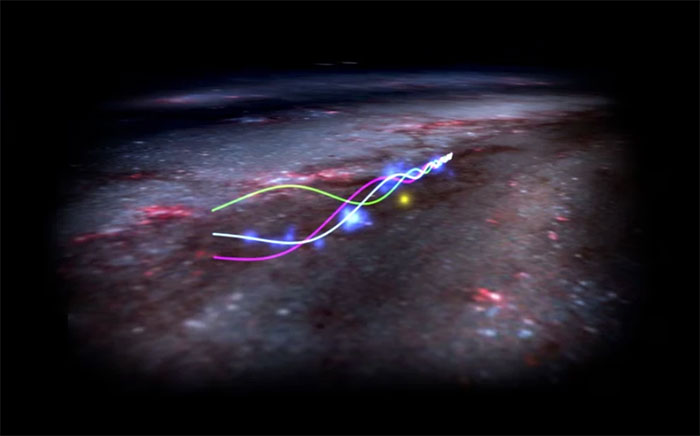
Simulation of Radcliffe Waves traveling through the Milky Way. (Photo: HARVARD UNIVERSITY).
The Radcliffe Wave spans 9,000 light-years, starting at the position of the constellation Canis Major in the night sky and extending to the position of the constellation Cygnus, with Orion in the middle.
Now, scientists have discovered that Radcliffe Waves are not stationary but actually moving , similar to the "waves" of fans that spread across the stands of a stadium during a game.
In cosmic terms, the wave structure is about 500 light years away from Earth.
Researchers also found that it appears our Solar System once surfed the Radcliffe Wave about 13 million years ago.
It's not clear what happened, but it must have been an exciting time for life on Earth, according to co-author Catherine Zucker, an astrophysicist at the Harvard-Smithsonian Center for Astrophysics.
Zucker notes that the Radcliffe Wave contains clouds of star formation, and therefore supernovae, exploding stars. And Earth has been through that wave.
The question is why does the Radcliffe Wave move? What force is behind the movement?
" The reason could be that stars going supernova eject dust and gas from the plane of the galaxy, creating oscillations that run along the structure," said lead author Ralf Konietzka, a graduate student at Harvard University.
Expert Konietzka predicts that the wave pattern will disappear in a few tens of millions of years.