A terrifying and enormous treasure from the ancient Aztec civilization has emerged after an earthquake damaged a building on a university campus in Mexico City.
According to Live Science, the treasure is the head of a giant stone snake, excavated and studied by scientists from Mexico's National Institute of Anthropology and History (INAH).
The school where the earthquake occurred is located in the capital Mexico City, where many other ruins of the famous Aztec civilization in Central America, famous for its unique architecture and sculptures, have been revealed.
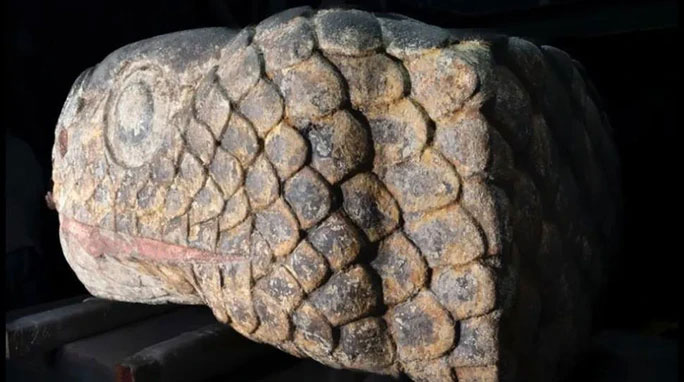
The 1.3-ton snake head crafted by the Aztecs - (Photo: INAH).
In this area, the Aztecs built temples, pyramids. to honor the gods, including Quetzalcoatl , a god often depicted as a snake. However, archaeologists have not yet been able to confirm whether this giant snake head depicts the god Quetzalcoatl or not.
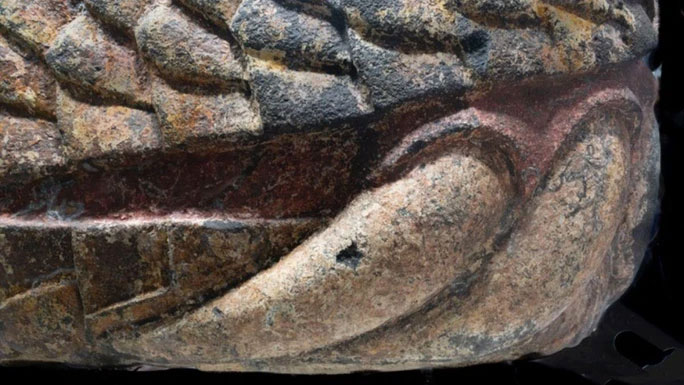
Ancient pigments are still well preserved on Aztec treasures - (Photo: INAH).
According to INAH, the intricately carved snake head is 1.8 meters long, 0.85 meters wide, and 1 meter high. It weighs about 1.3 tons and is painted in many colors.
Some of the ancient pigments, including red, blue, black and white, were still preserved after 500 years of burial. It is estimated that up to 80% of the surface still retains its color.
To preserve this rare treasure intact, INAH archaeologists had to use a crane to lift the stone block straight off the ground and build a special chamber to help the work gradually reduce humidity, thereby drying without damaging the color.
The preservation of the color is particularly important in this discovery, because it could help reveal how ancient people stabilized the color so it could be used in large-scale works that needed to be weather-resistant, said archaeologist Erika Robles Cortés of INAH.
This Aztec treasure has helped archaeologists visualize pre-Hispanic art from a different perspective.