Black holes are a terrifying astronomical object that cannot be observed directly, but they can be detected using other physical methods. They are very massive, can be many times more massive than the Sun, and have the ability to attract objects around them.
For the first time, astronomers have found two supermassive black holes gobbling up matter close together in a galaxy merger .
Two black holes — discovered by the Atacama Large Millimeter/submillimeter Array (ALMA) radio telescope network in the Atacama Desert in Chile — are growing in tandem near the centers of two host galaxies in a merger event called UGC 421 1 about 500 million light-years away, scientists reported at the 241st meeting of the American Astronomical Society in Seattle on January 9.
These supermassive objects weigh 125 to 200 million times more than the Sun. Although the black holes themselves cannot be directly observed, they are surrounded by clusters of stars and glowing gas that are pulled in by their intense gravity.
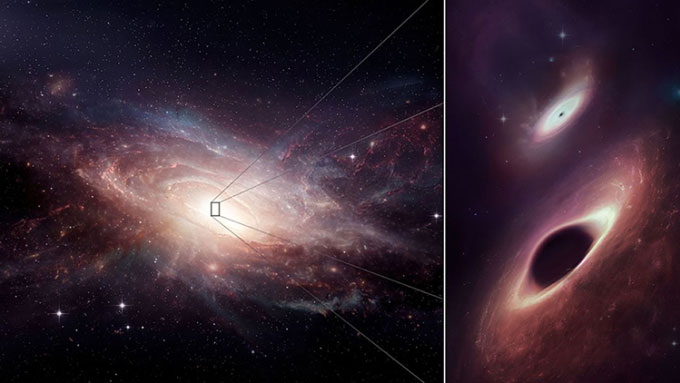
Simulation of the newly discovered black hole pair in UGC 4211. (Image: Michael Koss/ALMA/M. Weiss)
Analysis of the wavelengths of light shows that the two black holes are only about 750 light years apart . This is the closest distance ever recorded for supermassive black holes.
'That distance is pretty close to the limit of what we can detect, which is why this discovery is so exciting,' said co-author Chiara Mingarelli, a researcher at the Flatiron Institute's Center for Computational Astrophysics (CCA) in New York.
The two black holes are predicted to begin orbiting each other, eventually colliding and creating a larger black hole. This merger event would produce gravitational waves much stronger than any previously detected.
Galactic mergers usually take place in the distant universe, making them difficult to see with telescopes on Earth, but the ALMA observatory is an exception. Its network of sensitive antennas allows it to peer through dense clouds of gas and dust to observe the galactic nucleus in high resolution.
New discoveries suggest that mergers between pairs of supermassive black holes may be more common than previously thought, opening up opportunities for future gravitational wave research.