The ghost ship is 20m long, has a flat bottom like a barge and could be an important treasure revealing the famous Roman capital of Viminacium .
According to Live Science , the ghost ship was discovered by coal miners in Serbia, right on the ancient border of the Roman Empire.
Archaeologists are still awaiting official radiocarbon dating results, but they believe it dates to the third or fourth century AD, making it at least 1,700 years old.
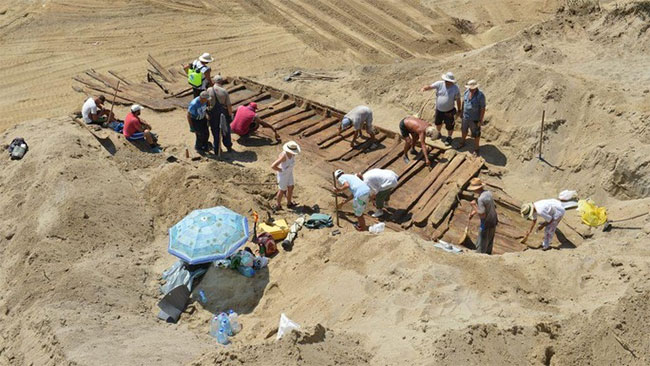
Part of a Roman ghost ship gradually revealed during excavations in Serbia - (Photo: SERBIAN INSTITUTE OF ARCHEOLOGY).
The excavation team is racing against time, as old wood exposed to the bright sunlight can decompose extremely quickly, causing the treasure to deteriorate very quickly. They have had to continuously water the ship to keep it moist while working.
This ghost ship is up to 20m long, 3.5m wide, and has a flat bottom like a barge, leading archaeologists from the Institute of Archaeology of Serbia (headquartered in the capital Belgrade) to believe that it is a large cargo ship.
The design of the ship and its location suggest that in the past it may have been a cargo ship to the city of Viminacium about a mile away along the Danube. It may have been powered by a rope pulled by people on shore or by oars.
No obvious remains of sails have been found, however scientists believe that the ship had auxiliary sails, which used the wind to assist when conditions were favorable.
Research into the ghost ship has only just begun, but scientists believe it is an important connection to the legendary Viminacium , an important commercial and cultural center of the region.
Viminacium was a combined settlement and military fortress, the capital of the Roman Empire's frontier province of Moesia Superior, with a population of 45,000, a huge number at the time.
The city was founded in the early years of the 1st century AD, and was destroyed by the Huns in 411, who ended Roman rule in much of Europe.
In the early 6th century, Viminacium was rebuilt by Justinian the Great of the Byzantine Empire, but was destroyed at the end of the century by the invasion of the Avars from the Eurasian steppe.