More than 2,000 years ago, an ancient scientist used only a stick to calculate the approximate circumference of the Earth with 99% accuracy.
About 2,240 years ago, a scholar named Eratosthenes calculated the circumference of the Earth using only a wooden stick . Even the number that Eratosthenes gave was only about 1% off compared to the figures that modern people calculate today.
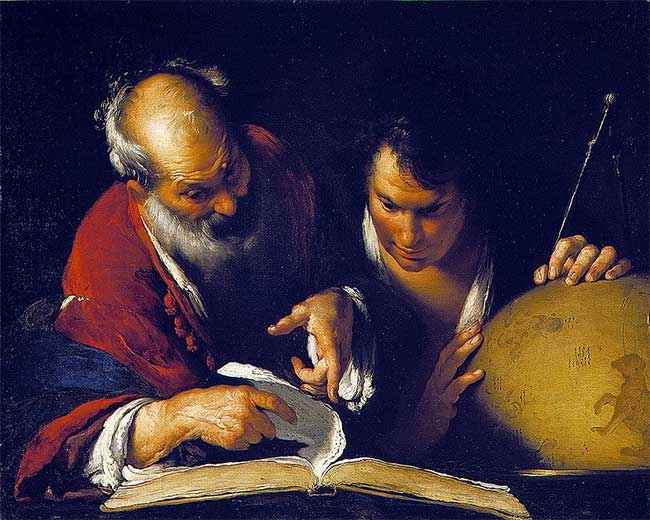
Eratosthenes, an ancient scientist, estimated the circumference of the Earth with just a stick. (Photo: Ancient Pages).
The scholar Eratosthenes (276-194 BC) was born in Cyrene, a region in present-day Libya. After studying in Athens, he went to Alexandria (Egypt), one of the prosperous cities and centers of learning at that time. Under the patronage of King Ptolemy, Eratosthenes ran the famous Alexandrian library.
Accordingly, in the city of Syene there is a very famous well. The special thing is that at noon on the summer solstice, the sun will shine directly into the well without creating any shade. The reason given is that the city of Syene is located right on the Tropic of Cancer . On the summer solstice, the sun will shine directly overhead.
Of course, the scholar Eratosthenes heard about this and saw an opportunity. Besides, Alexandria (where Eratosthenes worked) was located just north of Aswan. So the two locations were on the same meridian and had the same longitude.
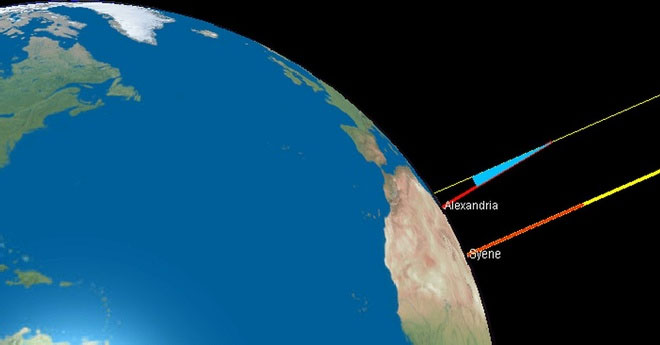
Eratosthenes discovered that Alexandria and Syene shared the same meridian. (Photo: The Cultural Tutor).
In Alexandria, at noon on the summer solstice, Eratosthenes placed a stick on the ground and measured the angle of the sun's rays based on the stick's shadow. At that time, Eratosthenes had an angle of 7 degrees, which is about 1/50 of the circumference of a circle.
Eratosthenes therefore calculated that the distance between Alexandria and Syene (where the angle is 0 degrees) was 1/50th of the total circumference of the Earth. He further multiplied that distance by 50 and came up with 250,000 stadia (a unit used in ancient times).
Ultimately, Eratosthenes estimated the Earth's circumference to be somewhere between 24,300 and 25,000 miles (39,100–40,300 km). Scientists now estimate the Earth's circumference to be 24,900 miles (40,075 km). This suggests that Eratosthenes's calculation was off by less than 1%.
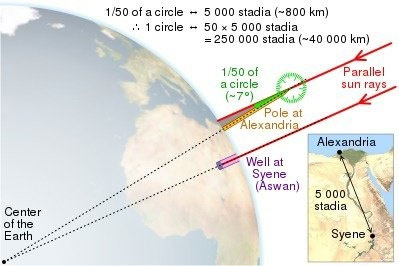
Eratosthenes' estimate of the Earth's circumference is within 1% of today's figures. (Photo: The Cultural Tutor).
Eratosthenes wrote down all the calculations in a book. However, it was lost for many years until Cleomedes, a Greek astronomer (10-70), wrote down Eratosthenes' calculations in a simplified form. This is the method we know today.
In it, Cleomedes wrote that Eratosthenes' original methods were much more complex than the simplified version. Finally, Cleomedes expressed admiration for Eratosthenes' ability to calculate the approximate circumference of the Earth using only a stick, a well, and knowledge of geography.