Back in 1980, less than 10% of Americans were cremated. That number is now around 53%, according to the National Cremation Association of North America.
The change comes from many causes, from religion to culture to widespread social acceptance. However, no event accelerated the change more quickly than the Great Recession (the 2009 global recession). "We saw an increase in cremation rates when the economy went down in late 2008 and people lost their jobs. Cremation is a less expensive alternative to traditional burial in the ground," said Jim Koslovski, director of Rosehill and Rosedale Cemeteries in New Jersey (USA).
Rosehill and Rosedale cemeteries charge just $190 to cremate a body, and charge extra for a casket, flowers and other services. By contrast, a grave can cost $2,500, plus $1,900 in additional fees.
How a crematorium works
Normally, when the hearse enters the crematorium, the deceased's body will be wrapped and placed in a coffin. This partly shows respect for the deceased as well as protects cremation technicians from infectious diseases, as well as helps them handle the remains most safely before cremation.
The coffins enter the crematorium's cold storage area. At Rosehill, we try to complete all cremations and return the remains to the family within 24 hours. This is in line with the burial guidelines in most states in the US.
Once the cremation preparations are ready, the coffin is taken out of the cold storage and placed on a hydraulic lift that looks like a barrel, then transferred to one of the cremation units (more accurately known as crematoriums, although Americans avoid this term because it reminds people of the crematoriums at the Nazi concentration camp Auschwitz).
A small mistake/mistake can have unforgivable consequences, so Rosehill uses two forms of ID to ensure the family receives the correct remains. A copy of the receipt is attached to the outside of the cremation unit and a metal ID tag accompanies the deceased inside the unit.
A cremation unit has two chambers: the primary chamber , into which the body is placed, and the secondary or "back chamber" , which consumes the gases produced by the cremation process. The primary chamber typically has brick-lined walls and a floor and roof of high-temperature resistant concrete.
The main chamber (where the body is cremated) is heated from 760 degrees Celsius to 1,093 degrees Celsius for 1.5 to 2 hours.
The resulting gases and particles enter the back chamber, a 30-foot-long maze designed to retain the gases for at least a second. The back chamber is designed to withstand blasts of air as hot as 2,000 degrees Fahrenheit.
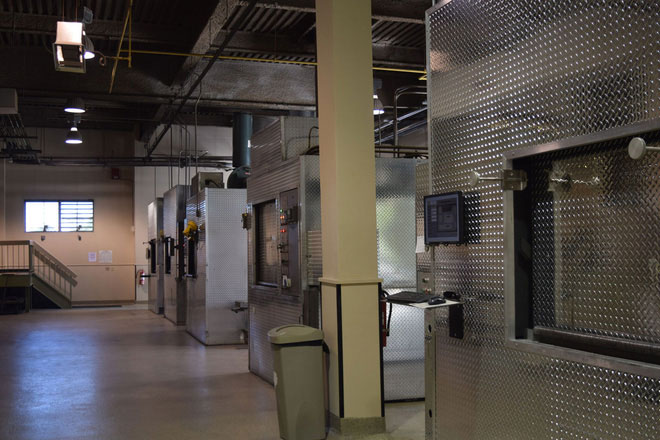
Cremation units (crematoriums - ND) in Rosehill. (Photo: CAREN CHESLER/Popularmechanics).
'Any solid will turn to gas if heated to the right point. That's essentially what happens to a body when tissue is heated to the point where its solids turn to gas and become combustible. The key is to design equipment that consumes the most exhaust gas so that they stay within state environmental regulations,' said Brian Gamage, marketing director for American Cremation Equipment in Florida.
According to environmental agencies in most US states, the emissions must be less than 0.1 per 0.0283 standard cubic meters. Problems arise when the volume of gas (smoke) becomes too large for the post-treatment chamber and it overflows. This can happen if the machine is not properly designed or if the operator overloads the main chamber, which can happen for surprising reasons – for example, putting an obese person into the unit at the wrong time of day.
It sounds creepy, but weight is something crematorium operators have to worry about. The machine doesn't know the difference between a 150-pound person and a 400-pound person. It just does its job.
The general rule of thumb for crematoriums is that 100 pounds of human fat is equivalent to 15 gallons of kerosene. If a person weighs 400 pounds, at least 200 pounds of that will be fat, which burns quickly. If you put the person in a machine that is too hot, as crematoriums tend to get hotter towards the end of the day, the back chamber can release a lot of smoke and odors and fill the air.
While some crematoriums can process bodies faster, a typical cremation unit can complete a cremation in about 1.5 hours . And that varies depending on the weight of the deceased and the type of casket they are in. The time-consuming nature limits the number of cremations each unit can process in a day.
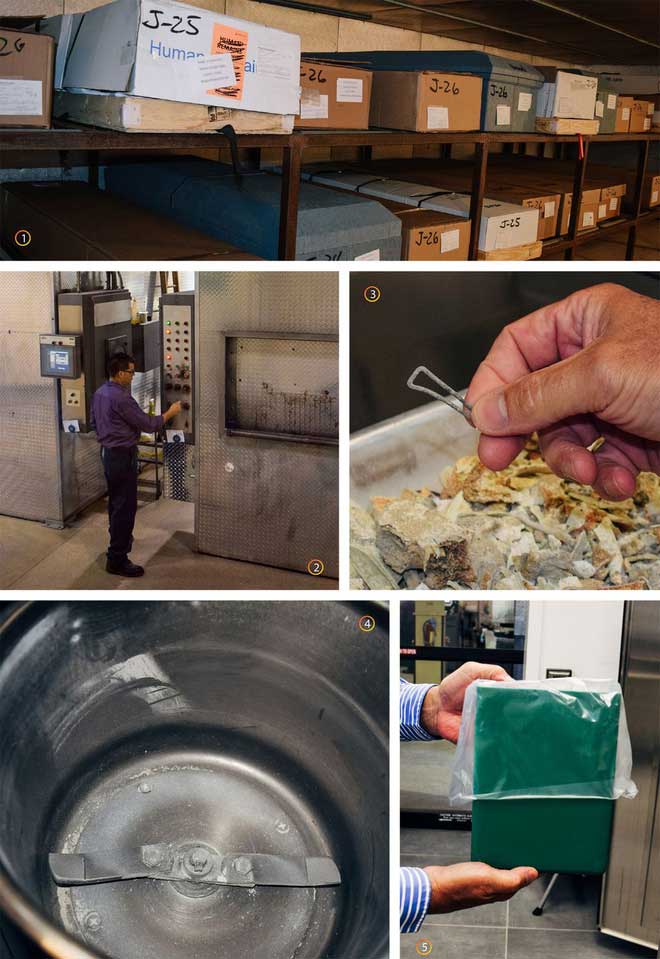
Cremation process in photos: (1) The body is identified and the deceased's family gives permission for cremation. Medical devices and prosthetics are removed and jewelry is collected before the body is placed in a combustible box. (2) The box is placed inside the cremation chamber and heated from 760 degrees Celsius to 1,093 degrees Celsius for 1.5 to 2 hours. (3) The remains are cooled and a technician removes metal fragments with a magnet. (4) The remains are ground into a fine powder. (5) The ashes are placed in a container or jar and returned to the family. (Photo: CAREN CHESLER/Popularmechanics).
Once the cremation process is complete, the remains are placed in a silver baking tray. A technician runs a magnet over them to remove any materials that don't burn during cremation. These typically come from staples, screws, hinges, and a person's prosthetic joints. The technician then visually inspects and removes any materials that the magnet missed, such as pieces of glass that were left behind.
The crematorium puts the bones and remaining ashes into a pulverizer, not unlike a food processor, to grind them into a more uniform powder. The remains are then placed in a container for the family to take home.
Back to the motherland
Of course, cremation is not a new concept. Cremation dates back to the Stone Age, and was common in ancient Greece and Rome. In certain religions, such as Hinduism, cremation, especially open-air cremation, is a very common form of burial.
The rise of Christianity put a damper on cremation in the West. By 400 AD, around the time Emperor Constantine Christianized the Roman Empire, Rome had banned cremation as a pagan practice. The theological reason for the ban was related to resurrection—they wanted to keep the body intact so that the dead could be resurrected in the afterlife. Jewish law also forbade it. By the 5th century, cremation had disappeared from Europe.
The practice saw a revival in Europe in the 1870s, largely in an effort to limit the spread of disease.
The first modern crematorium was built in the United States in 1876. By 1900, there were 20 crematoriums in the United States. The practice was further promoted in 1963, when the Catholic Church reversed its position on cremation during the reforms of the Second Vatican Council and said cremation was permitted. Today, there are more than 3,000 crematoriums across the United States.
Jim Koslovski said the widespread acceptance of cremation is consistent with the reality of cemeteries running out of space. He estimated Rosehill had just 15 years left before it ran out of space.
"Dust returns to dust" - Humans are born from the Earth and will return to the Earth. But how we return to Mother Earth is more important than an emotional story - It is an environmental issue.
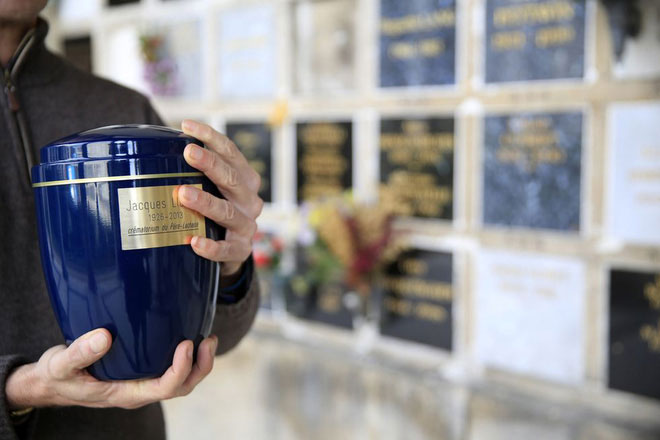
Urn containing ashes. (Photo: GETTY IMAGES).
As cremation continues to be seen as the leading alternative to burial, the emissions that come with the process have become a concern – so much so that people are starting to consider some alternatives to cremation.
There is now a water-based process called alkaline hydrolysis , which was invented as a way to dispose of animals infected with mad cow disease. It is being marketed as a more environmentally friendly option after slaughter for human consumption because it produces less carbon monoxide and pollution.
Alkaline hydrolysis involves placing a body in a chamber filled with water and potassium hydroxide and heating it to 149 degrees Celsius at high pressure. After three hours, the body becomes a greenish-brown liquid and the bones are soft enough to be crushed. The bones can be returned to the family, while the liquid can be discharged into the sewer system.
Perhaps unsurprisingly, the approach hasn't really taken off. It's slower than cremation. And more importantly, the technology is more expensive: A stainless steel pressurized device can cost anywhere from $175,000 for a basic unit to $500,000 for a high-end one, while a cremation unit costs about $110,000. There are also legal issues, as the process is illegal unless a state passes a law specifically allowing it.
Furthermore, ethical issues arise when a part of the deceased body (after alkaline hydrolysis) is turned into liquid and then flows into the sewer system. This is difficult for the family to accept.