The Laniakea Supercluster, also known as the "Laniakea Supercluster" or "SCI Supercluster" , is a supercluster containing the Milky Way and about 100,000 other galaxies.
Many people have probably seen this photo online that looks like a "leaf pattern", and it is hard to imagine that the Milky Way contains countless leaf patterns. As the tallest supercluster in the Milky Way, the Laniakea supercluster is 520 million light-years in diameter and contains about 100,000 galaxies.
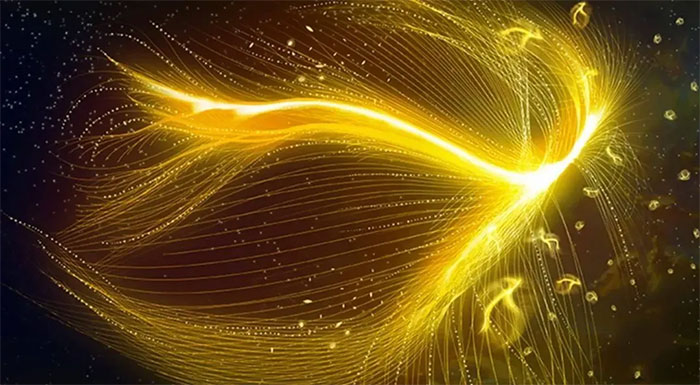
Conceptual image of the filamentous Laniakea supercluster.
So, what kind of terrifying structure is this giant Laniakea supercluster? How terrifying is it? Let's take a look!
For humans, our understanding of the universe is gradually enlightened, just like at first we thought that the earth was the center of the universe, and then we believed that the sun was the center of the universe after strengthening the heliocentric view.

Diagram of the Laniakea supercluster.
However, with the improvement of observation methods, the universe has indeed spoken to humans with its vastness, which has always been our dream. Like a frog sitting at the bottom of a well looking up at the blue sky, humans have only seen the tip of the iceberg of the universe.
First, let's classify the relationship between the different levels from a macroscopic perspective. The level above the Solar System is the Milky Way, and the Milky Way and the Andromeda Galaxy are members of the Local Group of Galaxies. The diameter of the Local Group of Galaxies is about 10 million light years or more.
The upper layer of the Local Group of galaxies is the Virgo Cluster of galaxies, which is also held together by gravity. There are over 1,300 galaxies in this cluster. For such a large group, the Virgo Cluster's diameter exceeds 65 million light years.
If you push it further out, you'll find many superclusters that consist of galaxy clusters, such as the Virgo Supercluster, which is 100 million light-years across and contains about 100 galaxy clusters.
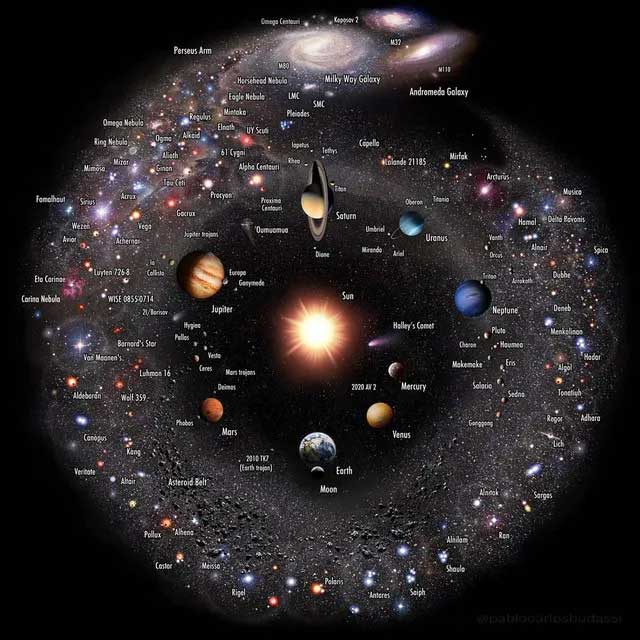
Image of the Milky Way galaxy. (Photo: Space)
When we come here, everyone feels that it is almost the same, the existence like Virgo Supercluster is already the largest structure in the universe. But in fact , "there is always a mountain higher than the mountain" , Virgo Supercluster which is already very large in the eyes of humans is just a small "branch" of Laniakea Supercluster.
According to scientists' calculations, there are at least 100,000 galaxies in the Laniakea supercluster and its diameter is up to 520 million light years .
Of course, in addition to its incredible range, the Laniakea supercluster is also terrifyingly massive, easily 100,000 times that of the Milky Way. And our Solar System, which is not very visible, looks even more like a 'bacterial nest' when placed on it, so its awesomeness must be expressed in some way in its ' enormity' .
So because the Laniakea supercluster is so large, it's like a giant dormant beast in the universe .
Visualization of the Laniakea supercluster.
It's safe to say that the shape of the Laniakea Supercluster should be pretty clear in the cosmos. After all, there are a lot of galaxies like the Virgo Cluster, the Centaur Cluster, and the Hydra Cluster within the body of this giant. And scientists believe that our current understanding of the extent of the Laniakea Supercluster may still be inaccurate, as some of its sky is obscured by the Milky Way's hidden belt.
However, large size does not mean easy to detect, because human observation equipment is very limited, it is impossible to directly observe such large-scale constructions by 'seeing'.
So, in 2014, after recording the positions of more than 8,000 galaxies in the vicinity of the Milky Way, scientists from the University of Hawaii established a "model" by proposing relative motion after cosmic redshift, thus determining the existence of the supergiant Kaia.
Scientists named it after this discovery, using the word Laniakea, which means "endless paradise" in Hawaiian, and the Polynesians who used their astronomical knowledge to navigate the oceans often used the word.
Today, humans have also used astronomical knowledge to deduce the existence of such a giant structure in the universe. In essence, this is really "further" from us on the cosmic ocean. But it should be noted that although the Laniakea supercluster is very large, it is still not the largest structure in the universe .
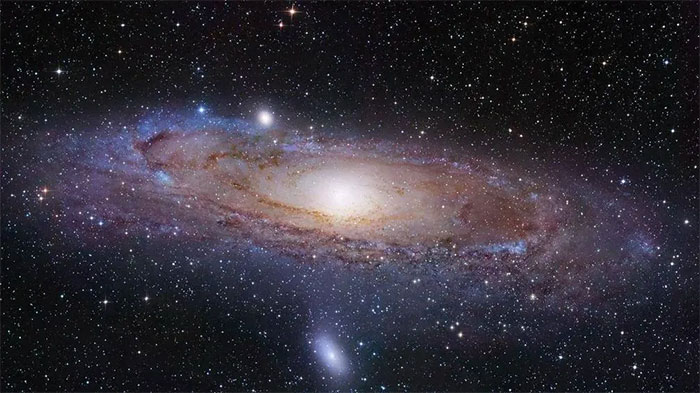
The vast galaxy is our home.
According to scientists' observations, there are still many large-scale architectural works in the universe, such as the Wuxian-Beimian Great Wall , discovered in 2013, which spans more than 10 billion light years. In this view, the Laniakea supercluster, which is 520 million light years in diameter, is not really a giant.
It is worth mentioning that in the eyes of scientists, the scary thing about the Laniakea supercluster is not its size, because in the universe there are many structures larger than it. The truly scary thing is the "giant source" at its center.
Everyone knows that the magnitude of gravity in the universe is a symbol of strength, and there is a "huge attraction" at the center of the Laniakea supercluster. This guy has been attracting neighboring galaxies toward it, and of course the Milky Way in the Local Group cannot escape.
So don't think that the Solar System only revolves around the Milky Way in a fixed position, in fact, due to the influence of the giant gravitational force, the Milky Way is moving forward, or running around chaotically because the speed of the Milky Way can reach about 600km/second.
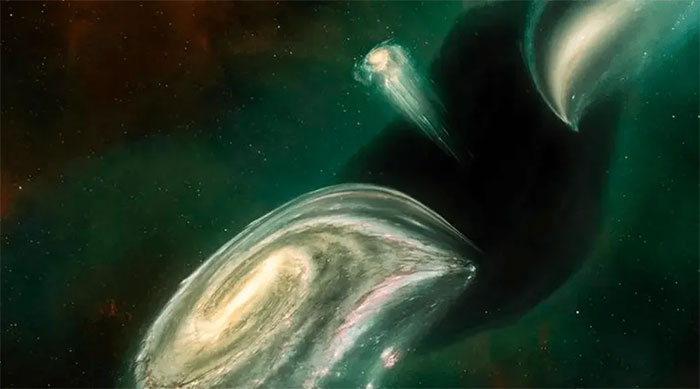
Conceptual image of giant gravitational swallowing galaxies
With such a huge gravitational force, the giant gravitational force is even more terrifying than a "black hole" in the eyes of some scientists. Because its current strength has actually surpassed the strength of a black hole, and it can pull many giant galaxies close to itself.
In this case, many people cannot help but fear this giant gravitational force that has not yet been fully seen, believing that under its impact, the galaxy we are in will be greatly affected. So, is the giant vacuum really a threat to humans?
From the current situation, it is normal for this matter to be gathered at a center. Scientists believe that this must be something that the universe has produced since its birth, its function is to continuously collect and accumulate, so that the matter in the universe changes from a "diffuse" state to a "gathered" state. As for what it does after the synthesis, there is no way to know.
Also, it's worth noting that although we're getting closer to the Colossal Gravity right now , we'll theoretically never reach it. Because there's so much dark matter in the universe, that dark matter would push us away, causing us to drift away from it.
As it turns out, the giant attractor shouldn't have a penchant for devouring stars like a black hole, it's just pointing the "home direction" for the various galaxies at the center of the Laniakea supercluster.
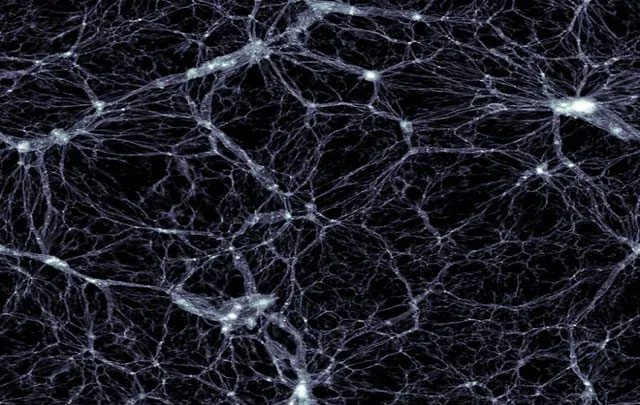
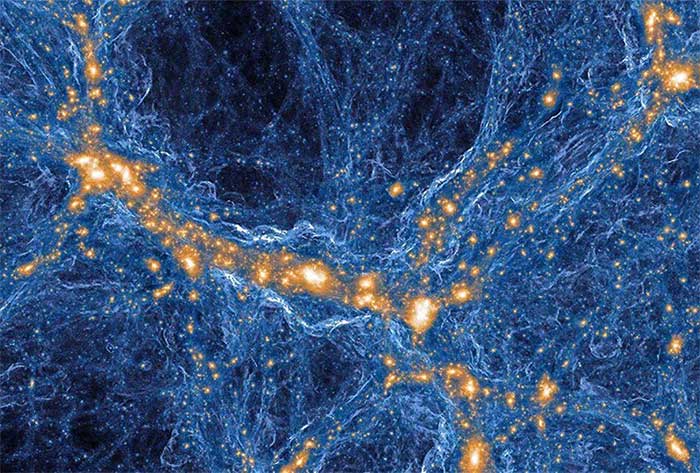
This simulated image shows matter existing in the form of filaments in the universe. Galaxies are contained within dense, bright white spots.
All in all, we have solved the mystery between the Laniakea Supercluster and the Attractor. The above discussion has been discussed on a large scale, and then let's narrow our view and compare this giant structure in the universe to something on Earth to see what we can find.
We used leaf veins as a model when describing the shape of the Laniakea Supercluster above. And when we look closely, we see that it has similarities to many things at the microscopic level. For example, the capillaries in our body, or the nerves in the brain.
You can also easily find it in nature, such as the branches on trees, the intricate network of rivers, and the fringed ornaments woven by humans, all of which have a high similarity to the huge structure in this universe. If two similar things can be classified as coincidences, then many similar things can hardly be generalized as "coincidences".
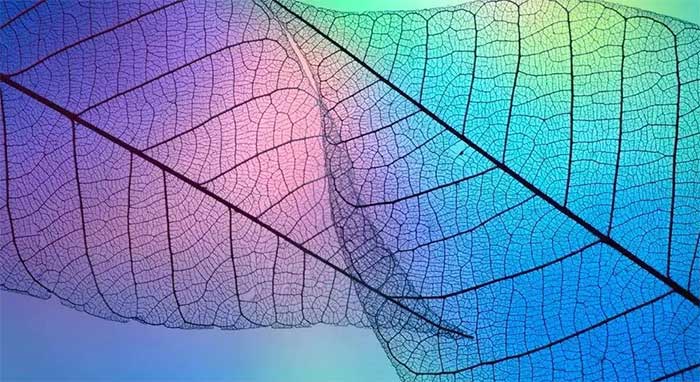
Leaf veins like cosmic web.
For this reason, some scientists theorize that since the large and micro scales of the universe may show this similarity, does that mean they are all 'modeled' or 'operated' according to the same set of processes? In this case, the universe itself could be a brain, and a structure like the Laniakea supercluster just a neuron. Of course, if this were the case, the universe would be a 'conscious' existence, and this would probably be harder to accept than relativity.
