After years of being obscured by dust and gas, the largest young supercluster in the Milky Way - Westerlund 1 - has finally been discovered by the James Webb Space Telescope (JWST).
See also: James Webb Telescope Reveals Secrets of the Universe: Was the Big Bang Just a Man's Imagination?.
This cluster is located near the center of the Milky Way, just below the tail of the constellation Scorpio, and can be seen from the Southern Hemisphere.
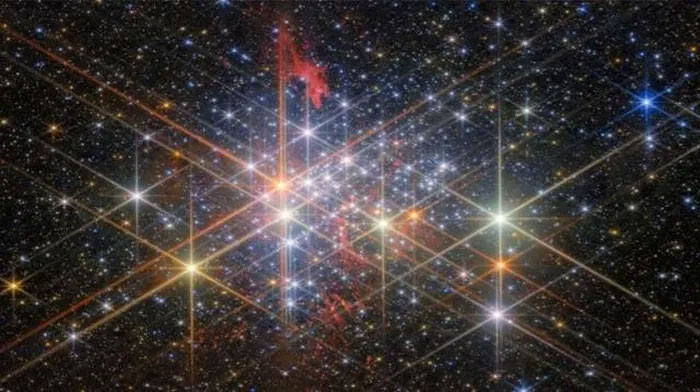
JWST's view of Westerlund 1, one of the closest "super clusters" to the Solar System. (Credit: ESA/Webb)
Westerlund 1 is a prime example of a "supercluster ," a cluster of hundreds of massive stars. With masses ranging from 50,000 to 100,000 times the mass of the Sun, the cluster dwarfs most other star clusters, which typically have masses of around 10,000 times the Sun's.
Some of the stars in Westerlund 1 are 2,000 times more massive than the Sun. If one of these giant stars were in our solar system, it would extend all the way to the orbit of Saturn. Not only are these stars massive, they are also a million times more luminous than the Sun.
If Earth were orbiting a star in the Westerlund 1 cluster, our night sky would be lit up by hundreds of brilliant stars, like the light of a full moon. This magnificent sight is one of the factors that helps scientists gain insight into the evolution of giant stars.
According to astronomers, Westerlund 1 is entering a particularly active phase, in which over the next 40 million years, more than 1,500 of its stars will explode in supernovae - giant explosions that mark the end of the lives of massive stars. Currently, the cluster is only about 3.5 to 5 million years old - very young in cosmic terms.
The latest images of Westerlund 1 provided by JWST have given astronomers unprecedented insight and comprehensiveness.
Westerlund 1 as seen by JWST. (Source: ESA/Webb)
Unlike the Hubble telescope, which is limited by its inability to see through dust clouds, JWST overcomes this challenge with its Near Infrared Camera (NIRCam) technology. NIRCam can capture infrared light, allowing it to "penetrate" the dust and reveal mysterious details inside the cluster.
In the striking images taken by JWST, red gas spirals appear front and center, while brilliant stars glow with diffraction spikes – a unique phenomenon created by the telescope's mirror design.
These are unique images that only JWST can capture, opening the door for scientists to better understand the past and future of the universe's largest star clusters.
Westerlund 1 is not only a cosmic wonder, but also an important key to helping scientists explore the formation and evolution of massive stars in the Milky Way .
Superclusters like Westerlund 1 are rare today. They are valuable clues to the galaxy's ancient history, and provide insight into how massive stars form and die.
