How was the universe born? This is one of the oldest and most intractable problems in human history .
How did the Big Bang theory come about?
The Big Bang theory states that the universe began from an extremely small and extremely dense singularity, after a violent explosion, time, space and matter were created, then expanded and cooled continuously to form stars, galaxies and other celestial bodies.
The theory was first proposed by physicist Georges Lemaitre in 1927, who proposed a mathematical model describing the origin and evolution of the universe based on Einstein's general theory of relativity.
Georges Lemaitre's theory was not widely accepted at first, and was even derided by the British physicist Fred Hoyle as the " Big Bang" . Hoyle himself was a proponent of steady-state cosmology, the idea that the universe is eternal and unchanging, with no beginning and no end.
However, after the 1950s, with the advancement of observational technology and new discoveries, the Big Bang theory gradually gained more evidence and support - the most important of which was the cosmic microwave background radiation .
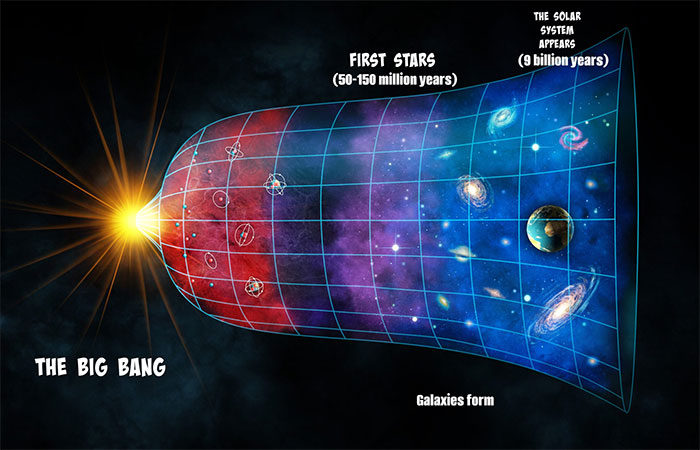
The Big Bang theory, commonly known as the Big Bang, is a prominent cosmological model that describes the early stages of the formation of the universe. (Photo: Zhihu).
The cosmic microwave background radiation refers to the first light emitted 380,000 years after the birth of the universe and it still permeates the entire universe 13.8 billion years later. The cosmic microwave background radiation was first discovered by accident in 1964 by American physicists Arno Penzias and Robert Wilson, who, using a radio telescope, detected faint noises coming from all directions in the sky.
After eliminating various sources of interference, they realized that the noise could be some kind of radiation from the distant past. At the same time, American physicist Robert Henry Dicke and his colleagues were preparing to use similar equipment to search for the existence of cosmic microwave background radiation. When he learned that Penzias and Wilson had detected cosmic microwave background radiation, Robert Henry Dicke immediately contacted them and confirmed his discovery.
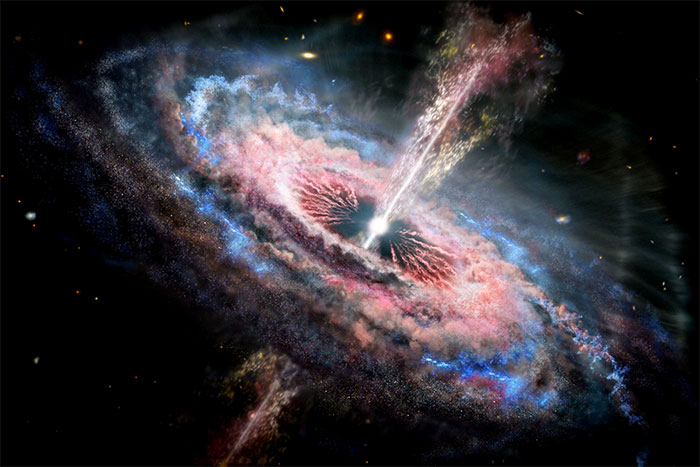
The Big Bang occurred about 13.8 billion years ago, which is considered the age of the universe. (Photo: Sciencealert).
Penzias and Wilson later won the 1978 Nobel Prize in Physics for their discovery of the cosmic microwave background radiation, while Dicke and his colleagues missed out on the honor for not publishing their theory in time.
The discovery of the cosmic microwave background radiation is the strongest evidence for the Big Bang theory, because it closely matches the temperature and frequency predicted by the theory, and is evenly distributed across the sky, suggesting a high degree of uniformity in the early universe. However, recent observations from the James Webb Space Telescope have posed some challenges to the theory.
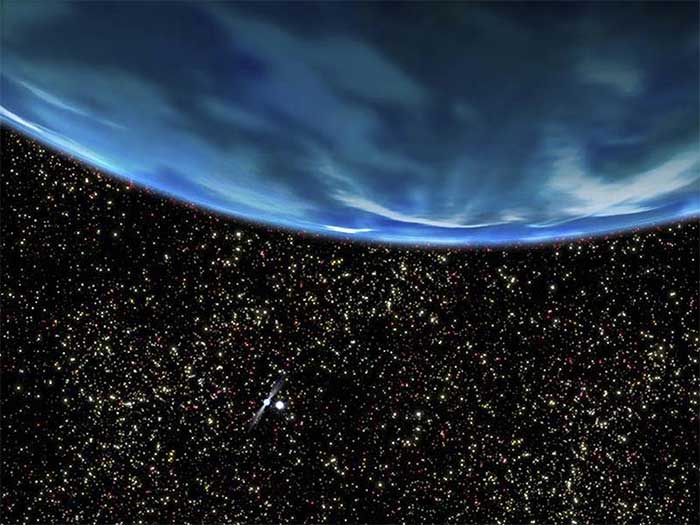
The cosmic microwave background radiation refers to the first light emitted 380,000 years after the birth of the universe, and it still pervades the entire universe 13.8 billion years later. (Photo: Zhihu).
What did the Webb telescope see?
According to the Big Bang theory, the universe was a homogeneous, high-temperature, high-density plasma, devoid of any structure or matter for the first few million years. As the universe cooled and expanded over time, small fluctuations in density began to develop and gradually amplified. These density fluctuations caused matter to accumulate in some regions and become sparse in others.
This created regions where some nuclei and electrons could combine to form neutral hydrogen atoms, known as reionization periods. During these periods, with no source of light, the universe was dark and transparent.
The epoch of reionization ended about 13 billion years ago, when the first generation of stars and galaxies began to form and emit intense ultraviolet radiation. During this period, stars and galaxies underwent rapid and complex evolution.
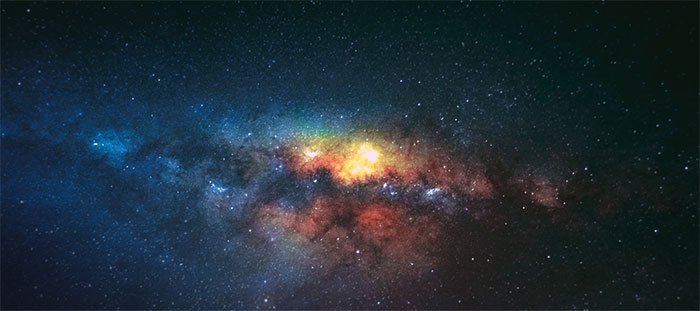
According to the Big Bang theory, the universe was a homogeneous, high-temperature, high-density plasma, without any structure or matter for the first few million years. Photo: Zhihu
According to theoretical predictions, protogalaxies should have the following characteristics: first, they are irregular in shape, without obvious structure or rotation; second, their luminosity and density are low, due to the lack of heavy elements and dust; finally, they are relatively small due to uneven distribution of matter and uneven, unstable gravity.
However, the James Webb Space Telescope has shown us a very different picture than expected. According to new papers published in journals including Nature, Science and Acta Astronomica, the James Webb Space Telescope has found something that doesn't match expectations.
First , some galaxies are so bright and dense that they exceed theoretical predictions. For example, the James Webb Space Telescope observed a galaxy about 13.2 billion light-years away that is as bright as 100 billion Suns and 100 times denser than the Milky Way, making it one of the brightest and densest known protogalaxies.
For more context, see James Webb Telescope captures galaxies merging.
Second , some galaxies already have spiral structures and smooth disks rather than irregular shapes.
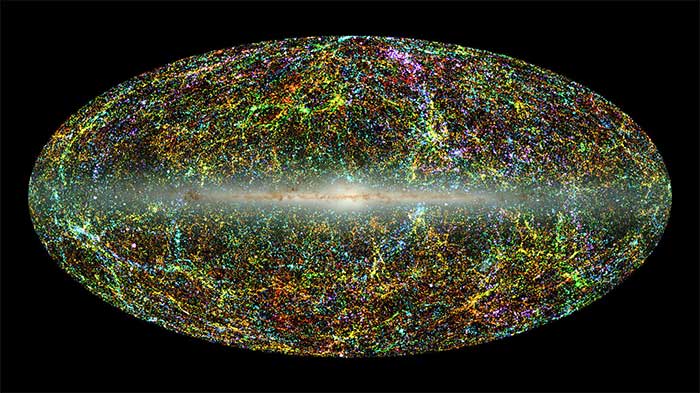
Illustration photo. Photo: Acta Astronomica
In addition, the James Webb Space Telescope has also discovered more than 1,000 protogalaxies in an area about 13 billion light-years away from us, while according to theoretical simulations, there should only be a few dozen galaxies in this area.
These galaxies are among the largest and densest known groups of protogalaxies. The findings surprised and confused astronomers because they did not fit what the Big Bang theory predicted.
According to theory, these primordial galaxies should have remained in a primitive and chaotic state, rather than having developed complex and mature features. So, how did these primordial galaxies form and evolve? Did the Big Bang really happen?
The Big Bang Theory: Revise or Abandon?
Faced with the new perspectives and challenges brought to us by the James Webb Space Telescope, astronomers have come up with different views and explanations. Some believe that these observations do not mean that the Big Bang theory is completely wrong. They believe that these primordial galaxies may have formed and grown at a faster rate due to the influence of dark matter or dark energy.
Dark matter or dark energy may have played a major role in the early universe, driving the accumulation of matter and the formation of structure, leading to the rapid growth of primordial galaxies. They also believe that these protogalaxies may have been anomalies caused by some special environment or conditions, rather than by universal laws.
On the other hand, there are also those who believe that these observations may mean that the Big Bang theory needs to be revised or abandoned. They believe that the universe may not have had a single beginning or end, but rather a cyclical process.
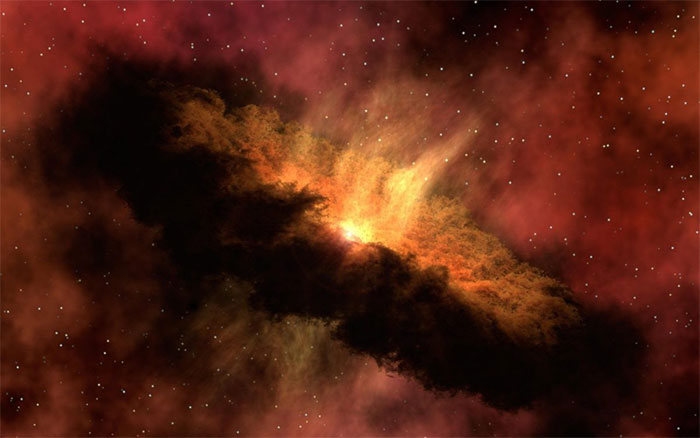
The Webb Telescope has brought us new challenges and opportunities to gain a deeper and broader understanding of the universe. It has also made us realize that there are still many shortcomings and blind spots in our understanding of the origin and evolution of the universe, which need to be constantly revised and improved. (Photo: Zhihu).
In other words, the universe may have gone through many big bangs and big collapses, each time creating a new universe. This theory is called the cyclic universe theory , and it believes that our universe is just one of an infinite number of universes, and each universe has its own characteristics and laws.
Perhaps these primordial galaxies are remnants of an earlier universe, not our own. Of course, this is just a possibility and there is no conclusive evidence. To verify this hypothesis, we need ever more precise observational data to analyze and compare.