Countries are trying to find ways to save 'dead' rivers and oceans, reviving them from ecological disaster.
According to The Ocean Cleanup , rivers are the main source of plastic waste entering the ocean. They estimate that 1,000 rivers, spanning every continent, are responsible for 80% of the world's annual riverine plastic waste, ranging from 0.8 to 2.7 million tons per year. Of these, small urban rivers are among the most polluting. The remaining 20% of plastic waste is distributed across 30,000 other rivers.
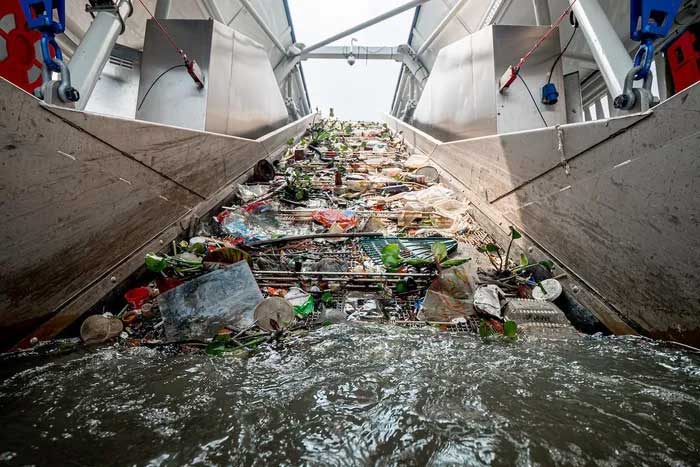
A river filter system in operation. (Photo: Green Matters).
So what are governments, NGOs and businesses doing to save water – the lifeblood of all life on the planet? Here are a few examples that are working.
Indonesia saves the "dirtiest river in the world"
Cleaning up the Citarum River is part of a long-running effort in Indonesia to address its water crisis. The Citarum is the longest and largest river in West Java, at about 297 kilometers (184 miles) long. It flows through thousands of settlements on the island, connecting villages and residents of Indonesia's most populous province of 25 million people.
Green Cross Switzerland and Pure Earth list Citarum as one of the 10 most polluted places in the world. It is a veritable ecological disaster, as the waters of Citarum are clogged with domestic waste and chemicals from thousands of factories, mainly from the textile industry, that are dumped into the water.
Mountains of waste pile up along the riverbanks, forcing residents to live with the 'trash'. According to the Asian Development Bank in 2013, about 9 million people live near the river, where fecal coliform bacteria levels are 5,000 times higher than the legal limit.
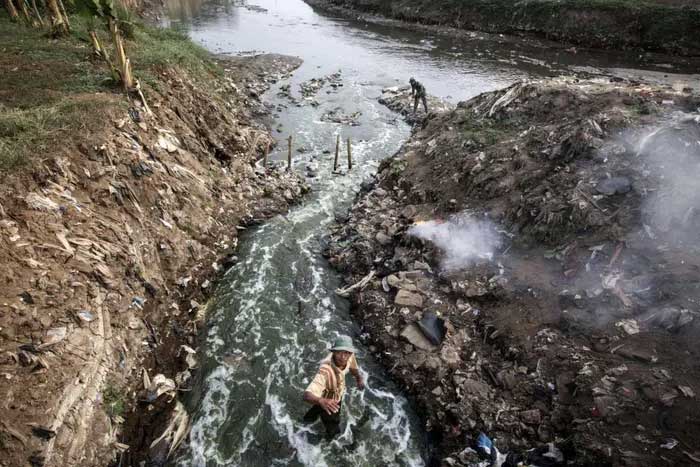
A corner of the Citarum River, where people often dump garbage directly into the river if they don't burn it. (Photo: Guardian)
The heavy pollution has caused a range of illnesses including dermatitis, rashes, intestinal problems, kidney failure, chronic bronchitis and tumours. The reason is that most local residents have to use polluted water directly from the river for bathing, washing clothes, drinking and cooking. Environmentalists estimate that at its peak, 20,000 tonnes of rubbish and 340,000 tonnes of sewage were dumped into the river every day.

A girl bathes her younger sibling in water from a river polluted with household waste in Ciwalengke village, Citarum river basin. (Photo: Mongabay)
Finally, in 2018, the pollution problem became so severe that Indonesian President Joko Widodo announced a seven-year program to return the Citarum River to its natural, clean state. The ambitious program aims to make the Citarum water drinkable by 2025, at an estimated cost of $4 billion. Since then, 7,000 soldiers, police, and volunteers have been deployed to clean up the river.
The target may be ambitious but according to village chief Bapak Cece in one riverside village, things have improved somewhat. By 2023, Cece said: ' Now people can go fishing in the river and children can also go swimming, especially when it rains'.
In February 2023, the United Nations Development Programme (UNDP), with support from the European Union (EU), in collaboration with the Indonesian Coordinating Ministry of Maritime Affairs and Investment, conducted training for 40 companies operating along the Citarum River, including both private and state-owned enterprises, on responsible business practices through the application of the United Nations Guiding Principles on Business and Human Rights (UNGPs).
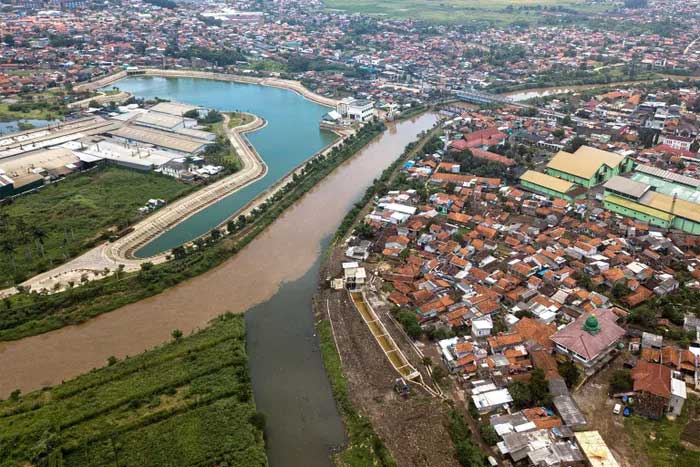
The Citarum River, flowing through Bojongsoang Subdistrict in southern Bandung. (Photo: Mongabay)
Generation Foundation , an Indonesian NGO, along with Waste4Change and RiverRecycle, has set up a plastic collection system that removes 20 to 100 tons of waste per day. They have placed active focus modules along the Citarum River to guide the trash to a collection point and scoop it up with a collection wheel.
The waste, once removed from the river, will be used as biofuel. On the other hand, the non-recyclable plastic will be converted into low-sulphur fuel to help finance the project.
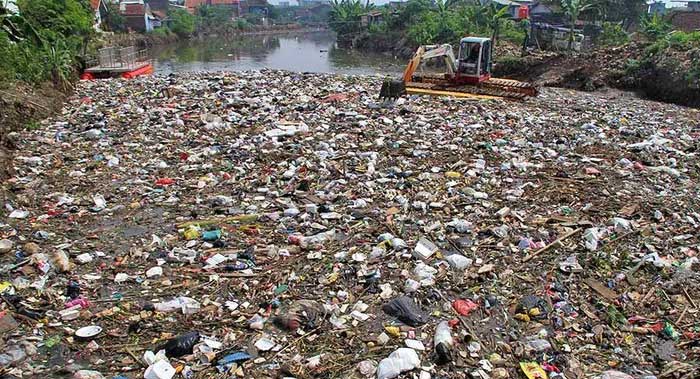
An excavator clears trash from the Cikapundung River, a tributary of the Citarum. (Photo: Mongabay)
The efforts have already yielded some initial results. At the UNFCCC COP 26 summit in Glasgow, UK, West Java Governor Ridwan Kamil presented progress on the restoration of the Citarum, declaring that the river had moved from being 'heavily polluted' to 'lightly polluted'.
Clean up the ocean
The Ocean Cleanup is perhaps best known for its efforts to clean up the Great Pacific Garbage Patch, an effort that the company's young founder Boyan Slat began pursuing in 2013 after a TED talk he gave on the subject went viral. According to CNBC, the company is now pursuing a dual goal of not just the ocean (Ocean in the name), but also building a range of river-cleaning technologies.
'Our goal is to keep plastic out of the ocean,' said Slat. 'We're interested in rivers because we believe that's the quickest and most cost-effective way to stop plastic from continuing to enter the ocean.'
The company's first river cleaning device, called the Interceptor Original, was launched in 2019. It's a barge powered entirely by solar power. It includes a barrier system and conveyor belts that isolate and filter plastic from rivers. The catamaran-style design allows for an uninterrupted flow path, allowing plastic to flow freely into the device while water continues downstream.
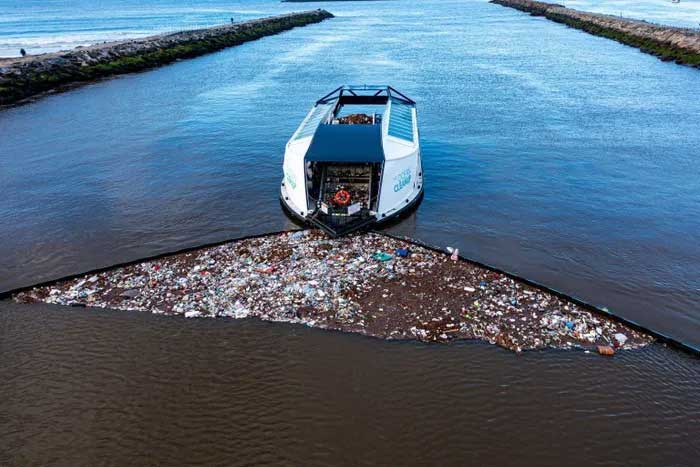
The Interceptor system in operation in Ballona Creek, California, USA. (Photo: The Ocean Cleanup)
The barrier collects debris as it flows down the river and leads to a permeable conveyor belt. At this point, the waste is transferred up the conveyor belt to an automated shuttle that distributes it between one of six containers located on a separate barge. Once full, the barge is switched and the waste is transported to a local waste management facility.
Apart from the unloading, dumping and re-installation of the waste collection barge, the Interceptor is solar powered, requiring no expensive fuel or pollution, resulting in cost-effective operation and minimal labour.
But since the giant interceptor isn't suitable for smaller rivers, the team developed another solution, a standalone floating barrier that collects waste and a small mobile conveyor belt that scoops up the trash and transports it to a landfill on shore. The system is currently being deployed in Kingston Harbor, Jamaica, where Slat said the rivers are too narrow for the Interceptor Original system.
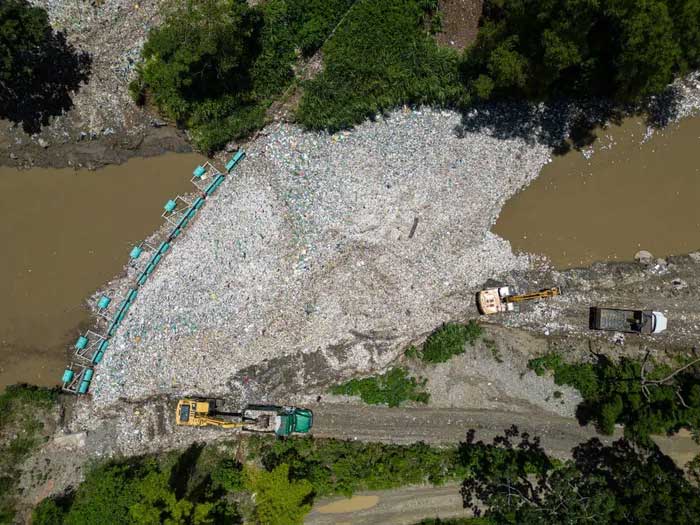
"Trashfence" solution - trash barrier. (Photo: The Ocean Cleanup)
For the most trash-ridden rivers, they use a solution called Trashfence. It works simply: An 8-meter-high steel fence is anchored to the riverbed and blocks the flow of trash during heavy storms. When the water recedes, excavators remove the accumulated waste.
However, their first version ran into problems once the amount of waste became so great that the system was overwhelmed, as happened in some of Guatemala's most polluted rivers.
' The force of the flowing trash was so great that the Trashfence collapsed, unfortunately. So we are currently working on a second version and hope to have it ready for the next rainy season ,' Silat said.
According to the latest update, The Ocean Cleanup currently has 15 Interceptor systems installed in 8 countries, including Indonesia, Malaysia and Vietnam.
"Trash filter wheel" in America
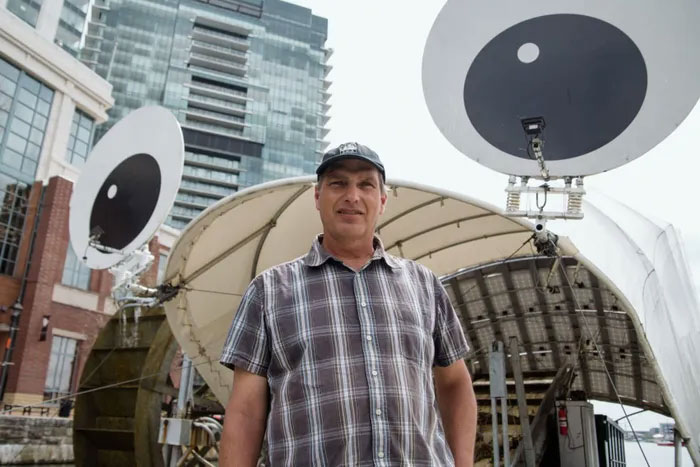
Founder John Kellett proudly stands next to one of the company's trash-filtering devices. (Photo: Here & Now).
In the US, Clearwater Mills is one of the pioneers of cleanup. The "Trash Wheel" in Baltimore, first introduced in 2014, is one of the pioneering efforts to solve the problem of waste in the river. Clearwater Mills founder John Kellett was inspired to design this trash filter after years of witnessing trash flooding into Baltimore Harbor during major storms.
Kellett says the company has four trash compactors, each with interesting names like Sir, Captain, or Professor, and they have become "stars" around town.
The machine works much like the Interceptor. A V-shaped screen is set up across the river, with rubber bands extending about 20 feet below the surface. The device catches floating debris downstream and funnels it toward a rotating waterwheel, powered by the river's current and attached solar panels. The wheel's rotation powers a conveyor belt that lifts trash and debris out of the river and into a bin. Attached cameras allow the team to monitor how full the bin is.
' And when that bin is full, we have another floating barge that brings an empty bin. Take the full one out, put the empty one in and keep collecting the trash ,' Kellett said.
By 2022, the four machines had collected a total of about 2,000 tons of trash and debris. Sticks and leaves made up the bulk of the weight because plastic is so light, but it also included about 1.5 million plastic bottles, 1.4 million Styrofoam containers, and 12.6 million cigarette butts. Everything was then incinerated in a waste-to-energy facility.
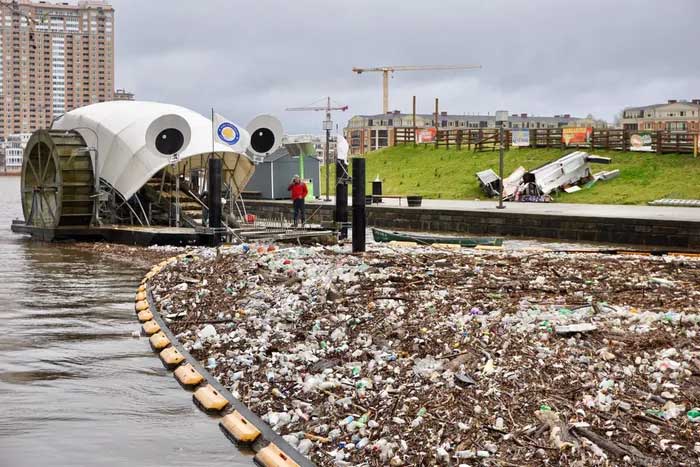
The entire system has filtered about 2,000 tons of trash in 8 years. (Photo: Business Wire)
Additional scrubbers are planned for Texas, California, and even Panama, where local nonprofit Marea Verde has partnered with Clearwater Mills to build a fifth, called Wanda Díaz. The project is funded by the Benioff Ocean Initiative and the Coca-Cola Foundation, which together support a portfolio of river cleanup projects around the world.
AlphaMERS in India
India-based AlphaMERS also uses the principle of a trash-filtering system and has 34 installations in eight different cities across the country. It is much smaller than Ocean Cleanup's Trashfence and not designed for the same amount of trash, but it can still handle the heavy lifting. Made of stainless steel mesh, the AlphaMERS fence floats a few dozen centimeters above the water's surface and extends about 5 meters below the surface.
' The hydrodynamics and hydrostatics of this system are very simple but very suitable for this job. And it is built very strong, very heavy duty with steel chains holding it on both sides. So it can withstand the monsoon flow right after the rain ,' said AlphaMERS founder DC Sekhar.
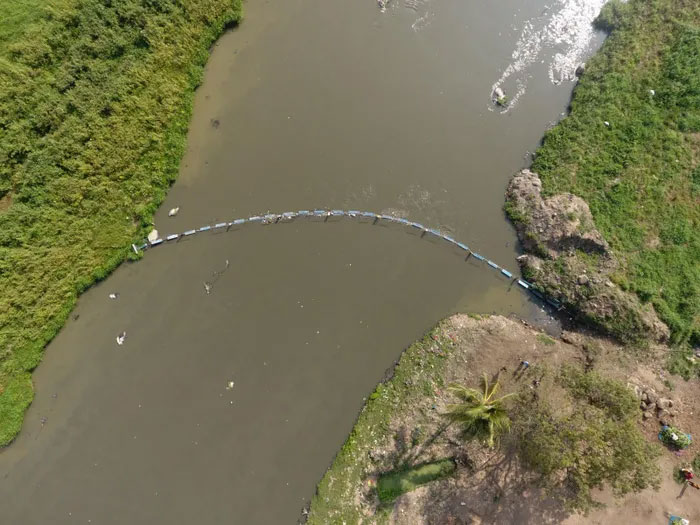
The AlphaMERS floating trash barrier system. In 2018, these eight barriers collected 22,000 tons of trash, 10% of which was plastic. (Photo: AlphaMERS)
Sekhar said his floating fence system is very good at blocking trash in fast-flowing rivers, while designs that rely on fences and barriers can fail when water levels rise, as water will flow over the fence, taking trash with it.
Eight floating barriers were deployed at various points along the Cooum River in Chennai in 2017. Sekhar said they collected about 2,400 tonnes of plastic in their first year of operation. To collect the overflowing trash, AlphaMERS also uses conveyor belts, as do Clearwater Mills and The Ocean Cleanup.
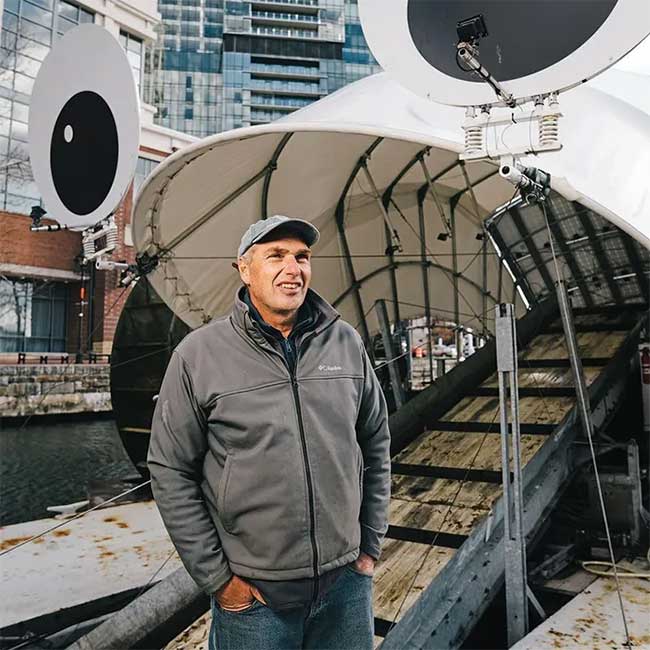
While he's still helping, John Kellett doesn't see river cleanup projects like his as a long-term solution. (Photo: Baltimore Magazine)
However, when looking at the overall picture of the global water pollution problem, while these technologies may have some impact in the short and medium term, they are not sustainable or long-term solutions. Organizations like The Ocean Cleanup and Clearwater Mills share the goal of removing as much waste as possible, but they also understand that river cleaning systems are not the optimal solution.
'One of the things we're looking forward to is when the filters are no longer needed, and that only happens when we address the problem upstream to the point where no trash gets into the water,' Kellett said.
Achieving that will be difficult and will depend on a combination of better waste infrastructure, more sustainable packaging, less consumption and greater public and business awareness of proper waste disposal.
Middle-income countries like the Philippines, India, and Malaysia are the biggest contributors to ocean waste. People have enough money to buy more packaged goods, but waste collection infrastructure is lagging behind. That's not to mention issues related to sustainable business or production, which are the responsibility of each business and organization.
Sandy Watemberg, executive director of the nonprofit Marea Verde, is excited that her organization brought the Wanda Díaz trash cleaner to Panama and is optimistic about its future performance.
' We are very hopeful that this will be a great success for our country ,' said Watemberg. However, she knows that real change will take longer.
' These types of technologies and projects are not the solution. We need to change our habits. We need to look for long-term solutions that allow us to have a cleaner and healthier environment because these types of projects help us raise awareness and help us reduce harm in the short and medium term. But at the end of the day, this is not something sustainable. We cannot keep thousands of projects like this running forever .'
According to UN Water, 44% of all wastewater on Earth is now returned to the environment untreated. This includes human waste, domestic wastewater, sometimes toxic waste, and even medical waste, which is discharged directly into the planet's ecosystems. The World Health Organization (WHO) says that about 2 billion people worldwide are consuming contaminated water.
According to the organization, 368 million people are using unsafe water sources. In addition, the majority of waste in water originates from land; for this reason, many organizations with initiatives to clean up water sources are turning their attention and investment to treating it at its source - the rivers whose basins are home to billions of people.