Scientists know almost nothing about the origin and composition of two large continent-sized rock masses located on opposite sides of the Earth's inner mantle.
At a depth of 2,896km below the Earth's crust, about half the distance to the planet's center, two giant rocks lie on opposite sides. One lies beneath Africa while the other lies beneath the Pacific Ocean. These rocks are known scientifically as thermochemical masses or large low-shear mass provinces (LLSVPs) , continent-sized regions that are distinct from the surrounding Earth's mantle, according to IFL Science .
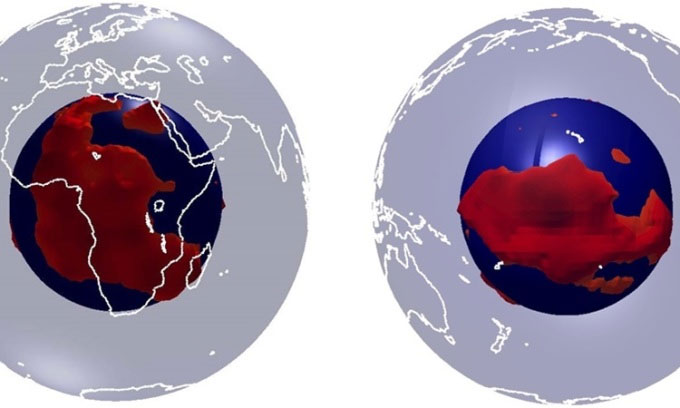
Two LLSVPs (red) are located in the Earth's mantle. (Image: IFL Science).
Scans of the Earth's interior have shown that LLSVPs are there, but researchers know little about them because it's impossible to send scientists or probes into the Earth's mantle. However, one particularly intriguing theory about the mysterious phenomenon is that they are remnants of the Earth's formation 4.5 billion years ago . If true, they could reveal a wealth of information about the Earth's internal mechanics and its complex history.
"The origin and composition of the LLSVPs are unknown. We suspect they hold important clues about how the Earth formed and functions today," said Edward Garnero, an expert on planetary interiors at the University of Arizona.
Garnero and other ASU geologists published a study of the mantle giant in 2016, using a combination of seismic, geochemical, and mineral physics data. While they didn't explain the origin and composition of LLSVPs, the paper revealed their role in the powerful geological forces we see on Earth, such as volcanic eruptions, tectonic plate movements, and earthquakes.
Many volcanoes lie along the edges of tectonic plates, rising from great depths in the Earth as the boundaries collide. Some are formed by mantle plumes, columns of hot rock that rise from within the mantle. As they reach the Earth's solid outer shell, the magma cools and penetrates the surface, creating volcanoes.
Scientists speculate that a giant mass of mantle beneath Africa and the Indian Ocean could break through the crust and create a supervolcano with the potential to erupt for millions of years.