Human eggs can last for a long time. When a girl is born, the reproductive system has developed all the eggs the girl will have for the rest of her life.
However, about 1 to 2 million immature oocytes can be healthy and successfully fertilized for up to 50 years. Reproductive scientists think the body has a secret strategy to keep eggs intact for a long time. Now, a team of developmental biologists based in Barcelona, Spain, have discovered that a key part of an egg cell can go into 'battery standby', which preserves the longer term storage.
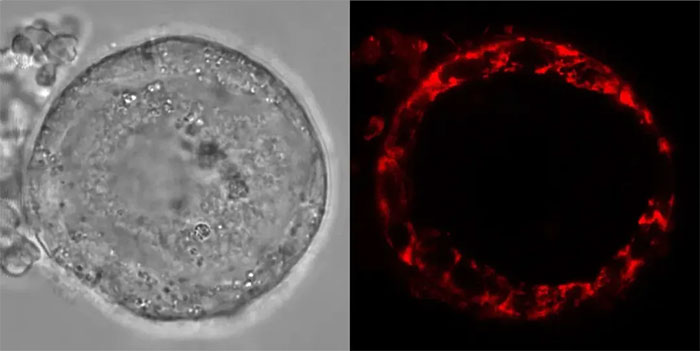
Human egg cells are particularly unique.
A study published July 20 in the journal Nature shows that mitochondria in egg cells combine with another energy pathway to prevent the production of free radicals - chemical molecules. can wreak havoc on DNA, proteins and cell walls. This finding provides new insights into the lifespan of oocytes and helps advance reproductive strategies.
'Women's fertility declines with age, and if you look at demographic studies they'll see more and more women choosing to have children in their mid-30s,' Elvan Böke, senior author of the study and is the team leader of the Cell and Developmental Biology Program at the Center for Genomics in Barcelona. But at this age, 'oocyte quality declines, and that's what leads to the majority of women's fertility problems,' she notes.
Human egg cells are particularly unique, says Böke. Human life span is long, cells must lie dormant in the body for decades - but unlike other long-lived cells such as neurons, egg cells cannot regenerate and are subject to any any damage that could affect the baby's health. There is very little research on oocytes because access is difficult. Previous work in other species has shown that normal oocytes have a slow metabolism, which allows for long-term stabilization. However, what that means for the long-term survival of the cell remains a mystery.
'We wanted to know what are the strategies of oocytes to keep the cytoplasm and cell structure young for many years,' she said.
Böke collaborated with study lead author and genomics researcher Aida Rodríguez-Nuevo and other colleagues to investigate mitochondrial activity in oocytes, specifically looking for traces of reactive oxygen species. harmful (ROS), or free radicals. In certain types of normally functioning cells, these molecules can help kick-start processes that are needed. But if the concentration is too high, they can cause a lot of damage, even causing cancer in some cases.
Essentially, 'the oocyte's mitochondria are like on standby,' says Böke. "They're still generating energy, but not too active." The team was able to show that parts of the cell have shifted energy production to a second protein complex, albeit less efficiently. but produces only a small amount of energy to help cells survive and maintain essential functions.
The metabolic system of the oocyte is also different from that of many other cells. In a review paper on the study published in the journal Nature, biomedical researchers at Monash University in Melbourne, Australia, note that it would be interesting if this metabolic pathway could be a feature common to early oocytes in other long-lived organs.
Many researchers say the finding has implications for understanding how long-lived cells maintain viability for decades. For eggs in particular, the discovery adds to an understanding of how primordial oocytes provide a safe haven for both nuclear and mitochondrial DNA between generations.
But mitochondrial abnormalities and low levels of free radicals are probably not the only factors affecting egg cell longevity. The team of researchers is looking at other potential tactics and plans to further study the specific energy sources that egg cells use to survive in the ovary. Other answers may provide a more complete picture of the link between diet, nutrition, fertility, and egg hardness.
Böke hopes that the new findings may also help with future fertility assessments. She wanted to see if the change in mitochondrial metabolic activity had any impact on people with infertility. She said: 'Extending fertility by five years, for example, would mean a woman's fertile age would be between 35 and 40. That would really make a huge difference.