The James Webb Space Telescope has captured a new image of a Sun-like protostar spewing gas and dust in a shockwave that looks incredible when seen in infrared light.
The James Webb Space Telescope (JWST) has observed a small Sun-like star spewing supersonic streams of gas and dust into space, causing visually stunning shockwaves that researchers say 'look like lightsabers'.
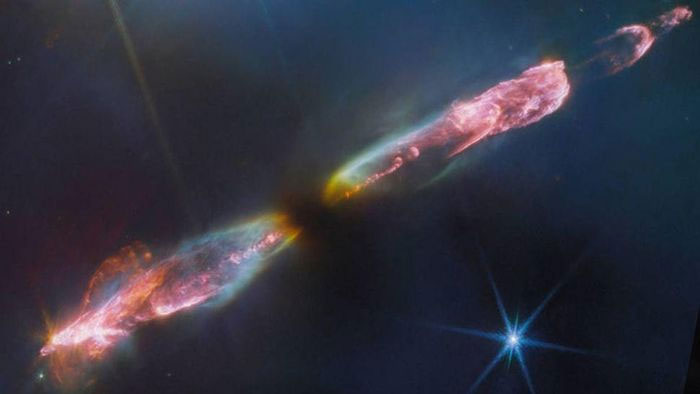
The protostar HH 211 is evolving like the Sun, shooting out a pair of glowing jets of gas and dust that create powerful shock waves as they collide with the gas surrounding the baby star. (Image: ESA/Webb, NASA, CSA, T. Ray, Dublin Institute for Advanced Study).
For more context, see Our Milky Way galaxy is old, there is not enough gas to create a new star.
The newborn star, or protostar , isn't actually visible in the latest JWST image. But scientists do know that it lies in the dark region between two glowing rivers of gas and dust, called bipolar jets , that emanate from the growing stellar mass, called Herbig-Haro 211 (HH 211) . A Herbig-Haro object is a nebula lit by a newborn star.
HH 211 is located about 1,000 light-years from Earth in the constellation Perseus and was discovered in 1994. Based on the size of its jets, the protostar is likely only a few thousand years old and weighs about 8 percent as much as the Sun, according to NASA. However, the small star will grow to be about the size of the Sun in the next few million years. This suggests that our star may have once looked a lot like HH 211.
The plumes can 'brighten with light from many different atoms and molecules' and become excited as they collide with surrounding gas clouds, said study lead author Tom Ray, an astrophysicist at the Dublin Institute for Advanced Study in Ireland. However, he added that JWST's near-infrared camera makes it much easier to distinguish between the components.
Infrared images show that these rays are mostly made up of molecules – two or more atoms connected by chemical bonds – including carbon monoxide, silicon monoxide and molecular hydrogen.
This surprised the researchers, who expected that, like other dipole rays, HH 211 was made primarily of individual atoms or ions.
They believe the jets are transmitting molecules, rather than atoms and ions, because the material flows relatively slowly. Faster speeds likely break molecules into individual atoms and ions. It remains a mystery why HH 211's jets are slower than other dipole jets, Ray said.
The level of detail captured by JWST is unprecedented. NASA notes that the new image is five to 10 times more detailed than any other image of HH 211. It's another example of how JWST can unlock secrets about the well-studied structure of the universe.
