NASA on September 21 released the first image taken by the James Webb Space Telescope of Neptune, the giant ice planet in the Solar System.
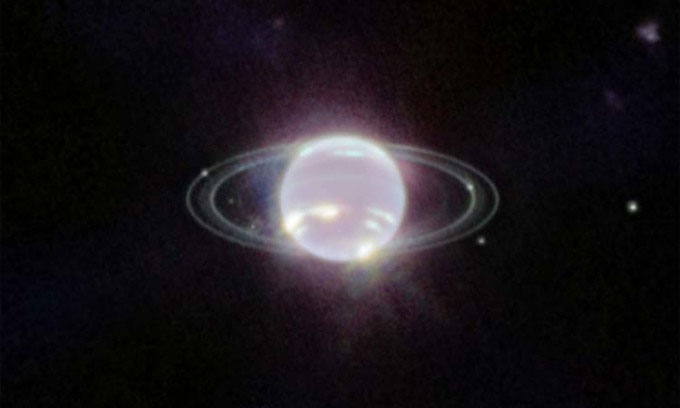
Neptune and its rings in this image taken by the James Webb Space Telescope. (Image: NASA/ESA/CSA/STScI)
The new image gives astronomers the clearest look at Neptune's icy rings in 32 years , since the Voyager 2 spacecraft flew past the planet on its way out of the Solar System.
'It's been three decades since we last saw those faint dust belts, and this is the first time we've observed them in near-infrared light,' said Heidi Hammel, a planetary scientist at the Association of Universities for Research in Astronomy (AURA).
In addition to the already known bright, narrow rings, the new James Webb image also reveals several fainter dust rings around Neptune that scientists have never seen before, even when Voyager 2 flew close to the planet in 1989.
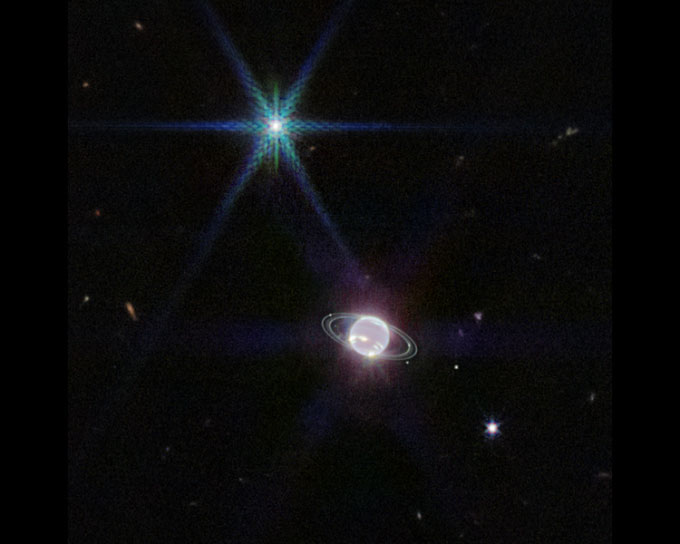
The James Webb Space Telescope captured this image of Neptune and its seven moons, with Triton standing out above. (Image: NASA/ESA/CSA/STScI).
In Hubble Space Telescope images, Neptune has a distinct blue hue. This blue hue is caused by methane in the atmosphere and is absent in the new image, which was taken by the James Webb Space Telescope, which observed Neptune in near-infrared light. Because the methane in Neptune's icy clouds strongly absorbs light at these wavelengths, regions without bright clouds and at high altitudes appear quite dark.
Another highlight is the series of bright patches in Neptune's southern hemisphere . They are ice clouds high in the atmosphere that reflect sunlight before being absorbed by methane in the clouds.
The James Webb image shows a band of high-latitude clouds surrounding a vortex at Neptune's south pole . Scientists also spotted a thin, faint streak of light rotating around the equator, which may be atmospheric circulation. Neptune's north pole also has a curious glow.
James Webb provided scientists with images of Neptune's seven moons . The bright spot above Neptune is Triton. This moon is covered in a layer of frozen condensed nitrogen and appears brighter than Neptune because it reflects about 70% of the sunlight.
