Building cross-desert highways is one of China's engineering marvels.
Great Achievement
The Tarim Desert Highway - which runs through the Taklimakan Desert in China's Xinjiang Uygur Autonomous Region - is not only the largest highway ever built in a desert, but also a true achievement in Chinese engineering.
The 522km route passes through one of the most inhospitable regions on the planet, covering an area of 270,000km². The name of this desert, in the Uyghur language, means "only enter but cannot exit". For the Chinese, this place is also known as the "Sea of Death".
Since its construction in 1995, the problem that has haunted the road's builders has been: how to keep sand dunes from burying the highway? During the first ten years of the road, the sand, terrain, and environment constantly affected the road, blocking dozens of oil trucks from the Tarim Basin to the south.
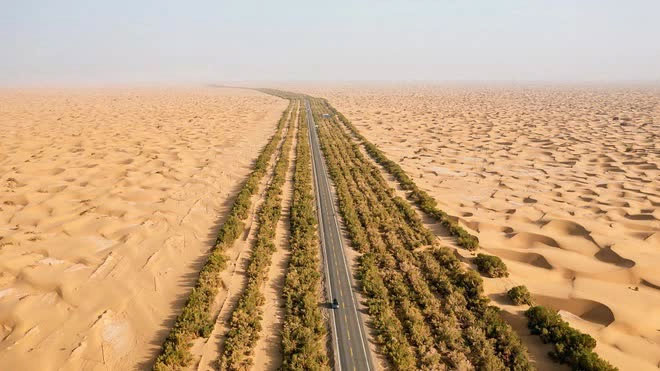
The Tarim Desert Highway passes through the Taklimakan Desert.
To find a solution, engineers built a giant green belt on both sides of the highway, supported by drip irrigation pipes to allow vegetation to grow. This way, the belt of bushes and small trees would block the sand from passing through and keep the highway clear.
To maintain this massive infrastructure and keep the oil flowing, the Chinese government has hired a large army of workers to work at the foot of the highway. Every 4km, a small blue house is provided for two Chinese nationals who monitor and repair the irrigation system on their stretch of highway. Each pair stays there for up to two years, and usually has no contact with anyone else during that time, not even their neighbours.
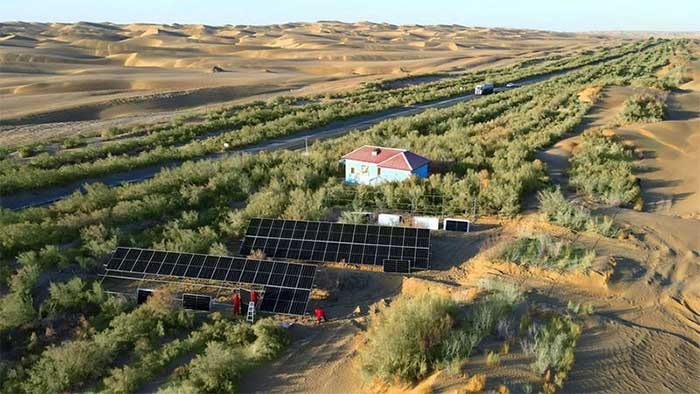
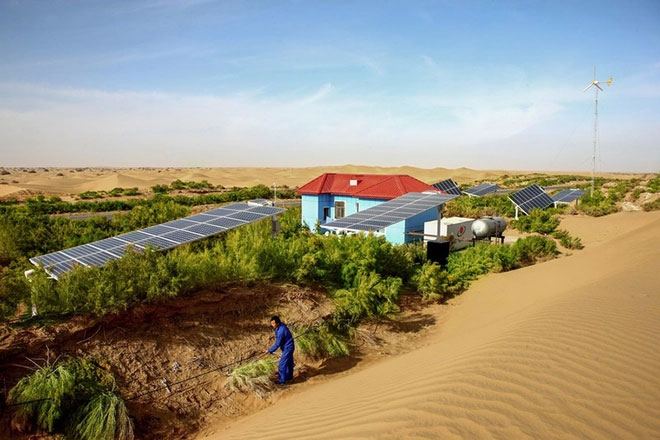
Since 2003, China has planted about 2 million trees a year in this desert.
Since 2003, China has planted about 2 million trees a year, built dozens of wells, and increased the size of the sand-proof belt to about 70 meters wide and 400 kilometers long. The tree planting on the Tarim Expressway is being studied by world scholars as a good example of how to develop irrigation systems in arid regions.
In January 2022, PetroChina's Tarim Oilfield branch launched a conversion project to convert all diesel generators to photovoltaic generators.
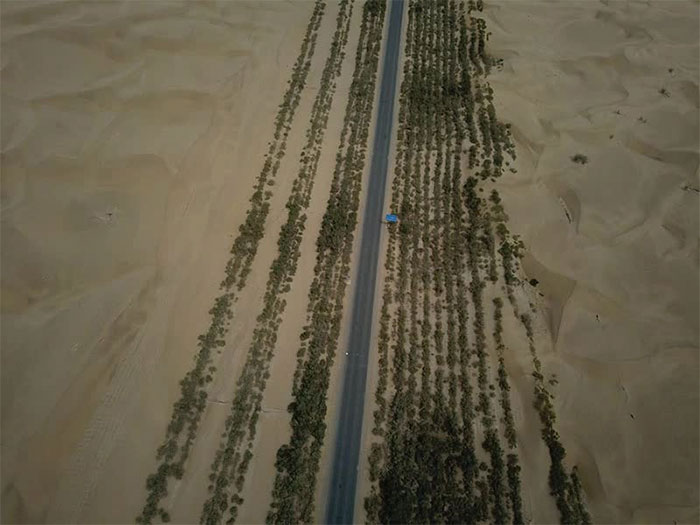
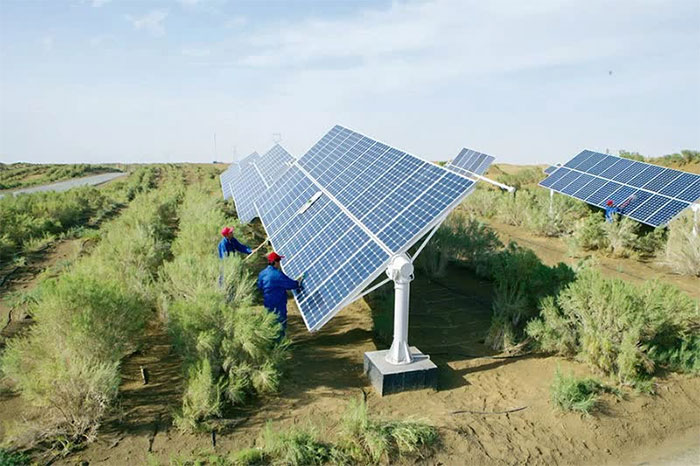
Solar generators are also equipped with energy storage devices, ensuring stable power supply and providing power for maintenance workers.
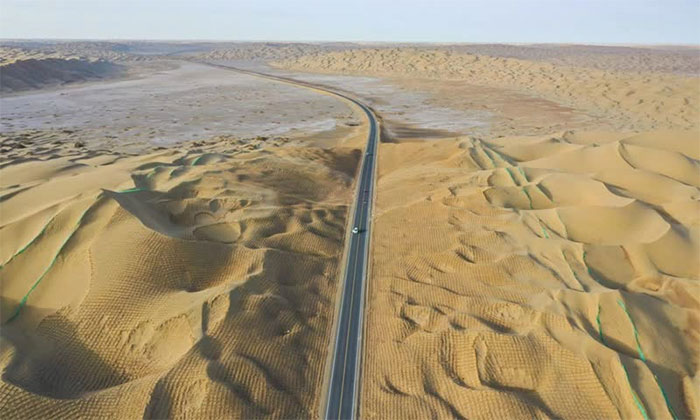
An aerial view shows a new highway passing through the Taklimakan Desert in northwest China's Xinjiang Uygur Autonomous Region, June 23, 2022. (Photo: Xinhua)
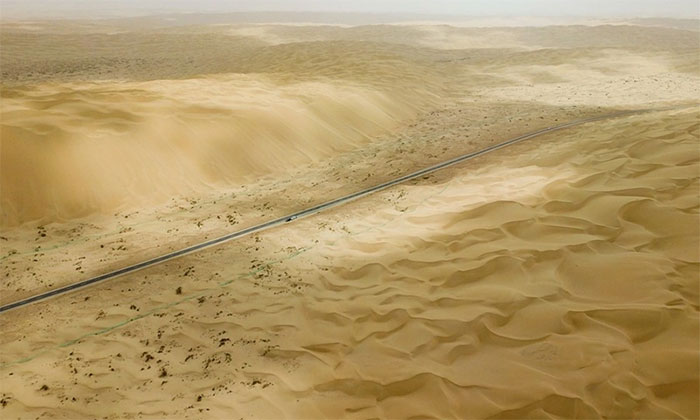
An aerial view shows a new highway passing through the Taklimakan Desert in northwest China's Xinjiang Uygur Autonomous Region, June 25, 2022. (Photo: Xinhua)
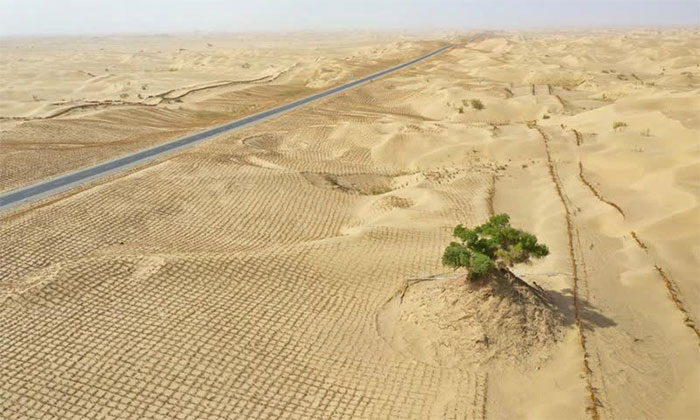
An aerial view shows a new highway passing through the Taklimakan Desert in northwest China's Xinjiang Uygur Autonomous Region, June 26, 2022. Photo: Xinhua
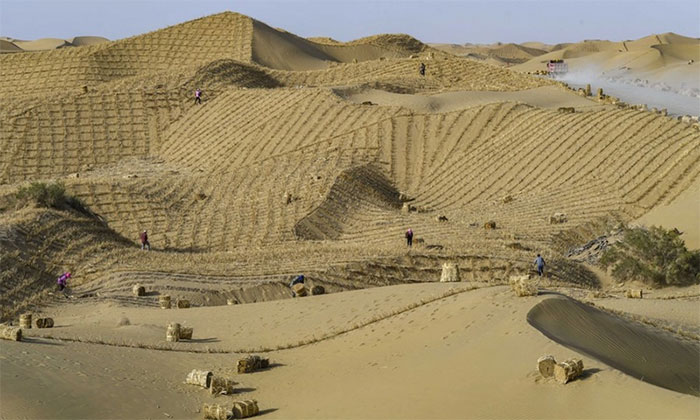
Workers lay grass nets along a new highway through the Taklimakan Desert in northwest China's Xinjiang Uygur Autonomous Region, July 13, 2018. (Photo: Xinhua)
Other routes
In addition to the main 500km-long desert highway, China has also built other desert highways to serve people's lives. Last year, the highway connecting Yuli County and Qiemo County - located in the south of Xinjiang's Bayingolin Mongolian Autonomous Prefecture, and the third road across the Taklimakan Desert - was put into operation.
With a design speed of 60 or 80 km/h for different sections, the highway has a total length of 334 km, with 307 km passing through the desert. To date, China has more than 1,200 km of highways crossing the Taklimakan Desert , the world's second largest shifting sand desert.
The expressway was built with an estimated total investment of about 1.75 billion yuan (about 261.5 million US dollars) and began construction in October 2017.
The expressway has shortened the journey between Qiemo County and the provincial capital Korla by about 350 kilometers. It is expected to effectively improve the situation of long travel distances, high living costs, and difficult-to-sell agricultural products.
Tursunjan Darman, 51, a local resident of Qiemo district, said that over the past few decades, the travel time from Korla to Qiemo has been shortened from three days to more than a dozen hours, and now it is just six hours.
Harsh weather conditions such as frequent sandstorms and limited access to water, electricity, communication signals and daily necessities have made building the highway across the desert a challenging task, said Wang Yunfei, project manager of China Communications Construction Company, which is undertaking the project.
Construction crews have leveled 32 high dunes and filled in 28 low-lying areas between the dunes, according to Mr. Wang. To prevent the highway from being buried by sand, contractors have installed 58 million square meters of grass nets and more than 900 kilometers of barriers along the road.
The opening of the expressway has boosted the confidence of businesses investing in areas along the route. A livestock company in Qiemo County has raised more than 6,000 cattle. "The road has saved nearly 1,000 yuan per cow in transportation and livestock costs, and we plan to invest another 500 million yuan to expand the scale of livestock farming ," said Guo Chengli, deputy director of the company.