"Lucy" is the name given by a group of scientists to an ancient human fossil unearthed in 1974, the skeleton of a human ancestor that provides important clues to the study of human evolutionary history. "Lucy" is also the name of a probe developed and launched by the US Space Agency (NASA) and has traveled a long way to discover Trojan asteroids orbiting Jupiter.
Its mission is to understand the origins of the Sun and planets like Earth, and provide clues to the Sun's evolutionary history in a larger pattern, so it plays a similar role. like the fossil skeleton "Lucy".
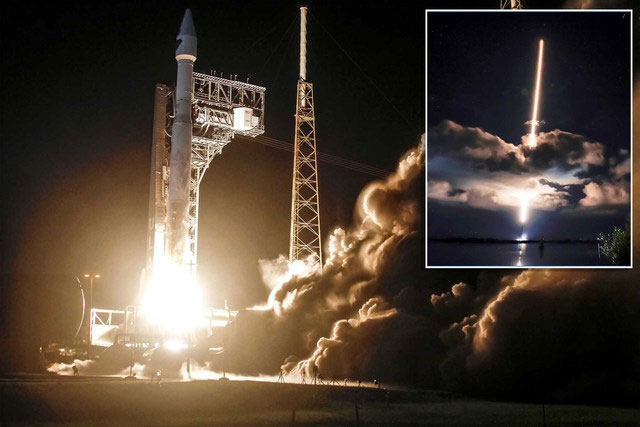
Lucy's mission is to find the "time capsule" of the Sun.
Lucy successfully made a long journey on October 16, 2021. Along the way, it will spend 12 years exploring alone in dark and deep space. According to NASA, its mission is to search for the "time capsule" of the Solar System.
Trojan asteroid group
Asteroids were first discovered in the orbit of Jupiter, where they are located at Jupiter's Lagrangian points. The so-called Lagrangian point is the gravitational equilibrium between the Sun and a planet. Each planet has five Lagrangian points, represented by L1~L5. Among them, L1 ~ L3 are on the junction of the two celestial bodies, and L4 and L5 are at the front and back of the planetary orbit.
As early as 1904, astronomers may have observed a few Trojan asteroids in Jupiter's orbit, but it went unnoticed at the time so it was not recorded. Since then, more and more asteroids have been discovered at the Sun-Mu Lagrangian points L4 and L5.
Jupiter's Trojan asteroids are distributed mainly on Jupiter's L4 and L5 points, which are symmetrically located 60 degrees in front of and behind Jupiter's orbit. As of September 2007, there are 2,239 confirmed Jupiter Trojan asteroids, of which 1,192 are in L4 and 1,047 in L5.
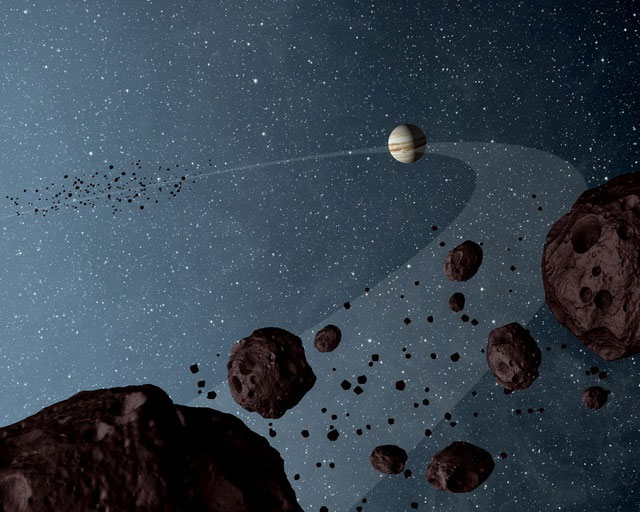
These are mainly asteroids left over from the formation of the Sun.
Trojan asteroids are named after Greek gods and goddesses. These are mainly asteroids left over from the formation of the Sun. According to NASA, there are two groups of Trojan asteroids orbiting the Sun in the same orbit as Jupiter, one ahead of Jupiter and one following - meaning Jupiter is in between the two groups along the way.
With further observations, astronomers found that the Trojan asteroid group phenomenon is not unique to Jupiter. Now, Earth has also discovered two such asteroids, one discovered in 2011, called 2010TK7; The other recently discovered asteroid, known as 2020XL5, is both located at position L4 of the Sun-Earth Lagrangian point.

Jupiter's Trojan asteroids are distributed mainly on Jupiter's L4 and L5 points.
Why are Trojan asteroids "time capsules" of the Sun?
All planetary systems are born around stars, and the birth of stars is caused by the contraction of huge clusters of nebulae (cosmic dust), the result of which the contraction is the birth of one or more stars in the core, and the remaining residues are adsorbed into planets and various minor bodies.
Scientific research suggests that Trojan asteroids are leftover debris from the formation of large planets, and are likely the basis for the formation of planetary satellites. Because the orbits of these asteroids or satellites would be disturbed and unstable, they could pose a threat to the planet. Some scientists believe that the Mars-sized planet that hit Earth 4.5 billion years ago may have been hidden at the Lagrangian point of Earth's orbit and crashed into Earth due to orbital perturbations. .
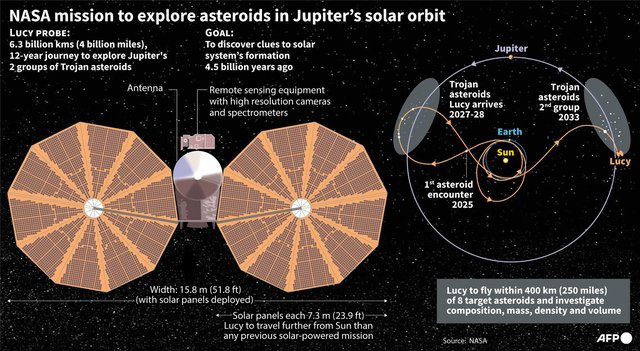
The Lucy probe is an asteroid probe developed by NASA.
Scientists call the planet that collided with Earth "Theia", which caused the Earth's axis to tilt, forming an angle of 23.44 degrees, from which the Earth has separate seasons of the year. Debris and matter that was thrown out into space after the impact condensed into the Moon, causing Earth to have larger tides.
Therefore, scientists believe that these Trojan asteroids are the product of the formation of the Sun and planets, or alternatively they are the earliest "fossils" of the Sun, " time capsule" of the Sun. In-depth analysis and understanding of such "time capsules" will allow us to better understand the past and present of the Sun.
As a result, Lucy was born, it took on the important human task of discovering where the Sun, Earth and humanity came from and where we are going in the future. Of course, this type of exploration is only a small piece in the overall exploration of the universe and nature. In the future, only by putting together all the small pieces of thousands of expeditions, we will be able to answer those questions that currently have no answers.
Lucy's specific quest
The Lucy probe is an asteroid probe developed by NASA. Its main mission is to investigate Jupiter's Trojan asteroid group. The total investment of this mission is up to 981 million US dollars, which sounds like a lot, but in fact it has been named the most "economical" mission in the history of NASA.
This is because Lucy's mission is very heavy, unlike previous asteroid probes, which only need to detect one or two asteroids, it has to check for 8 asteroids in a row. In this way, the cost per asteroid is just over 100 million US dollars, so it is called the cheapest interstellar expedition in history.
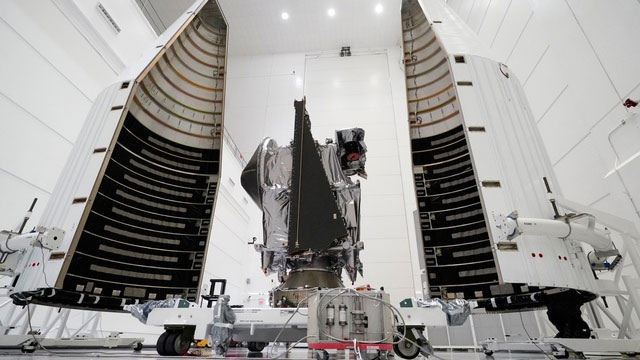
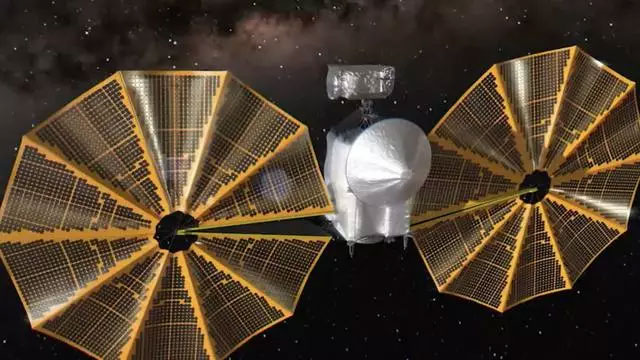
Lucy is equipped with two giant circular solar panels, with a total width of 14.25m.
The height of the Lucy detector is about 5 meters, the launch weight is about 1,550 kg and the dry weight is 821 kg. Lucy is equipped with two giant circular solar panels, with a total width of 14.25 meters and an effective area of 51 square meters when unfolded. Solar panels can receive 500 watts of power in the dim sunlight conditions of Jupiter's orbit, while Lucy only needs 82 watts of electricity to meet all normal needs.
During the 12 years of her mission, Lucy will accelerate through Earth's gravitational slingshot effect three times - the craft will re-enter Earth's orbit three times to receive gravity assistance during With acceleration and on track, it will eventually reach speeds of 560,000 kilometers per hour to enter Jupiter's orbit and drill into Jupiter's Trojan asteroid group.
After a second flight to accelerate, Lucy will go straight to the orbit of Jupiter.
Time of each boost lap:
- The first time in October 2022.
- The second time in December 2024.
- The third time in December 2039.
In fact, after the second flyby to accelerate, Lucy will go straight to the orbit of Jupiter. In April 2025, Lucy will perform the first asteroid discovery mission en route to Jupiter's orbit.
This asteroid, called Polymele, is not a Trojan asteroid in the orbit of Jupiter, but a member of the main belt of asteroids located between the orbits of Mars and Jupiter.
Lucy was launched into space from the coast of Florida, USA with an Atlas V 401 rocket at 5:34 on October 16, US Eastern time (16:34 on October 16 Vietnam time).