The intact mammoth corpse found in Siberia, Russia, may open up the hope of cloning this extinct animal.
>>>Restoring mammoths from corpses
The mammoth corpse was found in 2013, buried in frost in a remote area of Siberia. It is called Buttercup .
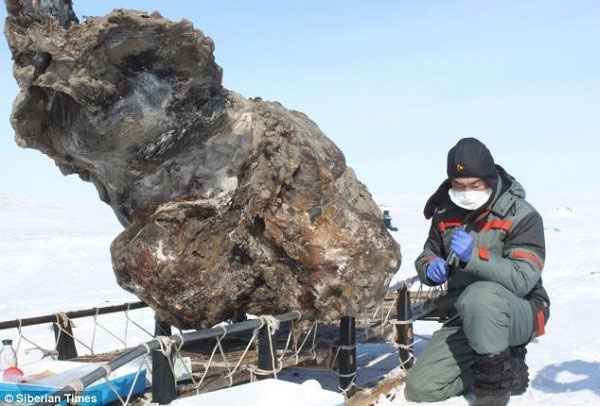
Buttercup mammoth remains found in Siberia, Russia, 2013. (Photo: Live Science)
During the search process, a team of experts from the Northeastern Federal University of Russia discovered two large tusks rising above the ground. Its body is almost intact with three legs, a head and an elephant. After thousands of years of being preserved under ice, the elephant meat is still fresh, with a dark red liquid that can be blood.
Based on Buttercup's well-preserved condition, the researchers determined it lived about 40,000 years ago and has a lifespan of 50 years. According to the ivory analysis, they assumed that Buttercup had 8 elephants. Its food is buttercup and dandelion. The mark on the mammoth bone indicates that it may have been trapped in a mire and attacked by wolves.
Live Science said the discovery could open up the hope of cloning and reviving mammoths. The analysis will be conducted to better understand Buttercup's life, and to determine whether its DNA is cloned. Previously, the DNA of other mammoth corpses was not intact enough to perform a human experiment.
Scientists believe that mammoths are extinct from more than 10,000 years ago, but some individuals still live until 1,650 BC.