A 12cm diameter meteorite plunged into the Moon, creating a 3 meter wide hole and 0.4m deep. The collision was reported on November 7 and has just been announced by the Space Environment Group at NASA's Marshall Flight Center.
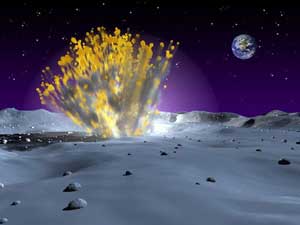
Simulation of collisions
The collision created a faint flash of light than the most faint star one could see with the naked eye. The brightness of the collision is only equivalent to a star with an apparent brightness of 7. That ability is a flash of a moving satellite that has been excluded.
Robert Suggs, team leader, and astronomer Bill Cooke checked star maps and used Moon photography software.
As a result, they identified the meteorite, which is certainly the Taurid - part of an annual meteor shower. This rain appeared at the time of the collision and experts thought that the rain was the remaining pieces of the Comke star.
This research work is of interest because NASA intends to return to the Moon. The agency needs to understand the Moon's collisions with meteors to protect future explorers as well as bases on it. The Earth's atmosphere evaporates most of the small meteorites, creating a brief flash of light. However, nothing prevents meteorites before they land on the Moon.
Minh Son (According to Space)