Some scientists hope to better understand the volcano's activity by learning how the circular smoke rings that hover above it form.
Some volcanoes can release circular rings of steam that fly near their mouths , the New York Times notes . These rings are usually short-lived.
Such phenomena have been spotted on volcanoes around the world, but it is unclear how they are created. Although the white smoke rings can stretch hundreds of meters, they are short-lived and unpredictable, making them difficult for scientists to study, National Geographic noted.
They are sometimes observed at volcanoes such as Etna in Italy and Eyjafjallajökull in Iceland. Now, researchers have found new clues about how gas bubbles create these strange phenomena at some volcanoes.
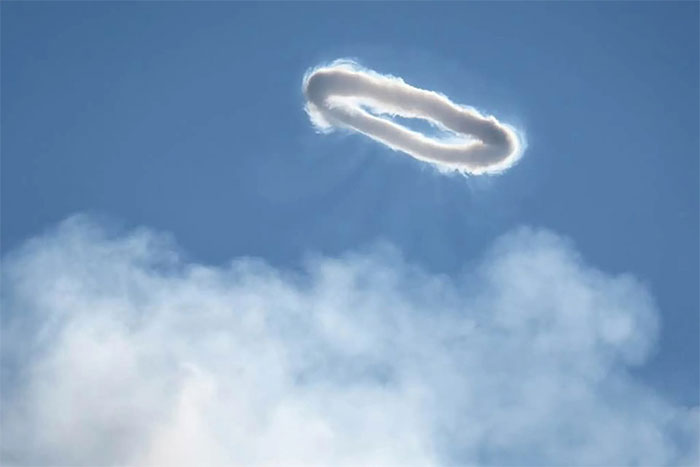
A ring-like smoke ring appears above the crater. (Photo: New York Times).
Blow smoke like a smoker
In addition, Simona Scollo, a volcanologist at the National Institute of Geophysics and Volcanology in Italy, said most research on volcanoes focuses on powerful eruptions that threaten human life.
However, 'we want to understand how volcanoes work, not just when they cause disasters for people or when they are very dangerous ,' she said.
So she and her team studied those ring-shaped smoke rings, which are typically associated with relatively mild volcanic activity. They published their findings last month in the journal Scientific Reports.
The New York Times points out the similarities between the way volcanoes produce these ring-like smoke rings and the way dolphins blow bubble rings or the way smokers exhale smoke. In the case of volcanoes, they are often called smoke rings , although they are actually made primarily of steam.
Despite their name, these smoke rings are not made of smoke. Instead, they are largely made of condensed gases, mostly steam, that are expelled from the volcano, said Boris Behncke, a volcanologist at Italy's National Institute of Geophysics and Volcanology.
Elements escaping from the volcano's crater (or smoker's mouth) slow down as they face the surface, causing the gas to rise on its own.
However, it is unclear exactly what happens inside a volcano to create smoke rings. And not all volcanoes produce such rings.
Dr. Scollo's team scoured the internet and studied footage to find steam rings caught on camera. The rings they found ranged in diameter from 9 to 198 meters and lasted for up to 10 minutes. The rings were usually white, sometimes tinged with gray or brown from ash.
Strong winds can prevent rings from forming or remain in place for a short time. On the other hand, rings—which are formed by a rich supply of volcanic vapor—can gradually drift skyward and begin to expand. Eventually, when most of the vapor has evaporated, the rings disappear from view.
In 2000, when Etna erupted with a series of ring-shaped plumes, Jurg Alean and Maro Fulle, two volcanologists at the observatory on the island of Sicily, told the BBC that the rings were most likely the result of rapid gas flows escaping from the volcano's narrow crevices.
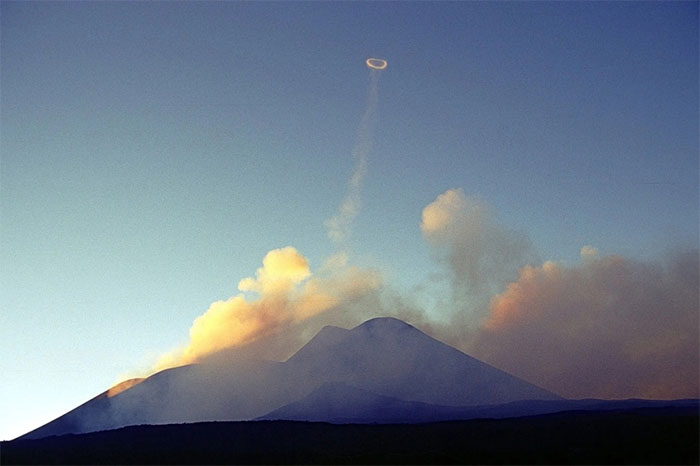
A ring of steam rises from a volcano in Italy in 2000. (Photo: New York Times).
The researchers modeled the possible movement of gas and bubbles inside the crater. For the steam rings to form, small gas bubbles must coalesce and rise through the magma to create pressurized pockets of gas.
When such bags explode, they can expel enough gas quickly enough to create a circular smoke ring.
However, the crater must also be circular or slightly concave. Craters that are more elliptical in shape are unlikely to form rings. If they were, the researchers said, they would distort or wobble the rings.
Combining photo and video observations with that model allowed the team to figure out the physical conditions needed to create smoke rings.
The Limits
David Fee, a volcanologist at the University of Alaska Fairbanks, believes that we can learn more about volcanoes by studying the conditions needed to create steam rings.
For example, the amount of steam that rises into a ring can tell you something about the volcano's magma. Volcanoes that release steam rings also have more fluid rock.
However, Dr Fee cautions there are limits to what smoke rings can reveal about volcanoes.
For example, when a volcano becomes dangerous, like St. Helens, which is constantly spewing gas and solid material in Washington, it doesn't create circular smoke rings, said Boris Behncke, of the Italian Institute of Geophysics and Volcanology.
Dr. Behncke has witnessed hundreds of smoke rings, including many at Etna during a period of intense volcanic activity.
In 2000, Mount Etna blew thousands of smoke rings over several months from one of its four craters.
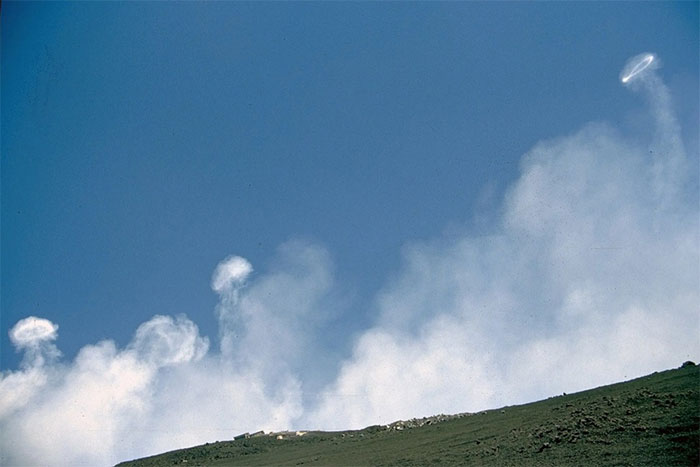
Smoke rings at Mount Etna in 2000. (Photo: New York Times).
'It's a most spectacular coincidence and unprecedented - neither on Etna nor on any other volcano. Sometimes you'll see five or six rings rising into the sky one after another ,' he said.
Dr. Scollo and her team hope to track these strange occurrences using high-speed cameras and devices that record the sounds of gas explosions. Perhaps capturing the rings as they appear won't be too difficult.
'It's something that happens in volcanoes probably more often than people think ,' said Dr Behncke.