The "King of Monsters" is destroying surrounding objects so violently that it is "dazzling" telescopes even though it is 240 million light years away.
According to SciTech Daily, the image that the NASA/ESA (US and European space agency) Hubble Space Telescope operating team just released is a spiral galaxy IC 4709 , with a "monster king" at its core.
This galaxy is located 240 million light-years away in the constellation Telescopium.
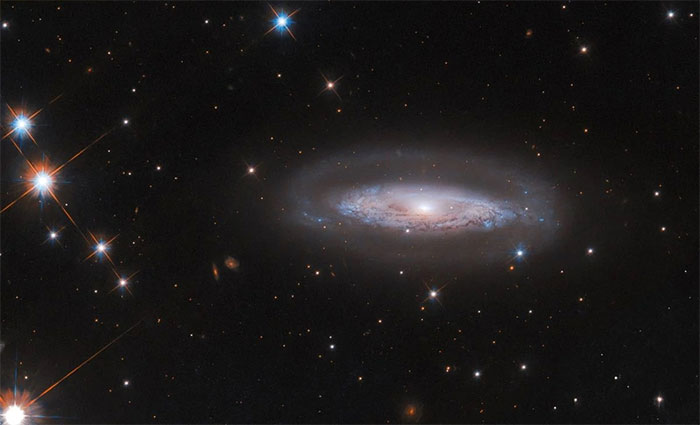
Galaxy IC 4709 with its heart is an incredibly large monster black hole - (Photo: NASA/ESA).
In the Hubble image, IC 4709 appears as a beautiful, swirling disk filled with stars, surrounded by a faint halo.
But the most noticeable thing is its glowing "heart" .
At the hearts of galaxies are supermassive black holes, commonly known as "monster black holes."
Our Milky Way galaxy, one of the largest in the universe, also has a monster named Sagittarius A* in its middle.
Sagittarius A* is already massive compared to black holes in the universe, with a mass of about 4.3 million Suns combined.
But the thing in the middle of the galaxy IC 4709 is the king of monsters: It weighs as much as 65 million suns.
Unlike the dormant "heart" of our galaxy, IC 4709's black hole is currently actively devouring the matter around it.
This creates a spiraling disk of gas around and eventually into the black hole, with the gas colliding with each other and heating up as it rotates.
The disc reaches such high temperatures that it emits large amounts of electromagnetic radiation, from infrared to visible light to ultraviolet and even X-rays.
To present the most beautiful image to the public, data from two Hubble surveys and from the Swift X-ray/UV telescope were combined.
Supermassive black holes at relatively "close" distances like this promise to help scientists learn more about black holes in more distant galaxies, as well as about the evolution of the universe in the past.