NASA's "exoplanet hunter" TESS has discovered two large and unusual worlds in the constellation Draco, one of which is the longest-orbiting exoplanet ever confirmed.
According to SciTech Daily, the surprising discovery came from a red dwarf star named TOI-4600 , about 815 light-years from Earth.
A team of scientists from NASA, the Massachusetts Institute of Technology (MIT) and the University of New Mexico (USA) has analyzed in detail data from the Transiting Exoplanet Survey Satellite (TESS), a NASA spacecraft carrying an observatory specializing in hunting for worlds outside the solar system.
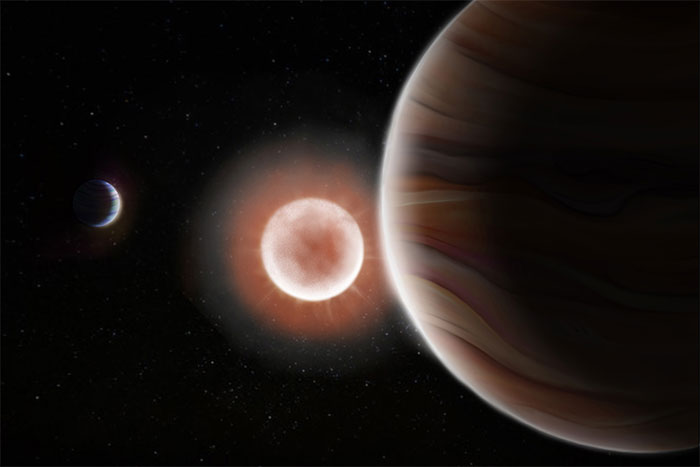
Red dwarf star TOI-4600 and the two "gas giants" it harbors - (Graphic: Tedi Vick).
Around a celestial body that is much smaller and "colder" than the Sun, they were amazed to witness something like a "giant world", much larger than the gas giant Jupiter - a planet with a radius 11 times larger and a mass 318 times that of Earth.
The first member of the "giant world" around TOI-4600 is TOI-4600b , which has a radius 6.8 times larger than Jupiter and an orbital period around its parent star of 83 days.
The outer planet is TOI-4600c, which has a radius 9.4 times that of Jupiter and a massive orbital period of 483 days. This is the exoplanet with the longest orbit ever known.
Preliminary data suggests they may be gas giants – like Jupiter – but their interiors may be a mixture of gas and ice.
They seem to bridge the gap between 'hot Jupiters' and the 'original' Jupiter in our own star system, a cold giant. This is the first time TESS has found a star system where both hot and cold Jupiters coexist.
The outer planet has a super cold temperature of minus 82 degrees Celsius, while the inner planet is more temperate at 74 degrees Celsius.
Following the above results, which were recently published in Astrophysical Journal Letters, the authors said they will seek to go deeper into the mysterious space surrounding TOI-4600.
Co-author Dr Ismael Mireles from the University of New Mexico revealed that they suspect the two giant worlds are hiding several smaller planets, either in between or around them.