A recent study has shown that Earth has a new "Moon", or more precisely, a quasi-new Moon .
The Moon is a celestial body that orbits the Earth, but is bound by the Sun's gravity.
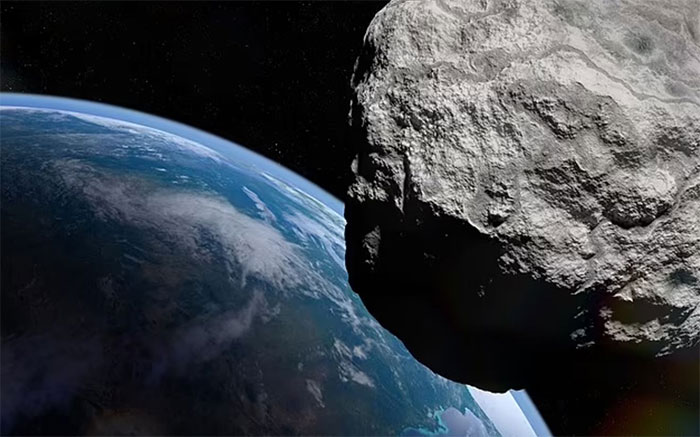
Astronomers have discovered a new "half-moon" of Earth. (Illustration: Shutterstock)
The moon, named 2023 FW13, was discovered by experts using the Pan-STARRS telescope located on the summit of the Haleakala volcano in Hawaii. It is one of the few known moons.
Experts believe this cosmic 'companion' has been near Earth since 100 BC and will continue to orbit our planet for at least another 1,500 years, until 3700 AD.
Fortunately, neither 2023 FW13 nor a similar quasi-moon named 469219 Kamoʻoalewa pose a danger to humans on Earth.
Semimoons, also known as quasi-satellites, typically orbit the Earth just like our natural satellite, the Moon.
But they are called 'semi' because they are gravitationally bound to the Sun rather than the Earth, in contrast to the natural Moon.
2023 FW13 differs from a natural Moon because it orbits outside Earth's Hill sphere. The Hill sphere is the region around a planet where its own gravity is the dominant force attracting satellites.
Earth's Hill Sphere has a radius of 1.5 million km, while 2023 FW13's radius is slightly larger than Earth's, at about 2.57 million km.
That distance is equivalent to 0.18 astronomical units, so large that the Earth plays essentially no role in the motion of this quasi-Moon.