Researchers have identified a new speed limit for the most extreme collisions in the universe.
According to a study published in the journal Physical Review Letters, the 'maximum possible retracement speed' when black holes collide exceeds a staggering 102 million kilometers per hour – about 1/10 the speed of light.
Next, the researchers hope to mathematically demonstrate that this velocity cannot be exceeded by using Einstein's equations of relativity, raising potential implications for fundamental laws of physics.
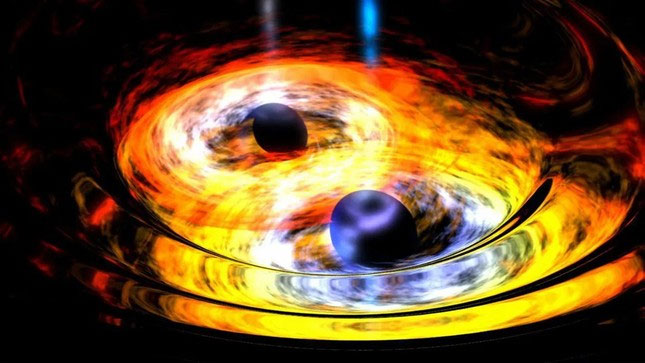
According to the study's authors, this climax occurs when the collision conditions at the tipping point between two black holes either merge or disperse as they approach each other.
Co-author Carlos Lousto, a professor of mathematics and statistics at the Rochester Institute of Technology (RIT) in New York, said: "We're just scratching the surface of what may be a more universal description. This newly discovered speed limit may be part of a larger set of physical laws that govern everything 'from the smallest to the largest objects in the universe'."
When two black holes pass close together, they will merge or change direction around their common center of mass before flying away from each other. Whether the black holes fly away from each other or spiral into each other depends on how far apart they are at their closest point of approach.
To determine the maximum possible recoil speed of black holes flying away from each other, Lousto and study co-author James Healy, a research associate at the RIT School of Mathematics and Statistics, used supercomputers to run numerical simulations. These calculations applied equations of general relativity that describe how two interacting black holes would evolve.
Lousto explained that, although attempts to solve these equations numerically began more than 50 years ago, the numerical techniques for predicting the size of gravitational waves from such collisions were not developed until 2005, just 10 years before gravitational waves were first detected by the Laser Interferometer Gravitational-Wave Observatory (LIGO).
Since then, LIGO has observed nearly 100 black hole collisions. Comparing the data from such a collision with numerical relativity data reveals that the black hole's orbit is "eccentric" or elliptical.
Previously, scientists thought that black holes approaching each other would spiral towards each other in nearly circular orbits. The discovery of elliptical orbits has broadened the range of possible collision events and spurred them to search for extreme collision scenarios.
Imre Bartos, Associate Professor in the Department of Physics at the University of Florida, USA, said: "The recoil of black holes after they merge is a crucial part of their interaction." This interaction is particularly significant for places in the universe with high black hole densities, as large recoils can completely expel any remaining black hole from the area.
New fundamental physics
According to Lousto, the 'critical point' that determines whether two colliding black holes will merge or recoil could lead to a slight change in the black holes' orbits.
For this reason, Lousto likens the interaction to a smooth phase transition, similar to the second-order phase transitions of magnetism and superconductivity, in contrast to the explosive first-order phase transitions of hot water, for example, in which a finite amount of latent heat is absorbed before it boils.
The researchers also glimpsed what might resemble the characteristics of the scaling factors of these phase transitions, although more high-resolution simulations are needed to definitively identify these factors.
However, these aspects of the results suggest the possibility of an 'overarching principle' that applies across all scales, from atoms to colliding black holes, Lousto said.