An X-ray-emitting star located in the Messier 82 galaxy about 12 million light-years from Earth is so bright it breaks the laws of physics.
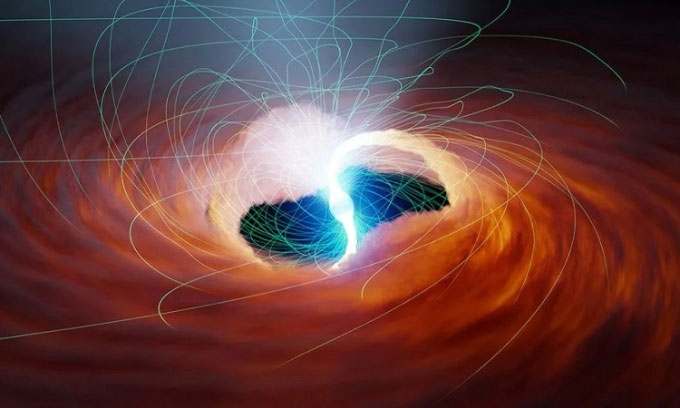
Simulation of a super-luminous X-ray-emitting neutron star with an extremely strong magnetic field. (Image: NASA/JPL-Caltech).
Astronomers call such rule-breaking objects ultraluminous X-ray sources (ULXs), and they emit energy 10 million times that of the Sun. This level of energy exceeds a physical law called the Eddington limit (the Eddington limit is estimated to be about 150 times the mass of the Sun, according to Nature), which states that an object's brightness is limited by its size. If an object breaks the Eddington limit, researchers predict it will explode into pieces. However, ULXs typically exceed this limit by 100 to 500 times, leaving scientists baffled, according to NASA.
New observations published in the Astrophysical Journal from NASA's Nuclear Spectroscopic Telescope Array (NuSTAR), which looks at the universe in high-energy X-rays, have confirmed that a particular ULX called M82 X-2 is so bright. It was previously thought that the extreme brightness could be some kind of optical illusion, but the results of the study prove that this hypothesis is incorrect and that M82 X-2 actually challenges the Eddington limit, Live Science reported on April 11.
Astronomers once thought ULXs might be black holes, but M82 X-2 is a neutron star . Neutron stars are the dead, leftover cores of stars like our sun. They are so dense that the gravity on their surface is 100 trillion times stronger than on Earth, meaning any matter pulled toward the dead star's surface would have explosive effects. For example, a marshmallow dropped on the surface of a neutron star would hit it with the energy of 1,000 thermonuclear bombs.
New research has found that M82 X-2 consumes about 1.5 Earths worth of matter from its neighboring star every year . When this material hits the star's surface, the force of the impact produces the brightness the team observed. They say this is evidence that something is causing M82 X-2 to break the Eddington limit. Their current theory is that the neutron star's intense magnetic field changes the shape of its atoms, allowing the star to stay the same even as it grows brighter.
"The observations allow us to understand the effects of extremely strong magnetic fields that we can never simulate on Earth with current technology," said study leader Matteo Bachetti, an astrophysicist at the Cagliari Observatory in Italy.