Luna-25, Russia's first lunar lander launched into space on August 11, has sent back the first images from outer space .
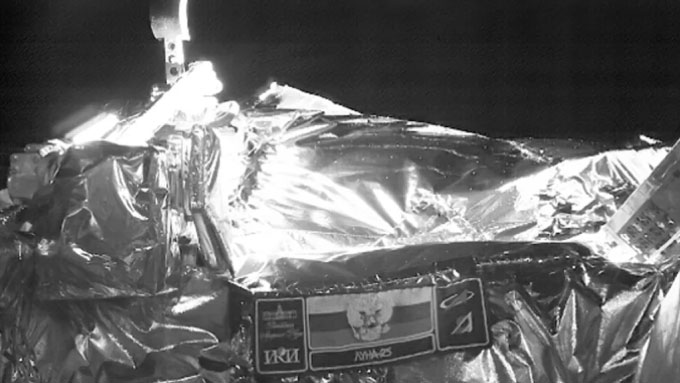
The image, taken by Luna-25 on August 13, shows the mission emblem (center) affixed to the spacecraft. (Photo: IKI RAS)
The Luna-25 spacecraft launched at 7:10 PM local time on August 10th (6:10 AM on August 11th Hanoi time) on a Soyuz-2.1b rocket from the Vostochny cosmodrome in the Amur region of Russia. This is the first domestically produced probe to be launched to the Moon in modern Russian history. Prior to this, Russia's closest lunar mission was Luna-24, launched in 1976 and returning approximately 170 grams of sample material.
Luna-25 captured its first images on August 13th , and these were published by the Space Research Institute of the Russian Academy of Sciences (IKIRAS) on August 14th. The black-and-white images show the Russian flag, the mission's symbol, on the spacecraft's hull, with the Earth and Moon shining brightly against a dark backdrop of space in the distance.
These images were taken from a distance of approximately 310,000 km from Earth, according to IKI RAS. For comparison, the average distance between the Moon and Earth is 384,400 km.
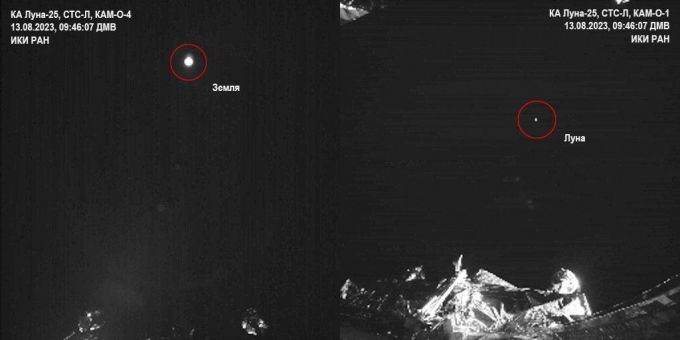
The Luna-25 spacecraft photographed Earth (left) and the Moon (right) from a distance of 310,000 km from Earth. (Image: IKI RAS).
New images have helped allay concerns about Luna-25 after launch, proving the spacecraft is functioning well and is on its way to its destination. "All of the spacecraft's systems are operating normally, communication with control remains stable, and the energy balance is very positive," IKI RAS stated.
If all goes according to plan, Luna-25 will reach its destination in mid-month, then orbit the Moon for 5-7 days. From there, the spacecraft will attempt to land near one of three craters around the Moon's south pole. The spacecraft is designed to operate for at least a year.
While operating on the lunar surface, Luna-25 will analyze soil and rocks, search for water ice, and conduct experiments on the celestial body's thin atmosphere. The lander carries eight scientific instruments, including a laser mass spectrometer and a device that can fire at soil and rock samples, then examine the resulting dust and fumes for chemical analysis.
Luna-25 is just one of a series of missions around the world aimed at studying or landing near the Moon's south pole. South Korea launched the KPLO spacecraft in August 2022, carrying NASA's ShadowCam camera to search for water ice near the south pole. India's Chandrayaan 3 spacecraft entered lunar orbit on August 7th and is expected to land near the south pole on August 23rd. NASA's Artemis program aims to land humans near the Moon's south pole as early as 2025, with the Artemis 3 mission.