One of Saturn's moons, which resembles the "death star" from Star Wars due to its cratered surface, hides an ocean underneath.
According to Sputnik (Russia), analyzing data from the Cassini spacecraft orbiting Saturn from 2004 to 2017, researchers have recorded small changes in the orbit of Mimas - the smallest and innermost moon of Saturn's eight main moons. The new discovery was published in Nature Magazine.
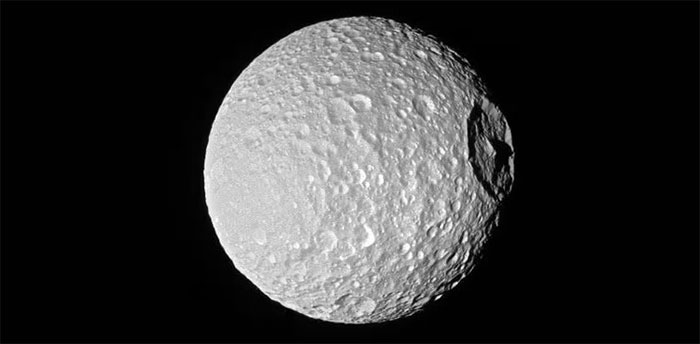
Saturn's moon Mimas.
Mimas's motion and rotation patterns around Saturn suggest the presence of a newly formed ocean inside this moon. The ocean is believed to be in a state of development.
'If you look at the surface of Mimas, there is nothing that would reflect a hidden ocean underneath. That is the most unlikely hypothesis so far,' said Valery Lainey, an astronomer at the Paris Observatory in France.
Mimas is Saturn's smallest moon, with a radius of about 198km . The team was surprised to find evidence of water beneath the moon's icy surface, but further studies of its orbit suggest the possibility of a deep ocean some 20 to 30km deep.
According to scientists, the Mimas ocean may have developed only within the last 2 to 3 million years.
Mimas' orbit lies within the orbits of Saturn's larger moons Enceladus and Titan.
Jupiter's moons Europa and Ganymede are also among the solar system objects with significant potential reserves of water, making them among the top "candidates" for the formation of life in our solar system.
' The existence of a recently formed liquid water ocean makes Mimas a prime candidate for scientists' investigation into the origin of life, ' explains Nick Cooper, co-author of the study and an astronomer in the Department of Physical and Chemical Sciences at Queen Mary University of London .
The 'red planet' - Mars is an ideal destination for the search for extraterrestrial life because it is similar to our planet.
ESA's Jupiter Icy Moons Explorer (JUICE) spacecraft is embarking on a new mission to see if those planets could support life. After Cassini's mission around Saturn ends, scientists have plans to send another spacecraft there, specifically to explore Enceladus. But that mission is unlikely to happen anytime soon.