If you lived in ancient Greece, you would have witnessed cousin weddings on a regular basis.
An international team of researchers analyzing the genomes of ancient human remains has discovered that, unlike in other European societies during this period, cousins in Minoan Crete and Mycenaean Greece often intermarried.
Experts from the Max Planck Institute for Evolutionary Anthropology in Leipzig, Germany, together with an international collaboration, analyzed more than 100 genomes of Bronze Age people from the Aegean.
The research, published on January 16 in the scientific journal Nature Ecology & Evolution, said their findings provided 'interesting insights' into the social order of the Aegean Bronze Age.
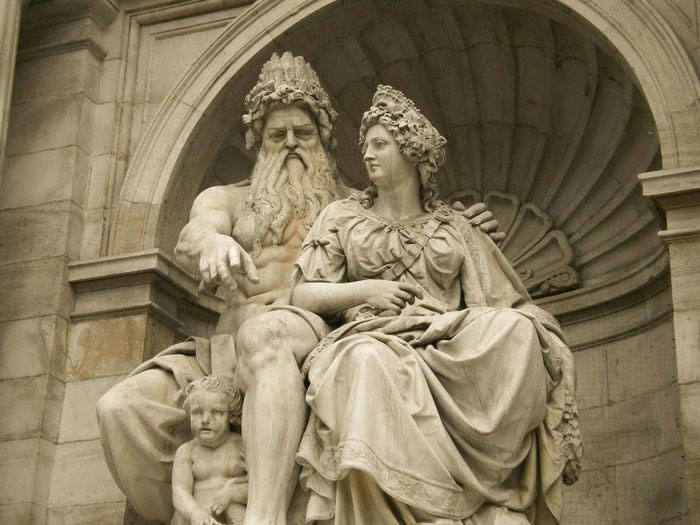
Zeus and Hera are said to be brothers.
By analyzing the DNA of people buried in a tomb under a house courtyard in a Mycenaean village, researchers were able to reconstruct the family tree of its residents from the 16th century BC.
'We wanted to find out how genetically related people who were buried together were and what you can learn about the relevance of genetic relativity to the structure of society,' archaeology professor Philipp Stockhammer, one of the study's lead authors, told CNN.
'We are trying to build the first family tree for the Mediterranean. We can tell who lived together in this house by looking at the people buried in the yard.
For example, we can see that three adult sons lived in this house. One of the daughters-in-law brought her sister and a child to live with her. It was a very complex group of people living together'.
Even more surprising was the discovery that about half of the people living on the islands marry their cousins , compared to about a third on the mainland.
'People have studied thousands of ancient human genomes and there is virtually no evidence that past societies had cousin marriage , ' says Stockhammer. 'From a historical perspective, this is really striking.'
Stockhammer and his colleagues believe that such marriages were driven by economic reasons , to prevent the division of family land. 'The whole motivation is to consolidate land within the family,' he explains. 'If you look at what people are growing, it's grapes and olives. To grow both grapes and olives, you can have to settle in one place for decades. And if you marry into your family, it means you choose to stay in the same area.'
He also argues that, by contrast, in other parts of Bronze Age Europe women married hundreds of miles away, explaining that those areas were often more prosperous.
'In Greece, there's not much space to grow crops and what you grow takes decades to grow. We can definitely see first cousin marriage from the genetic evidence,' he said .
Stockhammer explains the significance of the discovery: 'With this knowledge, we are fundamentally forced to rethink the social organisations of this period and the societies behind these great works of art and architecture. It is a society whose superstructure we have written a lot about, but now we can say something more about the lower classes.'
