The average distance between Earth and the Sun is increasing, with the leading suspicion being that our parent star is becoming less dense .
The distance between the Earth and the Sun is not constant due to their elliptical orbits, but for many years scientists have calculated the average distance to be 150 million kilometers, according to NASA. However, this number is changing, gradually increasing over time.
According to Live Science , the two leading causes cited by scientists are either the Sun losing mass, or a similar force related to Earth's tides.
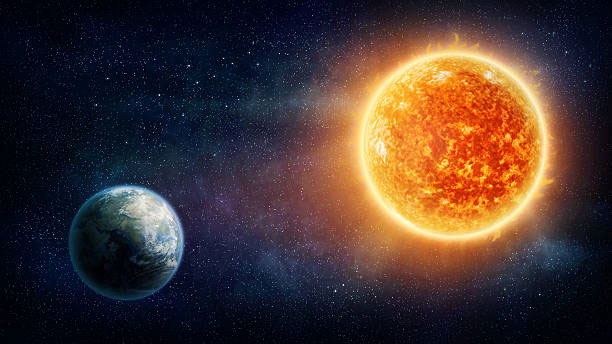
Is Earth gradually drifting away from its parent star? - (Illustrative image from iStock)
According to NASA, our parent star has only about 5 billion years left to live. During that remaining time, models of how stars evolve suggest it will lose about 0.1% of its mass before dying.
Astronomer Brian DiGiorgio from the University of California, Santa Cruz, explains: "The 0.1% figure is actually very large for the Sun's mass. This 0.1% is equivalent to the mass of Jupiter, which is 318 times the mass of Earth."
The gravitational pull of a celestial body is directly proportional to its mass, so it is very likely that the gravitational pull from the parent star has decreased, causing Earth to drift further away.
According to Britt Scharringhausen, associate professor of astrophysicism from Beloit University in Wisconsin, USA, the Sun rotates on its axis approximately once every 27 days, not in harmony with the Earth's 365-day rotation. This, combined with the Earth's own gravitational interaction, creates a peculiar tidal bulge that gradually bends the planet's orbit away from its parent star.
However, this effect is minimal, only enough to cause the Earth to move 0.0003 cm/year, so the weakening of the parent star remains the primary cause.
The Earth's drift away from its parent star is not thought to have a major climate impact. Over the next 5 billion years, the distance will increase by 0.2%, corresponding to a 0.4% reduction in solar energy reaching Earth. But this is small compared to the seasonal variations created by Earth's elliptical orbit.
The apocalypse can only truly occur in another 5 billion years, when the Sun enters its death throes – a rapidly growing red giant before collapsing. At that time, the heat radiating onto Earth will increase rapidly, causing the oceans to boil and life to be at risk of extinction.
- Portrait of the Russian mathematical genius Gtigori Perelman: Dubbed the smartest person in the world.
- Top 6 superfood crops that will help humanity fight hunger in the future.
- A type of fuel has suddenly "re-emerged" amidst the global energy crisis.