Scientists have discovered a new secret about how Leonardo da Vinci painted his mysterious masterpiece, the Mona Lisa.
See also: Has the 'most controversial' mystery in the Mona Lisa painting been solved?.
In October 2023, a groundbreaking new study was published in the Journal of the American Chemical Society, demonstrating Leonardo da Vinci's genius in creating the Mona Lisa masterpiece.
A team of scientists and art historians in France and Britain have discovered that Leonardo used his own special chemical formula on the base layer of the Mona Lisa painting.
"He was an experimentalist and each of his paintings was technically completely different. In this case, it's interesting to see that there was actually a specific technique for the Mona Lisa's base," said Victor Gonzalez, lead author of the study and a chemist at France's leading research institute, CNRS.
Gonzalez has studied the chemical composition of dozens of works by Leonardo, Rembrandt and many other artists.
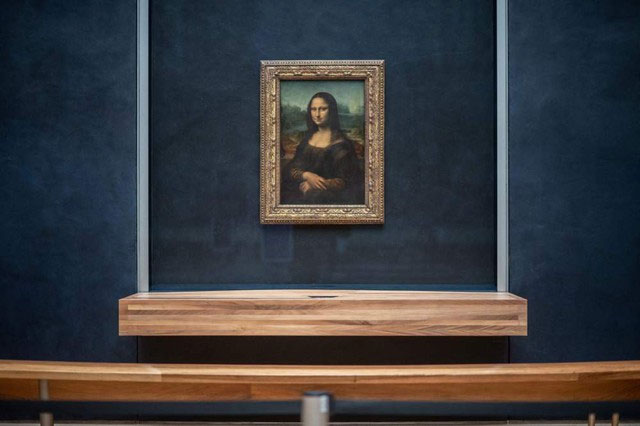
The Mona Lisa painting at the Louvre Museum.
Researchers have found a rare compound, plumbonacrite , in a fragment of the first layer of the iconic work, confirming art historians' suspicions that Leonardo used lead oxide powder to thicken and help dry the paint.
According to the study, the paint streak from the base layer of the 'Mona Lisa' painting that the researchers analyzed was barely visible to the naked eye because it was only the diameter of a human hair and originated from the upper right edge of the painting.
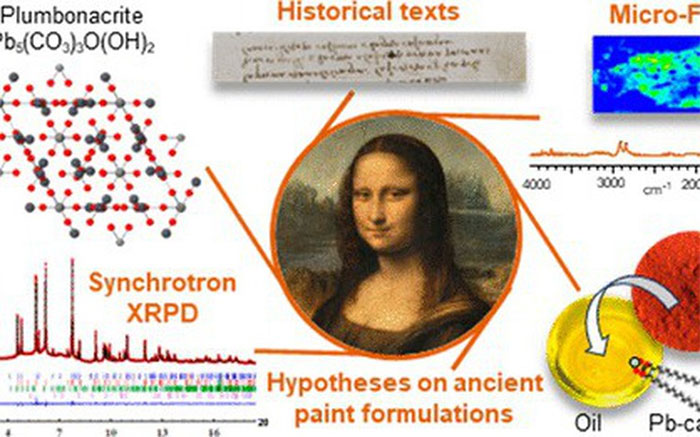
Scientists found traces of plumbonacrite, a byproduct of lead oxide, in da Vinci's painting.
Using a synchrotron accelerator , a large machine capable of accelerating particles to nearly the speed of light, the researchers analyzed the chemical composition of the fragment at the atomic level.
The study found plumbonacrite, a byproduct of lead oxide , which helped the researchers confirm with greater certainty that Leonardo may have used the powder in his homemade paint mixture.
'Plumbonacrite is really the hallmark of his formula, ' Gonzalez said. 'This is the first time we've actually been able to confirm it chemically.'
Gonzalez said the chemical was also found in Rembrandt's works, which he completed in the Netherlands in the 17th century.
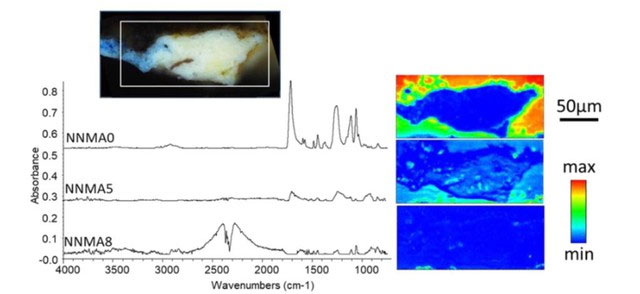
The piece of paint the scientists analyzed was only about the diameter of a strand of hair.
The discovery 'also tells us that those recipes have been passed down through the centuries' and 'it's a very good recipe', he said.
It is thought that Leonardo dissolved orange-coloured lead oxide powder in linseed or walnut oil by heating the mixture to form a thicker, faster-drying paste.
'What you end up with is a very beautiful golden oil,' says Gonzalez. 'It flows like honey.'
For centuries, the Mona Lisa has fascinated those who have seen it because of its subject's enigmatic smile and cold gaze. The Mona Lisa is believed to be Lisa Gherardini, the wife of a Florentine silk merchant, according to the Louvre Museum in Paris, where the painting has been kept since the 18th century.
Even after this groundbreaking discovery, there are still many secrets hidden in Leonardo's works, Gonzalez said.
'We're just scratching the surface,' Gonzalez said. 'What we're talking about is just a small brick in the knowledge.'