Scientists have discovered the most powerful cosmic rays ever recorded, likely originating from mysterious sources relatively close to Earth.
Related reading: Discover the origin of cosmic dust on Earth.
According to Science Alert , these cosmic rays - consisting of electrons and their antiparticles, positrons - were observed at energies of up to 40 teraelectronvolts (TeV) , which is 40,000 times higher than the energy of visible light.
The High Energy Satellite System (HESS) in Namibia detected the rays. Because their energy diminishes as they travel through space, rays of such high energy can only be detected if the source is close to Earth.
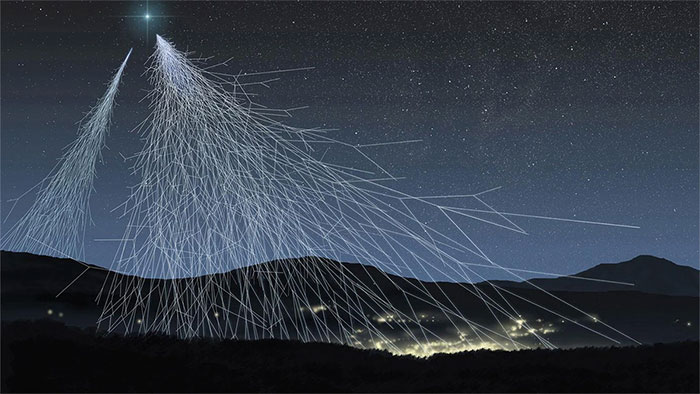
Cosmic rays have become an interesting topic of study for many scientists in recent years - (Photo: UCHICAGO NEWS).
However, exactly what created them remains a mystery. The research results were published in the journal Physical Review Letters on November 25.
"This is an important result, because we can conclude that the cosmic ray electrons (CRe) measured are likely to originate from a small number of sources in the vicinity of our Solar System, with a maximum distance of only a few thousand light years - a very small number compared to the size of the Milky Way galaxy, which is about 100,000 light years wide," said Dr. Kathrin Egberts, head of the astrophysics group at the University of Potsdam (Germany).
Cosmic rays are high-energy particles produced by the Sun, supernova explosions, rapidly rotating neutron stars (pulsars) , and other unidentified sources.
When these rays collide with the Earth's upper atmosphere, they create showers of particles that can be detected on the Earth's surface. However, reconstructing the original cosmic rays that created these showers is a complex and somewhat uncertain task.
To find the cosmic ray electrons, the researchers used the HESS observatory, which consists of five 12-meter-tall telescopes located on the Khomas Plateau in Namibia.
For more than a decade, these telescopes have been scanning the atmosphere for traces of Cherenkov radiation—a faint blue glow created when particles move faster than the speed of light in a medium that slows it down. The phenomenon is similar to the sonic boom created when an airplane passes above the speed of sound.
By observing this light and using sophisticated algorithms to filter out noise, scientists have created an unprecedentedly detailed energy spectrum for cosmic rays reaching Earth.
The amount of these cosmic rays drops significantly at higher energies – which suggests that small space telescopes are unlikely to detect them in large enough numbers.
The presence of particularly high-energy particles has indicated that at least some of these cosmic ray sources are located close to our planet.
'The extremely low flux at the upper TeV energy limit has limited the competitiveness of space missions in this measurement ,' stressed Mathieu de Naurois, a researcher at the French National Center for Scientific Research (CNRS).
"Our measurements therefore not only provide data in an important and previously unexplored energy range, helping to better understand the Earth's vicinity, but also have the potential to become a reference standard for many years to come," he added.