Three ghostly images showing the 13.3 billion-year-old "face" of an "ancestral" object have reached the lens of the James Webb telescope, a super telescope operating in Earth orbit.
A research team led by Dr Guido Roberts-Borsani from the University of California, Los Angeles (UCLA), used data from the James Webb Space Telescope's NIRSpec near-infrared spectrometer (developed and operated by NASA) to find the ancient dwarf galaxy JD1.
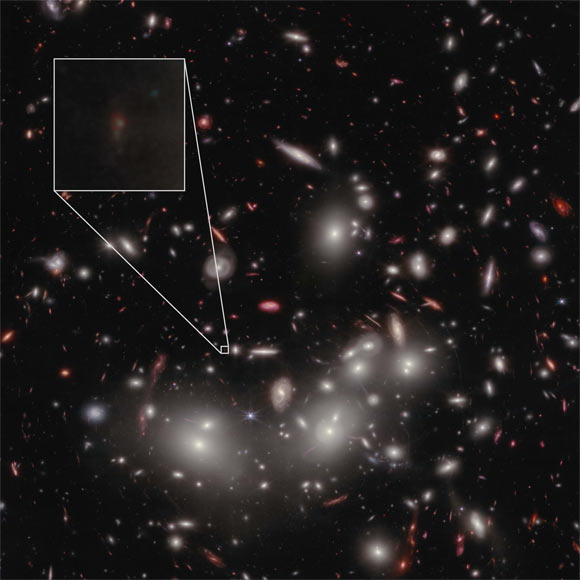
One of the "faces" of the aging object JD1, magnified by Abell 2733 - (Image: NASA/ESA/CSA).
Research results recently published in the scientific journal Nature show that the images that James Webb recorded from this galaxy were images when the universe was only born 480 million years , that is 480 million years after the Big Bang.
The fun gets even more interesting when we can see not just one but three JD1s from Earth's perspective, due to the "gravitational lensing" effect , where closer space objects bend space-time, causing the objects to be duplicated.
One of the gravitational lenses involved in the event is the giant galaxy Abell 2733 , which is 350 million light-years across and about 4 billion light-years away.
This effect also makes the JD1 appear larger and clearer, as if viewed through a magnifying glass, allowing James Webb to detect it despite its rather transparent and opaque appearance.
JD1 is a small galaxy compared to the entire Milky Way galaxy that contains Earth, but it is still a formidable giant compared to the tiny body we live in. All the more remarkable given that it formed in a poor early universe.
This image also traveled a distance of 13.3 billion light years to Earth - which also took more than 13.3 billion years in time - a true time-traveling image that helps humanity look directly into the early universe.
'"The combination of James Webb and the magnifying power of gravitational lensing is revolutionary. We are rewriting the book on how galaxies form and evolve shortly after the Big Bang," said co-author Professor Tommaso Treu from UCLA.
The new discovery promises to unravel many details about how the universe evolved and how our planet came to be, the product of a universe enriched in chemistry by generations of stars and planets in ancient galaxies that formed and collapsed.