An Earth twice as large is impossible, because astronomers have just found a dead planet desert .
Rocky planets outside our solar system that possess similar conditions to Earth have been found in the universe, but fewer than expected because exoplanets of that size are often too small and dim to observe.
A more feasible size for study – twice the size of Earth – has never been found. A team of scientists from Rice University in Texas, the University of California at Los Angeles (USA) and the Max-Planck-Königstuhl Institute for Astronomy (Germany) found an explanation in a study recently published in The Astrophysical Journal Letters.
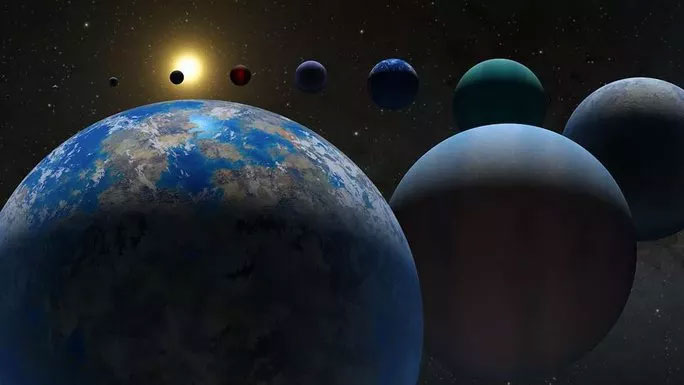
Scientists have just found the reason for the absence of some expected planets - (Photo: NASA/JPL-Caltech)
Based on the massive data gathered by telescopes around the world, they built a spectacular planet formation model that shows a widespread migration of young planets.
This has been suggested in studies of the Solar System, with the most likely migrant being Jupiter : Approaching the Sun in its early days, it contributed to the formation of small planets between it and the Sun, including Earth.
But new supercomputer simulations also show that the inward migration of planets into the giant disk of dust and gas of a protostar system has a catastrophic consequence: Planets collide, kill each other—and, if lucky, coalesce into new worlds.
"The migration of young planets towards their parent stars creates an overload and often leads to catastrophic collisions that strip the planets of their hydrogen-rich atmospheres," said Dr Andre Izidoro from Rice University in Texas, a member of the research team.
Citing the research, Space magazine said the process transformed the worlds into two types of planets: One group of rocky planets is about 1.4 times the size of Earth or smaller; the other group is small Neptune-like gas planets, with a radius 2.4 times that of Earth or more.
The small ones are planets that are stripped of their hydrogen-rich atmospheres and become rocky planets, the large ones are lucky enough to escape, although they probably also collide, but their atmospheres are thick enough to remain gaseous planets.
Our Earth may have come into being this way, with the now well-established theory being that a collision 4.5 billion years ago between a different early Earth and a Mars-sized planet called Theia ejected a mass of material that later coalesced into the Moon.
But clearly, despite its deadly beginnings, Earth is still habitable.
The new research also shows that the separation of the two distinct planet types and the creation of a "death desert" - a region completely devoid of planets between 1.4 and 2.4 times the size of Earth - occurs in just the first 50 million years of a star system.