Although it is a legendary animal, the dragon in the eyes of Westerners and Easterners has a very big difference .
Dragon in Western concept
According to information from the website Draconika.com, dragons in the West are often considered a symbol of evil , as this animal can fly and breathe fire. Many Western legends often describe dragons as a cunning animal, often guarding treasures or used as a target for heroes to conquer.
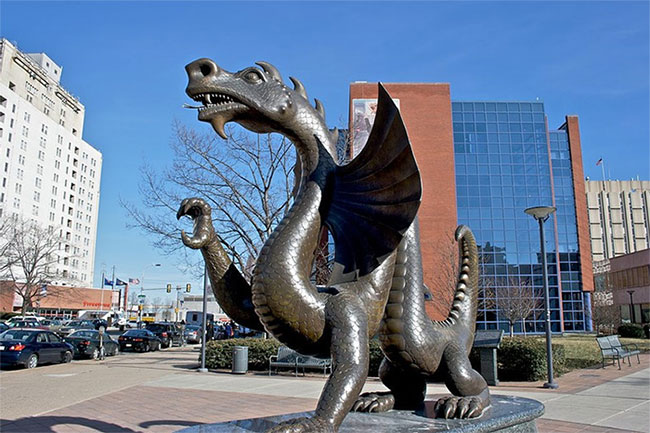
Western dragon statue at Drexel University, USA. (Photo: Wikipedia).
The image of the dragon in the West is sometimes used as a symbol of war or protection . The Vikings living in the Nordic region often used a type of ship called drakkar to transport their warriors to conquer many areas in Europe. Some ships were also equipped with a sculpture of a dragon's head on the bow, to ward off evil spirits or sea serpents when making a sea voyage.
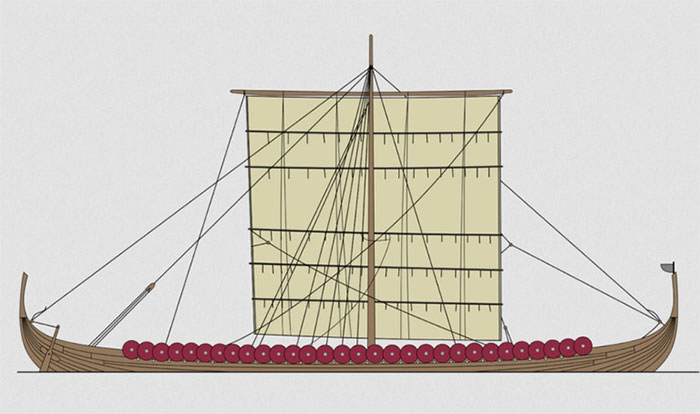
Drawing of a drakkar ship. (Photo: Wikipedia).
In Greek mythology, dragons also appeared in some stories involving the sun god Apollo and the sky god Zeus as villains. Or in the story 'Jason and the Argonauts', the heroes are forced to fight a dragon to obtain the treasure, the Golden Fleece.
In France, people often tell each other a story called 'Saint Martha and the Dragon'. The story is about a dragon named Tarasque that ravaged the town of Nerluc near the Rhone River in the middle of the 1st century AD. Although the people here tried many ways to destroy the dragon, they were useless against the power of Tarasque.

Saint Martha and the Dragon. (Photo: Wikipedia).
Later, the people of Nerluc town had to invite a nun named Martha to capture the dragon. With her strength, Martha quickly subdued the monster. The people of Nerluc town, to remember the nun Martha's merit, renamed this town Tarascon (now in the Bouches-du-Rhone department, France).
However, the most famous Western story involving dragons is the legend of Beowulf . The story revolves around a dragon, angry that its treasure was stolen, that came to destroy the Geat kingdom, where King Beowulf ruled. King Beowulf, despite his old age and weakness, was determined to confront the monster. Although he defeated the dragon, Beowulf died in battle due to many wounds from the beast.
Dragon in Eastern concept
Contrary to the negative image in the Western concept, the dragon of the Eastern people, especially the Chinese people, is a benevolent and respected creature. Particularly for kings, the dragon is a symbol of power, because the leader of the world must be a person of extraordinary intelligence.
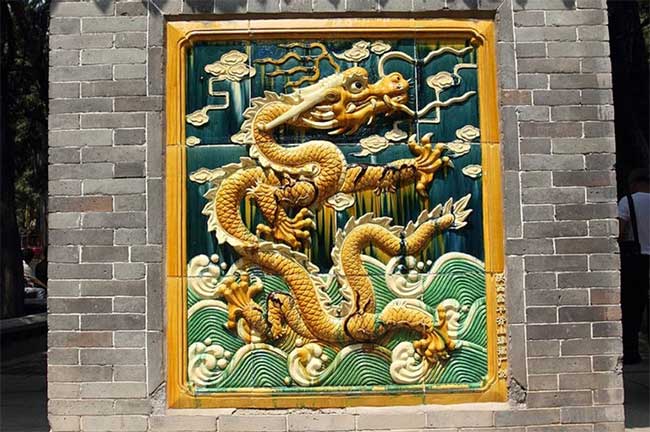
Dragon sculpture at a scenic spot in Shaanxi province, China. (Photo: Wikipedia).
Painter Dong Yu, who lived during the Five Dynasties and Ten Kingdoms period (907-979) in Chinese history, once described the dragon as a combination of animal characteristics such as 'the horns of a deer; the head of a cow; the eyes of a shrimp; the mouth of a camel; the belly of a snake; the scales of a fish; the feet of a phoenix; the whiskers; the ears of an elephant'.
According to History skills, the combination of all the characteristics of the above animals shows that the dragon is a symbol of power and the natural world. The power of the Eastern dragon is described as being able to call rain, call wind, control the elements. affecting the natural world, weather and crops. Not only that, the dragon is also a symbol of intelligence and wisdom. The long shape of the dragon is often accompanied by a pearl, representing intelligence and enlightenment.
In addition, the dragon also symbolizes transformation . For example, the dragon has the ability to fly between heaven and earth, change size. This reflects the constant change of human life.