After being present on Earth for 250,000 years, we Homo sapiens have had to face an "attacker" from space .
Approximately 56 million years ago, at the boundary between the Paleogene and Pleistocene epochs , the Earth's temperature warmed by as much as 8 degrees Celsius – an event devastating enough to threaten the climate and push humanity to the brink.
The secret behind that devastating change has just been revealed by research led by planetary scientist Nathan Kaib at the Sean Raymond Institute for Planetary Science and Astrophysics (part of the Bordeaux Astrophysics Laboratory - France).
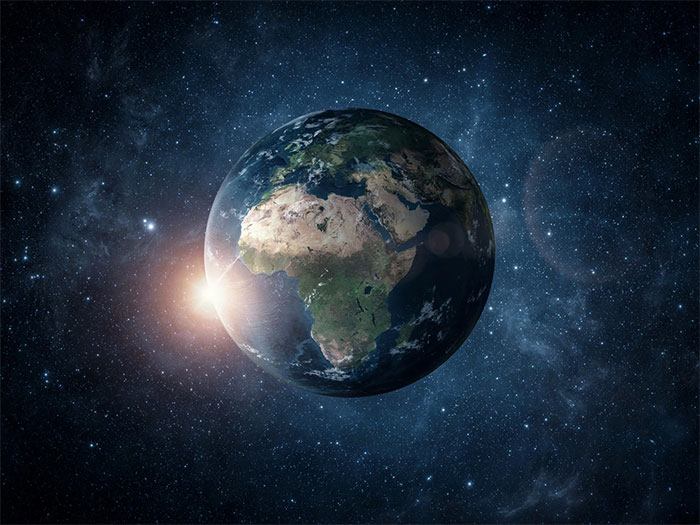
Earth was once greatly affected by the passing of a strange star - (Image: SCITECH DAILY).
According to Science Alert, using simulations from data about this catastrophic period as well as existing astronomical knowledge, the authors point to the appearance of a strange star .
It "encountered" the Solar System, with our Earth at that time.
"Encounter" here doesn't mean a direct collision between visible objects, but rather a "collision" between the gravitational fields of celestial bodies.
It passed through a region close to the solar system, close enough for gravitational interactions between celestial bodies to cause disturbances in the planets.
Evidence for this lies in Earth's own geological record: An orbital eccentricity appears to have occurred in parallel with this alarming climate upheaval, according to a paper published in The Astrophysical Journal Letters.
By piecing together the orbital changes our planet has undergone over its 4.5 billion-year "life," scientists point out that this could only have been caused by an intruder from space.
This strange star may have approached within a distance of 4,000 to 31,000 astronomical units (AU ), which is 4,000 to 31,000 times the distance between Earth and the Sun. This sounds incredibly far for the average human, but for celestial bodies in the universe, those are distances close enough to cause an impact.
The study also showed that the probability of a star passing through the Solar System at a distance of 50,000 AU is once every million years or more; the probability is once every 20 million years for a distance of 10,000 AU.
Global warming, ranging from 5-8 degrees Celsius depending on the region, will affect all living organisms on it, including our ancestors.
This also helps explain how events strong and catastrophic enough to cause the extinction of other human species allowed the highly adaptable Homo sapiens to dominate the genus Homo (Human) today.
- Why does a year have four seasons?
- Why don't satellites fall out of the sky?
- With the sun changing direction, is Mars a more habitable planet than Earth?
