Once considered a landmark flight for both NASA and Boeing, technical problems have turned the CFT into one of the most forgettable missions in history.
On June 5th, Boeing's Starliner spacecraft was successfully launched, carrying NASA astronauts Butch Wilmore and Suni Williams to the International Space Station (ISS) for a planned week.
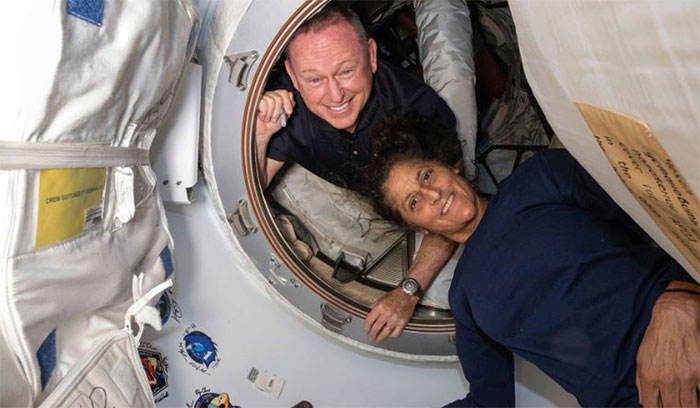
Astronauts Butch Wilmore and Suni Williams pose for a photo on the International Space Station (Photo: NASA).
This was the first time the Starliner spacecraft was used as a crewed vehicle. Not only that, it was also the first astronaut mission to use an Atlas rocket since the Mercury program in the early 1960s.
Therefore, the mission, known as the Crew Flight Test (CFT), aimed for a significant milestone, perhaps even a historic flight for American aviation.
However, a series of technical problems turned this into the most forgettable flight experience for the two astronauts – who are still stranded on the ISS space station with no idea when they will be able to return to Earth.
First, it's necessary to briefly recall the history of the Starliner spacecraft. Right from its first launch in December 2019, Starliner encountered a series of problems shortly after liftoff, causing it to become stuck in orbit and unable to reach the necessary altitude.
On its second test launch , the Starliner spacecraft was successful. However, when it came time to transition to a crewed flight, the Starliner consistently failed to meet its schedule for various reasons.
A typical example is the delay in 2023 after the discovery of flammable material in Starliner's wiring system.

The Starliner spacecraft successfully launched on June 5th (Photo: NASA).
On May 7th, Boeing and NASA planned a crewed rocket test launch to the International Space Station (ISS). However, a malfunction in the rocket's second-stage valve caused the flight to be delayed, even though it had already been placed on the launch pad.
Nearly a month later, on June 5th, the Boeing Starliner finally took off successfully, marking a significant milestone after almost two decades since the US established commercial crewed space flights.
Just when it seemed everything would go smoothly, bad luck continued to plague the spacecraft. When Starliner docked with the ISS, experts discovered several helium leaks from its instrument compartment. Surprisingly, these leaks had actually been detected before the spacecraft even left the launch pad.
However, the flight went ahead, due to NASA's firm assurances that it would pose no threat during its journey. Then, halfway through the mission and after successfully docking with the ISS, the Starliner experienced another leak.
"Expert teams have identified three helium leaks on the spacecraft. One of these was discussed before the flight. The other two occurred since the spacecraft entered orbit ," NASA updated the journey in a post.
NASA is currently working to fix the Starliner problem. Experts have identified and found a solution.
NASA officials also tried to offer a positive outlook on the current situation. They asserted that the two astronauts were "enjoying their time on the space station" and "will be home on time."
However, these assessments cannot negate the fact that the Starliner spacecraft is still experiencing problems and there is no set date for its return to Earth. To date, 50 days have passed since the mission was launched. The two astronauts on board have spent five times longer than initially planned (the mission was supposed to last 10 days).
The challenges Starliner faces are not unprecedented in the history of space exploration. Previous missions, such as the Apollo 13 incident in 1970, also encountered unexpected obstacles, requiring astronauts and ground crews to demonstrate adaptability and flexibility.
While the world closely monitors developments in space, NASA quietly sees them as a benchmark for perseverance and innovation, potentially even shaping future spaceflight goals for humanity.
There, the reluctantly extended stay of Sunita Williams and Butch Wilmore is seen as an answer to the expertise and human habitability required in extended space programs, where they must patiently await flights to return safely to Earth.
Sunita Williams' last space mission was in 2012, while Butch Wilmore's was in 2015.