The Gemini North telescope , located atop Maunakea in Hawaii, USA, has discovered interacting spiral galaxies approximately 60 million light-years away in the constellation Virgo.
The pair of galaxies NGC 4567 and NGC 4568 , also known as the Butterfly Galaxy , have just begun to collide as gravity pulls them closer together.
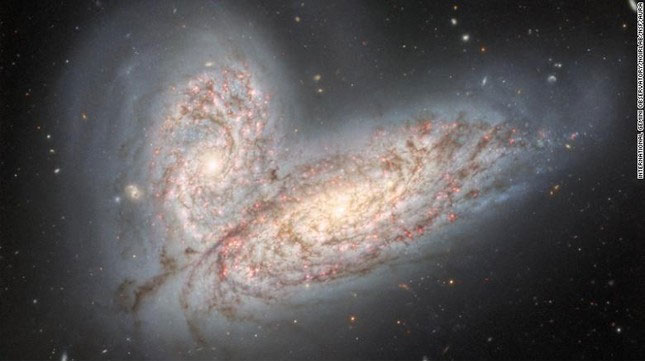
Two galaxies twisted together to form the shape of a butterfly.
In 500 million years, these two galaxies will complete their merger to form a single elliptical galaxy.
At this early stage, the two galactic centers are currently 20,000 light-years apart, and each galaxy still maintains its own shape. As the galaxies tend to move closer together, gravity will lead to more intense star formation events. The initial structure of the galaxies will change and deform.
Over time, these two galaxies will orbit each other in progressively smaller circles. This tight loop dance will pull and stretch long streams of gas and stars, merging the two galaxies together into something resembling a sphere.
As millions of years pass, the twisting of these galaxies will disperse the gas and dust necessary to trigger star formation, causing the process to slow down and eventually cease.
Observations of collisions between other galaxies and computer models have given astronomers further evidence that the merger of spiral galaxies creates elliptical galaxies, also located in the constellation Virgo.
The brilliant light of a supernova, first detected in 2020, is also visible in the new image as a bright spot in one of the spiral arms of the galaxy NGC 4568.
The Merging of Galaxies
A similar galactic merger would occur when the last galaxy in the Milky Way collides with Andromeda, our largest and closest neighbor. Astronomers at NASA used data from the Hubble Telescope in 2012 to predict when a head-on collision between two spiral galaxies might occur. They estimate this event would happen in about 4 billion to 5 billion years.
Currently, a massive halo surrounding the Andromeda galaxy is actually colliding with the Milky Way's halo, according to research based on data from the Hubble Space Telescope published in 2020.
This neighbor, which may contain up to a trillion stars, is roughly the same size as our large galaxy, and it's only 2.5 million light-years away. That sounds incredibly far, but on an astronomical scale, that makes Andromeda close enough to be visible in our autumn skies. You might see it as a faint glimmer of light high in the fall.
Scientists at NASA say it's unlikely our solar system will be destroyed when the Milky Way and Andromeda merge, but the sun could be kicked into a new region of the galaxy, and Earth's night sky could have some spectacular new sights.
- A 3,000-degree-cold purple beam of light splits the Earth's sky after a series of "cosmic fireworks."
- Humanity faces the risk of extinction; experts say the culprit is a familiar "giant."
- Current technology has made it possible to bring AI to the eyes of "The Terminator".