Calcium magnesium carbonate, chemical formula CaMg(CO3)2, accounts for about 2% of the Earth's crust and takes hundreds of millions of years to form naturally.
It took scientists two centuries to recreate them in the lab. Experts have even dubbed the challenge the 'Dolomite Problem' , highlighting the scientific challenges of reproducing the mineral in a lab setting.
A study published in the journal Science, a collaboration between the University of Michigan (UM) and Hokkaido University in Sapporo, Japan, appears to have solved this geological conundrum by leveraging proprietary software and dissolving imperfect crystals with an electron beam.
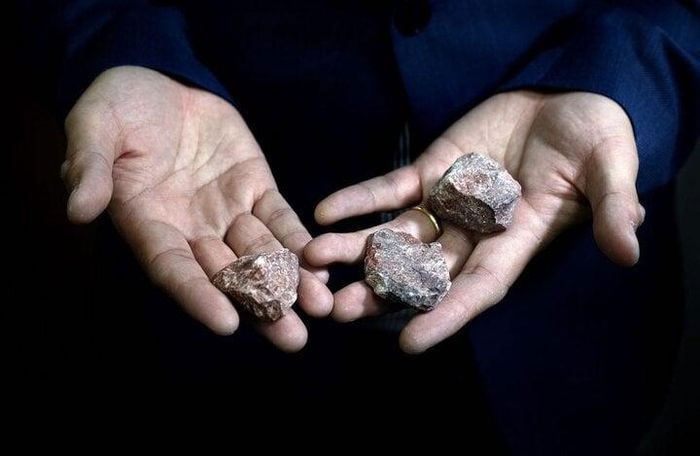
Dolomite is typically found in rocks that are more than 100 million years old.
' Previously, people who wanted to grow perfect crystals have tried to do it very slowly. However, our theory shows that you can grow them very quickly if you periodically remove defects during growth,' Wenhao Sun, a scientist at UM and study author, said in a press release, 'if we understand how dolomite grows in nature, we can find new strategies to accelerate the crystal growth of modern technological materials.'
Dolomite is typically found in rocks that are more than 100 million years old, meaning it takes a long time for the mineral to form. The researchers believe this slow growth rate may be due to the process by which dolomite's crystal structure forms.
The mineral is formed by alternating rows of calcium and magnesium. In aqueous environments, these elements often randomly combine in the wrong places, preventing dolomite from forming. While the Earth has almost infinite patience for slow growth (only one layer of dolomite is formed every 10 million years, for example), humans with their relatively short lifespans do not.
To figure out how to speed up the natural process, scientists needed to understand how these defects adhere to the dolomite surface. This would normally take thousands of supercomputer hours, according to one researcher, but UM's proprietary software leveraged a new technique to complete these simulations 'in just 2 milliseconds on a desktop computer'.
' Our software calculates the energies for some atomic arrangements, then extrapolates to predict the energies for other arrangements based on the symmetry of the crystal structure,' said UM associate researcher and co-author Brian Puchala, one of the software's lead developers.
Next, scientists from Hokkaido University used electron microscopy to blast electrons into water, creating an acid that could dissolve the crystals. Each dolomite sample was placed in a calcium/magnesium solution and pulsed with an electron beam 4,000 times for two hours straight. The resulting acid effectively dissolved any imperfections and allowed the dolomite to grow about 100 nanometers across. This is equivalent to about 300 layers of dolomite, 60 times more than had ever been grown in a lab before.
Deciphering the secrets of dolomite's growth could help future scientists understand the geological processes of other minerals, especially those used in semiconductors.