Images from Italian satellites and ground telescopes show the moment the DART spacecraft hit the asteroid Dimorphos and the subsequent impact.
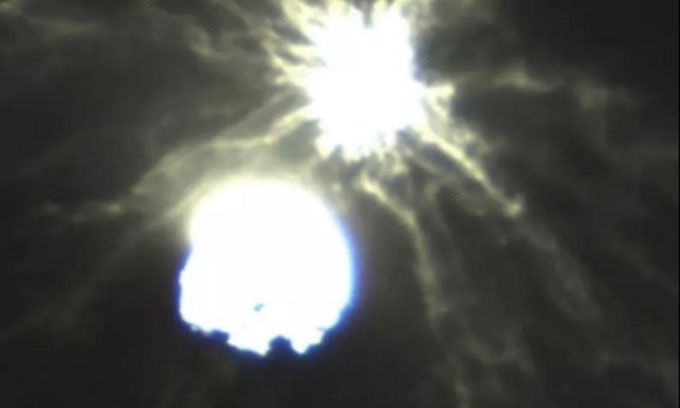
Didymos and Dimorphos shortly after colliding with the DART spacecraft, as seen from the LUKE camera on the LICIACube satellite. (Photo: NASA).
The Italian space agency released the first images from its Extra-Lightweight Exoplanet Imaging Cubesat (LICIACube) spacecraft on September 27. The series of images arrived on Earth about three hours after NASA's Double Asteroid Redirection Test (DART) spacecraft successfully crashed into the Dimorphos target, some 11 million kilometers from Earth. The images include a comparison of the Didymos asteroid system before and after the impact, as well as images of the glowing debris surrounding Dimorphos.
For more context, see NASA is about to crash a $ 330 million spacecraft into an asteroid.
According to Elisabetta Dotto, head of the scientific team at the Italian National Institute for Astrophysics (INAF), these images are important for scientists to understand the structure and composition of Dimorphos. Dotto shared that in addition to the first two images, the LICIACube images that the team will release in the next few days are also very promising.
Before the event, scientists were unsure what the asteroid would look like after impact. Images from LICIACube show Dimorphos completely covered in a cloud of dust and debris created by the DART impact.
NASA's DART mission crashed into Dimorphos, a small asteroid orbiting a larger asteroid called Didymos, to test how to adjust the orbit of the Earth-threatening object. Astronomers are now closely monitoring the Didymos system, ready to measure how Dimorphos' orbit changes. That's the data NASA needs to determine the success of the DART mission.
The LICIACube satellite flew with the DART spacecraft and separated on September 11. LICIACube conducted tests of its two cameras on several targets including Earth and the Pleiades star cluster. The LICIACube Explorer Imaging for Asteroids (LEIA) camera can take high-resolution images but can only capture black and white images, while the LICIACube Unit Key Explorer (LUKE) camera incorporates red-green-blue filters and has a wider field of view.
On September 26, LICIACube flew at a safe distance as DART accelerated and crashed into the impact zone three minutes later. LICIACube also took pictures of the dark side of Dimorphos opposite the DART crash site. The spacecraft is now flying through deep space, slowly sending images back to Earth.
ATLAS watches the DART spacecraft crash into Dimorphos. (Video: ATLAS Project).
Telescopes on Earth also captured images of the DART spacecraft's 'suicide' in deep space. Observations from the Asteroid Terrestrial-impact Last Alert System (ATLAS) in Hawaii showed that the Didymos binary system brightened dramatically at the moment of impact. Shortly afterward, a huge shell of material was ejected from the Dimorphos asteroid.
One of the 1m telescopes at the Las Cumbres Observatory in South Africa tells a similar story from a different angle. DART hits Dimorphos while moving from left to right in the frame, rather than right to left as in the ATLAS image.
The 170-meter Dimorphos asteroid and its 780-meter sister, Didymos, are not a threat to Earth. But the data from the test will inform the effectiveness of the kinetic impactor technique, which will aid future efforts to divert dangerous asteroids. More ground-based telescopes around the world will begin monitoring the Didymos system in the coming months.