Scientists have calculated what will happen in the future, taking into account the fact that the Moon is moving further and further away from Earth , and is also causing our planet to slow down its rotation.
For more context, see The Moon is slowly moving away from the Earth, possibly being pulled into the Sun and disappearing..
According to Live Science , the Moon's orbit around Earth seems so regular that some civilizations relied on its movement to keep track of time. However, modern science shows that it is gradually moving away from Earth, causing the world's oceans to expand .
Scientists have determined the speed at which the Moon is drifting away from Earth using reflective panels that NASA placed on the celestial body during the Apollo missions.
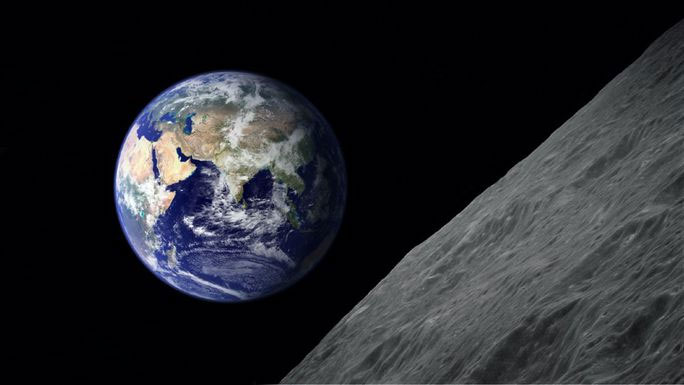
Earth as seen from the Moon - (Photo: Jeremy Horner).
For over 50 years, laser beams from Earth have been directed at them, and the reflected pulses have been recorded, helping NASA estimate that the celestial body is drifting away from Earth at a rate of about 3.8 cm per year.
This growth rate is only about the speed of a human fingernail, but the cumulative effect over the extremely long lifespan of astronomical objects creates a real problem.
Earth's oceans are bulging towards the Moon due to the gravitational pull affecting the tides. Conversely, our Moon is gradually taking on an oval shape because it is also being stretched by Earth's gravitational interaction.
Astrophysicist Madelyn Broome from the University of California, Santa Cruz (USA) said that about 4.5 billion years ago, when the Moon was just forming, the Earth's rotation speed was significantly faster, and the length of a day was only about 5 hours.
The Moon was also much closer to Earth at that time, and the two celestial bodies constantly interacted. The gravitational pull from Earth's tidal bulges affected the Moon; conversely, the oceans shifted due to the Moon's force, creating friction on Earth's surface that slowed its rotation.
Because the Earth and the Moon are both part of a gravitational interaction system, the angular momentum of the entire system must be conserved. Angular momentum (also called rotational momentum) represents the energy contained in something that is rotating. The faster it rotates and the farther apart the two rotating objects are, the more energy there is, and vice versa.
Therefore, as the Earth slowed down—and in the past the Moon also slowed down—the two celestial bodies must have balanced the angular momentum for the entire system by moving away from each other. The Moon took on the part of the movement.
The moon no longer slows down its rotation today, as it officially stopped rotating long ago and is "tidally locked" with Earth , meaning it only faces our planet on one side.
Models suggest that Earth eventually chose to "hold onto" the Moon by also locking itself tidally, facing the Moon with a single side so that the Moon wouldn't have to move further away.
This will happen in the next 50 billion years, according to Dr. Jean Creighton, Director of the Manfred Olson Planetarium at the University of Wisconsin-Milwaukee, and Professor Eric Klumpe from Middle Tennessee State University (USA).
Unfortunately, their parent star – the Sun – will run out of energy and evolve into a red giant before collapsing into a white dwarf in about 5 billion years.
As it swells into a red giant, the Sun is predicted to engulf several nearby planets – including, of course, its own moons.
According to calculations, Earth is on the list of things that could be "swallowed up." This means that both the Moon and Earth will disappear much sooner than they decide to stop rotating together.