An upcoming NASA telescope could discover more than 400 lonely Earth-sized planets wandering the Milky Way.
These lonely planets are thought to have started their lives in a planetary system, similar to our Solar System, but were kicked out for one reason or another. Despite the familiar image of planets orbiting their host stars, new research suggests that these 'orphan' worlds may outnumber the stars in the Milky Way by a factor of 20:1. This means that there are six times more rogue planets in our galaxy than there are planets orbiting their host stars.
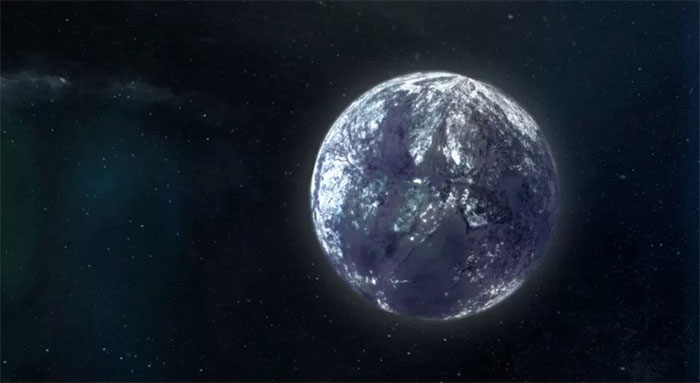
A lonely ice planet in the universe. (Photo: NASA).
"We estimate that our galaxy is home to 20 times more lonely planets than stars — that's trillions of planets wandering around out there, " said study author and NASA senior scientist David Bennett.
Planets outside the Solar System, also known as exoplanets , are typically discovered by their effects on their host stars. However, solitary planets are too far away from their stars to be detected . One of the main goals of NASA's Nancy Grace Roman Telescope is to discover these solitary worlds. Previous estimates suggested that Roman, which is scheduled to launch in May 2027, would be able to detect around 50 Earth-sized solitary planets, but new numbers suggest that the number could be much higher, possibly closer to 400.
Since the discovery of the first exoplanet orbiting a Sun-like star in 1995, the number of exoplanets found has reached 5,000. Most of these planets are giant objects orbiting their host stars.
Meanwhile, the research team revealed that solitary planets are usually planets that are smaller or equal in size to Earth.
"We found that Earth-sized solitary planets are more common than larger planets. The difference in the average mass of planets orbiting a star and free-floating planets is key to understanding the planet formation mechanism," said study author Takahiro Sumi, now a professor at Osaka University.
The chaotic nature of planet formation may explain how isolated planets begin to wander the galaxy. Less massive planets tend to have less gravity to cling to their host stars, so they are more likely to be ejected and wander alone.