The 646-gram meteorite once left us, flew out into space, and somehow ended its extraordinary journey on Earth .
An unpublished study by scientists from the French National Center for Scientific Research may surprise you about the journey of a black rock, which was discovered in Morocco in 2018.
Accordingly, the rock, officially named "Northwest Africa (NWA) 13188" , is believed to have left Earth and flown into outer space.

A mysterious rock has undergone an extraordinary journey after being launched into space and returning to Earth. (Illustration: Getty).
According to the French National Center for Scientific Research, this 646-gram "boomerang rock" may have been ejected from Earth by volcanic activity . Its crystal structure and chemical composition also match the above assessment, possessing a mixture of oxygen isotopes and many trace elements.
After its extraordinary journey into space, the rock's structure changed. It contained large amounts of Helium-3, Beryllium-10 and Neon-21, the researchers said. These are radiations found in space, but are largely blocked by Earth's magnetic field.
Although the concentration of these isotopes is lower than in other meteorites, it is still significantly higher than in rocks of terrestrial origin. This opens up the possibility that 'NWA 13188' may have been exposed to cosmic rays over a period of up to several tens of thousands of years.
'We consider NWA 13188 to be a meteorite that was launched from Earth and then returned,' the team concluded. The rock may have been larger. However, it was partially melted on the surface when it entered Earth's atmosphere.
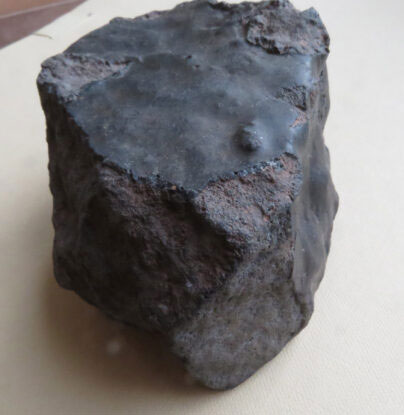
Close-up of the rock that is believed to have "traveled" through space for tens of thousands of years, then returned to Earth. (Photo: Meteorological Society).
Still, the unpublished research has not convinced all experts.
Planetary scientist Philippe Claeys dismissed the claim, citing insufficient evidence for the origin of the strange rock. "When you make extraordinary claims, you need extraordinary evidence to back them up. I'm still not convinced," he said.
In addition, many arguments have cast doubt on the possibility that volcanoes can launch rocks into space.
According to Phys calculations, to enter orbit, a rock ejected from a crater would need to travel at tens of thousands of kilometers per hour. However, this is unlikely because it is much higher than the average flight speed of most other rocks.
In addition, the tallest volcanic plumes are usually only about 31 - 45km from Earth, making it impossible to launch rocks into space due to volcanic activity.
Another hypothesis has been put forward. Analysts believe that the collision of an asteroid created a force that sent the rock "backward" into space .
In fact, some collisions between Earth and asteroids can generate enough force to send debris into space. One such rock was found on the Moon during the Apollo 14 mission in 1971.