Hawking's paradox states that in the process of disappearing, black holes destroy all information about their origin, contrary to the rules of quantum physics. This paradox has been solved.
According to theoretical physicist Stephen Hawking, black holes slowly disappear because they leak radiation, called 'Hawking radiation', but in the form of heat. Radiation can carry information about its source, but heat cannot. So as black holes slowly disappear, so does any information about the star that created them.
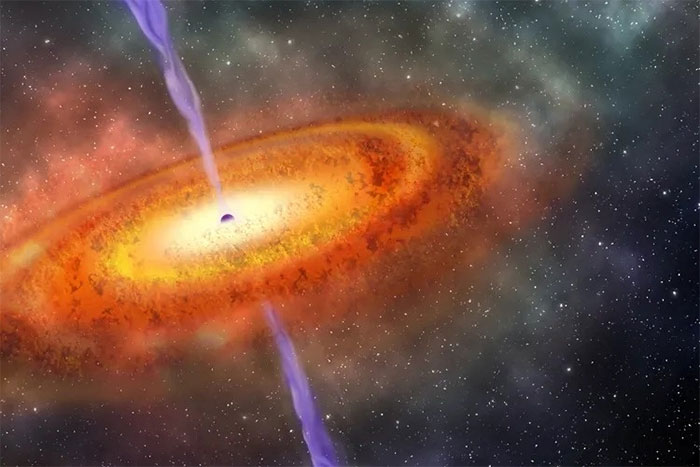
Information about the formation of a black hole can be found in the radiation it emits, according to new research that explains Hawking's paradox. (Image: NASA).
This goes against the laws of quantum mechanics, which say that information cannot be destroyed and that the final state of an object can reveal clues about its initial state. This is known as the 'Hawking information paradox'.
Hawking's paradox
Black holes are objects so massive that nothing can escape their gravitational pull, not even light. They form when massive stars collapse in on themselves.
In classical physics, black holes are considered to be very simple objects that can be characterized by three numbers — mass, angular momentum, and electric charge, explains Xavier Calmet, a physics professor at the University of Sussex. However, the original star that gave birth to the black hole is a complex astrophysical object, consisting of protons, electrons, and neutrons that combine to form the chemical elements of that star, Calmet notes.
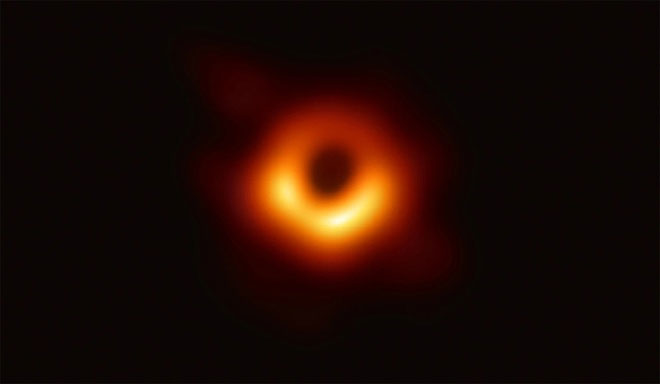
The first image shows a black hole at the center of the M87 galaxy, nearly 54 million light-years from Earth. (Photo: EHT Collaboration).
Although black holes do not carry traces of these complex chemical elements, the rules of quantum physics say that information cannot be erased from the universe. Therefore, in theory, it is still possible to recover information about the original complex star from the radiation emitted by the black hole .
In 1976, Stephen Hawking 'broke' this rule by suggesting that black holes constantly emit a type of radiation. This leakage of radiation causes black holes to gradually evaporate and eventually disappear completely. But this radiation is emitted as heat, meaning that all information about the star that gave birth to the black hole is also lost.
'This goes against the rules of quantum physics, which suggest that the "life" of a black hole can be rewinded, and that through radiation it is possible to re-imagine the black hole and the star that created it,' Calmet said.
Decoding the black hole paradox
Calmet spent nearly three years trying to decode Hawking's paradox. In the new study, he re-evaluated Hawking's 1976 calculations, but this time taking into account the effects of 'quantum gravity' - describing gravity according to the principles of quantum mechanics - which Hawking did not.
'Although these quantum gravitational corrections are very small, they are crucial for the evaporation of black holes. We have been able to show that these effects make the Hawking radiation no longer thermal energy, and can contain information,' Calmet said.
Calmet's team has also determined the physical phenomenon by which information escapes from a black hole via Hawking radiation, and how an outside observer could retrieve this information to reconstruct the black hole and its parent star. However, this process is not yet feasible in practice, as it requires a device sensitive enough to measure Hawking radiation, which does not yet exist.
