As the only highly intelligent life form in the Solar System, humans have existed on Earth for 5 million years. True to their inherent nature, no matter how many generations pass, humans have always maintained an insatiable curiosity and a burning desire to explore everything in the universe.
From geocentric theory to the Big Bang theory, we are constantly renewing our understanding of the world around us. But even though our understanding of the Solar System has reached unprecedented levels, many mysteries remain unsolved.
For example, when dividing the Solar System, we consider the size of the Oort Cloud. But in reality, decades later, it's still uncertain whether the Oort Cloud even exists. Another example: scientists discovered some unusual movements while studying Neptune; does this mean that besides Pluto, there's a ninth planet in the Solar System?
In a new study, some scientists even claim that the Solar System once had two suns. So what's going on?

Planet Nine has yet to be found. (Illustrative image)
When we were children, many of us probably heard the legend of Hou Yi shooting down the sun. In the story, ten suns appeared in the sky at the same time, causing the earth to almost wither. Hou Yi shot down nine of them, so now only one sun shines in the sky.
Legends are just legends; if there were really 10 suns, the Earth would collapse instantly. However, in the real universe, 2 suns, or even 3 suns, are common. More than 50% of the galaxies in the Milky Way belong to binary or multi-star systems, where several stars orbit each other or a common center of mass. For example, the nearest galaxy, Alpha Centauri, is a 3-star system.
Based on current observational results, most star systems typically have more than one parent star. Therefore, theoretically, the Sun very likely has a sister star. This conjecture may have originated in the 1980s. After a long period of research, an astronomy enthusiast named Muller first proposed the idea of two Suns and reasoned that the Sun actually has its own companion star.
Subsequently, many scientists studied it. Researchers from Harvard University believe that the early formation of the Solar System should have also been a binary star system, but the other star was much smaller than the Sun and was a red dwarf. However, as the Solar System developed, that star left the Solar System for unknown reasons.
Or perhaps it hasn't left the Solar System at all, but is orbiting very far from the Sun… The reason we can't observe it is because its surface temperature is too low and it emits almost no light.

Scientists believe that the Sun has a companion star with a cycle of 27 million years. (Illustrative image).
Although difficult to observe, scientists are trying to prove the existence of this companion star through two phenomena.
First, in 1984 and 2010, two paleontological research groups conducted studies and analyses of biological extinction cycles and discovered that over the past 500 million years, the extinction cycle of organisms was approximately 27 million years. Therefore, they believed that the Sun had a companion star with a 27 million year cycle of encounters.
This companion star will wander through the Oort Cloud every 27 million years, bringing destruction to Earth. Hence its name, Nemesis, the ruthless goddess of vengeance in Greek mythology.
After calculations, researchers believe Nemesis's perihelion is approximately 1 light-year away and its aphelion is 3 light-years away. When it is at perihelion, it causes gravitational disturbances in the Oort Cloud and the Kuiper Belt. Both of these are comet reservoirs in the Solar System, so a large number of comets would break away from their original orbits and move toward the inner Solar System. This significantly increases the likelihood of Earth being struck by a comet, causing periodic biological extinction events on Earth.

There may be a more massive object in the Oort Cloud region. (Illustrative image)
The remaining phenomenon is Neptune's unusual orbit. Not long after the discovery of Uranus in the 1820s, astronomer William Herschel observed Uranus's orbit and found that there was a discrepancy between the theoretical position and the position calculated by summing the actual observed positions. Therefore, scientists at the time suspected that another, more massive planet was exerting a gravitational force on Uranus, affecting its orbit.
Using Newtonian mechanics, Oban Le Verrier manually calculated the orbit of the eighth planet. After handing it over to the Berlin Observatory for observation, the eighth planet was discovered there: Neptune .
After resolving the orbital anomaly of Uranus, new anomalies appeared on Neptune. Additionally, the Kuiper Belt exhibited some unusual clustering phenomena. The concentration of celestial bodies in certain areas should be more random, suggesting that a heavier celestial body might be attracting them.
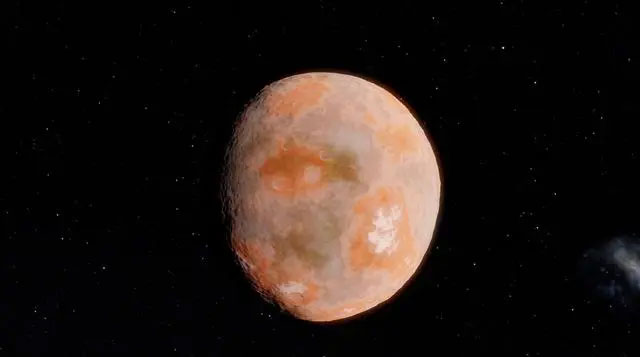
Pluto has a very small mass and is clearly not the mysterious ninth planet. (Illustrative image).
So scientists wanted to use a similar process to calculate the location of the ninth planet. But this time something went wrong; after the discovery of Neptune, the search for Pluto using telescopes took over 80 years. But Pluto has a very small mass and is clearly not the mysterious ninth planet.
Therefore, scientists speculate that there may be a more massive object in the Oort Cloud region , possibly a Sun companion star or Planet Nine. And to confirm this, we would have to visit or observe the Oort Cloud.
However, the Oort Cloud is located in interstellar space at the edge of the Solar System, about one light-year from the Sun, and its maximum radius is also one light-year. This means that to reach the edge of the Oort Cloud, one would need to travel a distance of two light-years, roughly half the distance from the Sun to Proxima Centauri.
Even the Voyager 1 probe, which flew the furthest, took 300 years to get close to the Oort Cloud and 30,000 years to pass through it. Therefore, we can only wait until a faster detector is invented in the future before we can fully search for the mysterious ninth planet in the Oort Cloud.