A ghostly object from the beginning of the universe has been hurtling through our vicinity at least once every decade.
A new study from the Massachusetts Institute of Technology, the Santa Cruz Institute for Nuclear Physics, and the University of California at Santa Cruz (USA) suggests that primordial black holes (PBHs) , invisible objects from the dawn of the universe, may have caused many planets and moons around us to wobble.
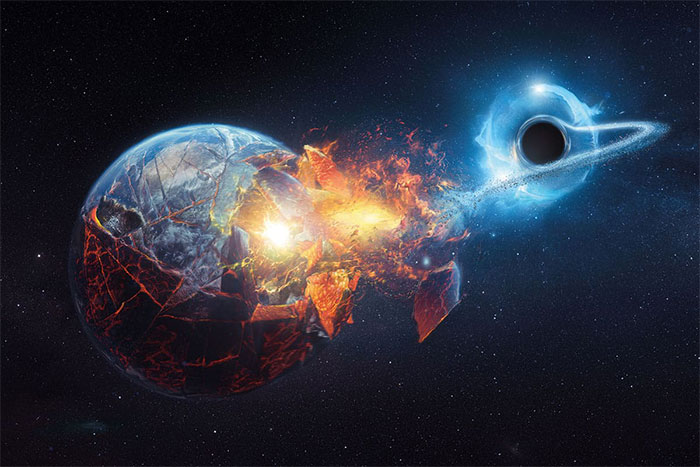
An illustration depicting an "object from the first second of the universe" approaching an Earth-like planet. However, the truth may be more benign - (Photo: PHYSIC WORLD).
PBH is a hypothetical object that has been mentioned in space science.
These extremely large gravitational regions may have come into being in the split second after the Big Bang, due to the collapse of hot, dense regions of space.
Depending on when they were born during this first 1-second period, PBHs can have masses ranging from 1/100,000th of a paperclip to 100,000 times that of the Sun.
However, most scientists believe that the majority of PBHs have masses somewhere between those of the asteroids Juno and Eros.
More importantly, this ancient, ghostly object is made mostly of dark matter, making it difficult to capture.
According to new research, although no one has yet obtained direct evidence of PBH, they have revealed their whereabouts by repeatedly shaking our neighboring planets and moons at least once every decade.
If such an object were to pass by Earth, it would not destroy our world. However, it could cause some wobbling and turbulence as it passed by.
In a worst-case scenario, a BBH could be powerful enough and come close enough along its path to knock a planet off its path. Not enough to knock the planet off course, but enough to change its distance from its parent star.
For a habitable planet like Earth, that would be very bad news because the change in distance would certainly lead to major changes in environment and climate.
Fortunately, according to scientists' calculations, the probability of "flying away" is low . PBH usually only causes some subtle wobbles to the planets it impacts.
Using data on the positions of certain planets and moons from NASA's JPL Horizon database, researchers simulated JPL's impact on the Solar System.
They found that if a PBH with an asteroid mass passed within 2 astronomical units (twice the Sun-Earth distance) from the Sun, then over many years the orbits of the planets and moons would wobble from 1 inch (2.54 cm) to several feet (1 foot = 30.48 cm).
So scientists expect machines like the one NASA used to measure centimeter-level distances from Mars to Earth to provide important clues to identifying PBHs.