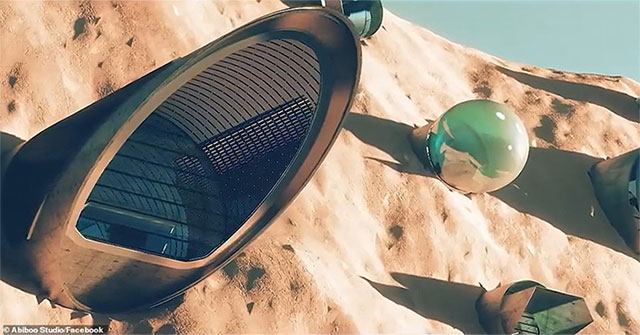
Mars can experience winter temperatures as low as -123 degrees Celsius, has two types of snow with square snowflakes, and has many strange shapes on the surface when the ice melts.
When winter hits Mars, the planet's surface transforms into a different world. Subzero temperatures bring ice, snow, and frost. Some of the coldest areas are at the planet's poles, where temperatures can drop as low as -123 degrees Celsius. However, no region on Mars experiences more than a few meters of snowfall. The red planet's elliptical orbit means winter lasts for months. A Martian year is about two years on Earth. However, the planet still has many unique winter phenomena that scientists can study, thanks to NASA's robotic explorers.
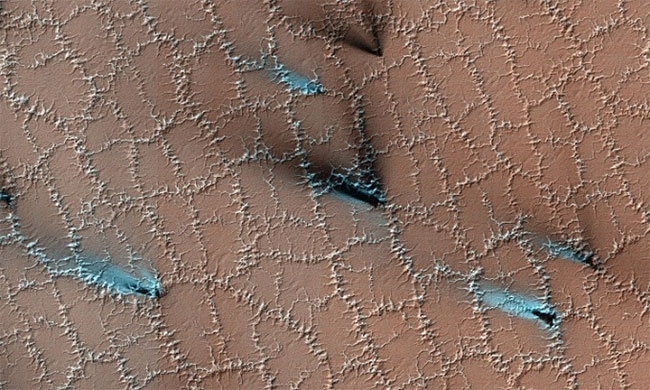
Water ice divides the ground into beautiful polygons. (Photo: NASA).
Two types of snow
Snow on Mars comes in two forms : water ice and carbon dioxide, also known as dry ice . Because the Martian atmosphere is so thin and the temperatures are so cold, snow made from water ice sublimates, becoming a gas before it even hits the ground. Snow made from dry ice actually hits the ground. "However, if you're looking to ski, you'll need to go to a crater or cliff," where snow accumulates on a steep surface, says Sylvain Piqueux, a Mars researcher at NASA's Jet Propulsion Laboratory in Southern California.
How NASA Detects Snowfall
Snow only occurs during the coldest times on Mars, including the poles, under cloud cover, and at night. Cameras on orbiting spacecraft can't see through clouds, and ground missions can't survive the extreme cold. As a result, there are no photos of snow falling. But scientists know it happens thanks to some specialized equipment.
NASA's Mars Reconnaissance Orbiter can see through cloud shadows with its Mars Climate Sounder instrument, which detects light at wavelengths invisible to the human eye. That ability allows scientists to detect carbon dioxide snow falling to the ground. In 2008, NASA sent the Phoenix lander to within 1,000 miles of the Martian north pole. There, Phoenix used a laser to detect water-containing snow falling to the ground.
Square snowflake
Because of the way water molecules bind together when they freeze, snowflakes on Earth have six sides. The same principle applies to all crystals. The arrangement of atoms determines the shape of the crystal. In the case of carbon dioxide, the molecules in dry ice always bind together in four-sided shapes when they freeze. "Because dry ice has tetrahedral symmetry, we know that snowflakes formed from this ice will be square," Piqueux says. "With the Mars Climate Sounder, we can determine that snowflakes will be smaller than the width of a human hair."
Frost on Mars
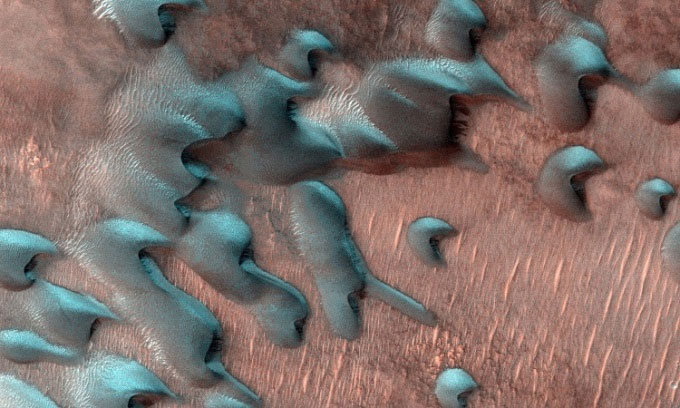
Frost covers the colder, north-facing portion of a dune on Mars. (Image: NASA).
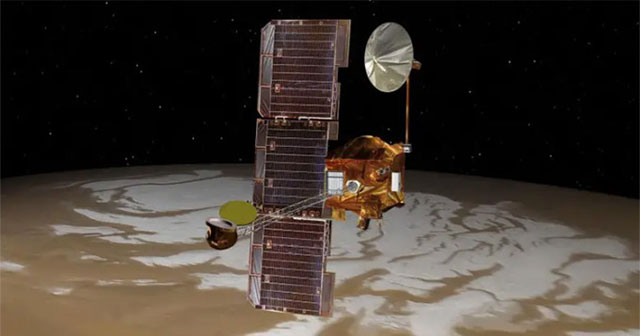
Water and carbon dioxide can both form frost on Mars. Both types of frost occur much more widely on the planet than snow. The Viking landers encountered frost while studying Mars in the 1970s. NASA's Odyssey orbiter has observed frost forming and melting in the morning sunlight.
Winter is over
Perhaps the most exciting discovery comes at the end of winter, when all the accumulated ice begins to melt and evaporate into the atmosphere. As it does, the ice forms strange and beautiful shapes reminiscent of Spiderman, fried eggs, and Swiss cheese. The melting also causes many geysers to erupt. The transparent ice allows sunlight to heat the gas below. When the gas explodes, a layer of dust shoots up to the surface. Scientists have begun studying this dust to learn more about how winds blow across Mars.