It is unexpected that Genghis Khan's mighty Mongol army had to stop in Europe because of this small creature .
Genghis Khan (1162 – 1227) was one of the most brilliant and influential leaders and military leaders in world history. He was the founder of the mighty Mongol Empire after uniting the tribes in northeastern Asia in 1206.
Under the leadership and military strategy of Genghis Khan, the extremely skilled Mongol army once shook the world. The territory of Mongolia during the reign of Genghis Khan also stretched from Asia to Europe. The army of this Khan was not only elite and fierce but also famous for its invincibility, becoming the fear of many countries at that time.
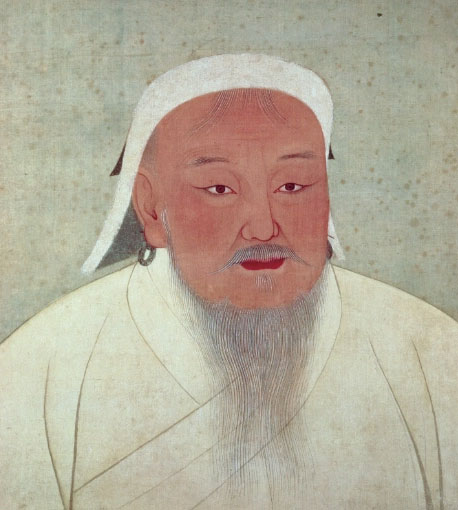
Genghis Khan was one of the most brilliant military leaders in world history. (Photo: Alamy).
From Childhood Shock to the Rise of Genghis Khan
Genghis Khan's real name was Temujin. He had a very difficult childhood because his father, the military leader Yesugai, suddenly died and his family was abandoned on the steppe.
Having gone through many hardships during his childhood, Temujin understood that to survive in Mongolia, it was necessary to form alliances with others. From then on, he always had in mind the idea of unifying the tribes in Mongolia.
In the process of unifying alliances and factions, Genghis Khan broke with the long-standing traditions of the Mongols. Specifically, instead of killing or enslaving the defeated, he pledged to protect and persuade them to participate in future conquests with spoils of war. In particular, unlike the traditional way, instead of favoring members of tribal and clan alliances, Genghis Khan was willing to use and appoint talented people with loyalty and intelligence to important positions.
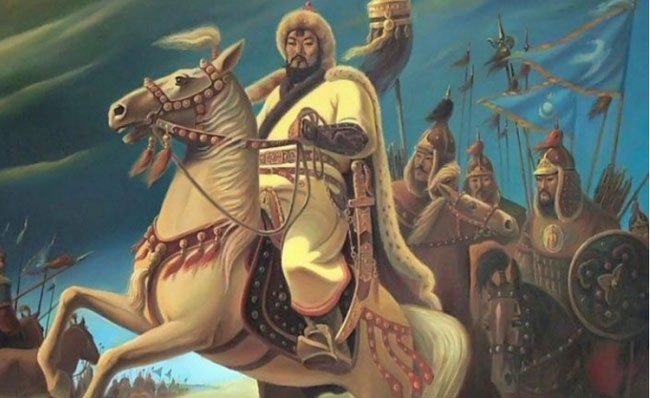
Genghis Khan had his own way of organizing his army and unique military tactics, creating the success of the invincible Mongol army.
Thanks to these different ideas, it helped to strengthen the bond, continuing to strengthen the military power of Genghis Khan's alliance, which became increasingly powerful. By 1206, Genghis Khan had completed his dream of unifying the Mongol tribes, thereby forming one of the largest empires in world history.
After unifying the Mongol tribes, Genghis Khan and his mighty army launched a series of military campaigns from Asia to Europe. The Mongol army was a master of lightning attack tactics. The horsemanship, archery, and fighting speed of the Mongol cavalry also became a nightmare for many on the battlefield.
In 1220, Genghis Khan divided his army into two groups. Specifically, the main army, led by Genghis Khan himself, marched through Afghanistan and northern India to return to Mongolia. The second army, consisting of about 30,000 cavalrymen, led by Subutai and Jebe, led the army through the Caucasus and into Russia.
In addition, Genghis Khan also sent a small army to conduct reconnaissance in Poland and Hungary with the ambition of advancing westward and entering Europe. However, in the summer of 1223, this army quickly retreated back to Mongolia.
Why did the Mongols decide to abandon their conquest of Europe? This is a controversial topic. According to historians, the Mongols, though invincible, were helpless against mosquito attacks. Malaria-carrying mosquitoes attacked the armies stationed in the Caucasus and along the Black Sea.
Furthermore, during this time, Genghis Khan himself suffered from persistent malaria. As evidence, most historians agree that Genghis Khan died at the age of 65 (in 1227) due to various illnesses because his immune system was weakened after contracting malaria.
To this day, Genghis Khan's burial place remains a mystery.
Tiny creature stops Mongol army from entering Europe
After Genghis Khan's death, his third son Ögedei Khan succeeded him and took power, launching a campaign to conquer Europe from 1236 to 1242. Accordingly, the Mongol army chose the route through eastern Russia, and occupied the Baltic states, and advanced to Budapest, Hungary and the Danube River in December 1241.
From Budapest, the Mongol army then continued deep into Austria, struck south, and finally returned east into the Balkans in 1242.
Winston Churchill, the former British Prime Minister, once shared: "At one point it seemed that all of Europe would fall into the hands of the Mongols from the East. The Mongol army, with its skilled horsemen and archers, swept through Russia, Poland and Hungary in 1241, defeating the Germans and European cavalry near Buda, but they suddenly retreated. Western Europe was lucky to escape."
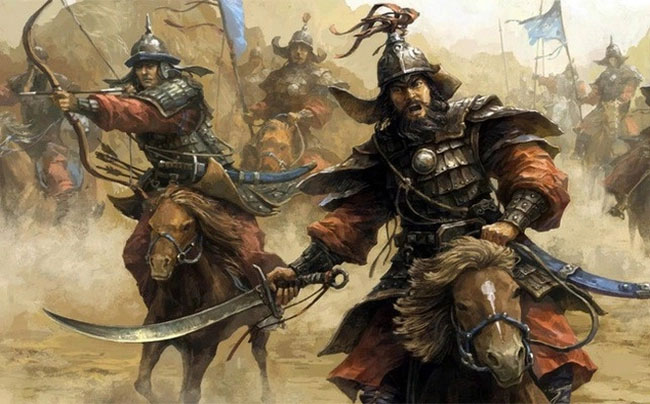
The Mongol army was extremely good at fighting.
According to experts, the Mongol army decided not to advance deep into Western Europe for the following two reasons .
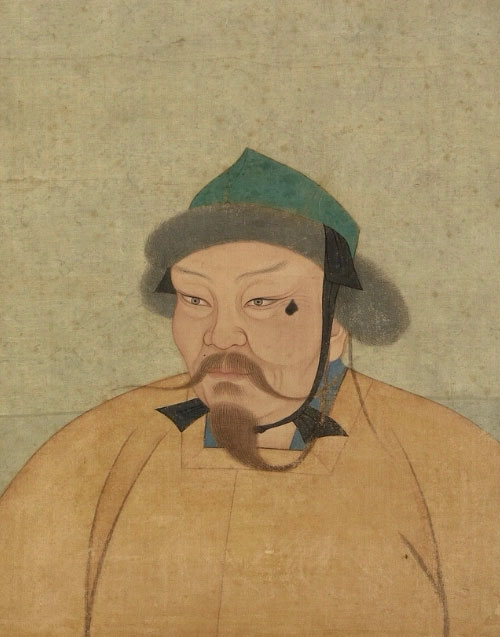
The sudden departure of Ögedei was one of the reasons why the Mongol army missed the opportunity to colonize Europe. (Photo: Public Domain).
- First, in 1241, the Mongol army retreated after hearing the news of Ögedei's sudden death. The passing of this prestigious khan is considered one of the reasons that "saved" Western Europe and all of Europe. Immediately after receiving this news, many generals commanding the expeditionary army had to withdraw their troops back to Mongolia to attend the conference to elect a new khan. Because according to Mongol custom, when a khan died, all Mongol troops, no matter where they were, had to return to witness the coronation of a new khan.
- Second, due to hot and humid climate conditions and rampant malaria-causing mosquitoes.
Although the Mongol army was a good fighter, their weakness was that they had difficulty adapting to hot and humid climates. Furthermore, heavy rains turned the Magyar grasslands in eastern Europe into swamps. This also became an ideal habitat for malaria-carrying mosquitoes. These disease-carrying mosquitoes were part of the reason why the Mongol army was unable to invade Western Europe.
On the other hand, the unusually high rainfall in Eastern Europe during the spring and summer of 1241 inadvertently deprived the Mongol army of its numerous war horses of essential grazing and pasture, which was considered the key to the military strength of this invincible army.
Although the Mongol army had some success in conquering Europe, these battle-hardened soldiers were forced to retreat several times in the face of malaria and other epidemics, along with the defenses of the European alliance.
Historian John Keegan, who has spent years studying Mongolia, shared: "The Mongol army failed to project military power from the semi-temperate and desert regions to the heavy rains of Europe. They had to accept defeat."
By 1368, in addition to divisions and civil wars, malaria-causing mosquitoes were still cited as one of the main reasons for the collapse of the mighty Mongol Empire.
