Few people know that one of the most expensive and sought-after coffees in the world is harvested from the droppings of the Jacu, a large, black bird similar to a pheasant, whose digestive system creates the aroma of coffee beans.
Jacu bird coffee is one of the most expensive coffees in the world, selling for around $1,700/kg.
Jacu Bird Coffee is one of the rarest and most expensive coffees in the world. It is made from coffee berries that Jacu birds eat, digest and excrete.
At around 50 hectares, Camocim Estate is one of the smaller coffee plantations in Brazil, but it still makes a pretty good profit thanks to its very unique and sought-after coffee.
It all started in the early 2000s, when Henrique Sloper de Araújo woke up to find his precious plantations overrun by Jacu birds, a pheasant-like bird that is protected in Brazil.
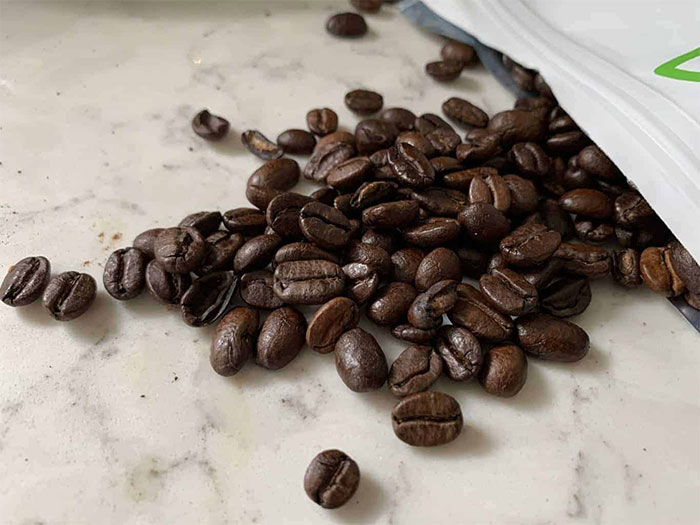
The roasted coffee beans have a unique, attractive flavor. (Illustration photo).
At first, Henrique Sloper de Araújo tried to drive the birds away from his plantation, and even called the environmental police about it, but no one could do anything to help the guy.
This breed of bird was protected by law, so he really couldn't hurt them in any way. But then an idea flashed through his mind, and despair turned to excitement.
In his youth, Sloper was an avid surfer, and his pursuit of waves to ride once took him to Indonesia, where he was introduced to kopi luwak , one of the most expensive coffees in the world, made from coffee beans harvested from the feces of Indonesian civets.
This gave Sloper an idea. If Indonesians could harvest coffee berries from civet droppings, he could do the same with jacu bird droppings.
'I realized I could try something similar with Jacu birds, but coming up with the idea was only half the battle,' Henrique Sloper de Araújo tells Modern Farmer.
'The real challenge was convincing my coffee pickers that instead of picking coffee cherries, they needed to hunt for bird droppings.'
Apparently, Sloper had to turn the hunt for Jacu guano into a treasure hunt for the workers, providing them with financial incentives to search for a certain number of discarded coffee beans.
But collecting the Jacu guano is just the beginning of a very laborious process. The coffee cherries then have to be extracted from the guano by hand, washed, and their protective membranes removed. It's this manual labor that makes Jacu bird coffee significantly more expensive than other coffees, but it's not the only thing.
Henrique Sloper de Araújo believes that Jacu birds only eat the best, ripest coffee berries they can find, something he has observed with his own eyes.
'I was quite surprised to watch from my living room how the Jacu birds only picked the ripest berries to eat and left more than half the bunch, even the ones that looked perfect to the human eye,' said the owner of Camocim Estate.
Unlike kopi luwak coffee which is digested by the Indonesian civet, the coffee beans move more quickly through the digestive system of the Jacu bird and are not broken down by animal proteins or stomach acids. The resulting roasted coffee beans have a unique, nutty flavor.

Coffee from Jacu bird droppings. (Photo: Imperial Teas).
Brazil's Espirito Santo state is the fourth-largest coffee producer in the world, but the Camocim farm is the only one that uses jacuzzi compost to produce its coffee. For the past decade, it has been considered one of the most expensive coffees in the world, and is particularly popular in countries like France, Japan and the UK, where it sells for around $1,700 per kilogram. It is sought after by diners.