A collision with a rogue planet would destroy Earth completely. Its mere presence in the Solar System would also change the orbits of all the planets.
Unlike Earth or the planets orbiting the Sun, there are billions of rogue planets scattered throughout the Milky Way galaxy, not bound to any host star.

Illustration of Earth colliding with a planet. (Photo: NASA/Newsweek).
However, one thing that scientists are discussing is what would happen if a rogue planet entered the Solar System, even approaching Earth. According to What If, a rogue planet has been discovered on the edge of the Solar System.
What is a wandering planet?
In contrast to planets that orbit the Solar System, a rogue planet is a planet that moves freely between stars and does not orbit a host star.
When they are born, gravity can cause planets to collide with each other. The collision can cause a planet to deviate from its host star's orbit, becoming a rogue planet.
In 2015, scientists in Canada published research saying that there was once a gas planet that existed in the Solar System more than 4 billion years ago, but there were signs that it was 'kicked out of orbit' by Jupiter after collisions, according to Science Alert.
Additionally, rogue planets come from stars that cannot ignite, making them isolated gas planets .

Illustration of a rogue planet in the Rho Ophiuchi star cluster. (Photo: Newsweek).
Scientists aren't sure how many rogue planets there are in the Milky Way, as they're hard to see because they don't emit much light. But estimates put the number in the billions, Newsweek reported.
Unwanted scenario
In 2018, scientists discovered a rogue planet, just 20 light years away from Earth, 13 times larger than Jupiter - currently the largest planet in the Solar System (61.42 billion km 2 ). Meanwhile, the area of Earth is about 510 million km 2 .
Scientists have been posing scenarios about whether rogue planets will enter the Solar System, or even collide with Earth.
With an area thousands of times larger than Earth, a rogue planet could move at hundreds of kilometers per second. A direct collision would cause complete destruction of Earth.
However, scientists also say that the scale of the Solar System is quite large. In the absence of a collision, the rogue planet would also disrupt the orbits of all the planets in the Solar System. The gravitational force of the planet of more than 770 billion km2 would cause the Solar System's orbit to become more elliptical.
The Earth would then orbit in a narrow region of the Solar System. While humans would still be able to live there, orbiting so close to the Sun would mean short, hot summers and long, cold winters.
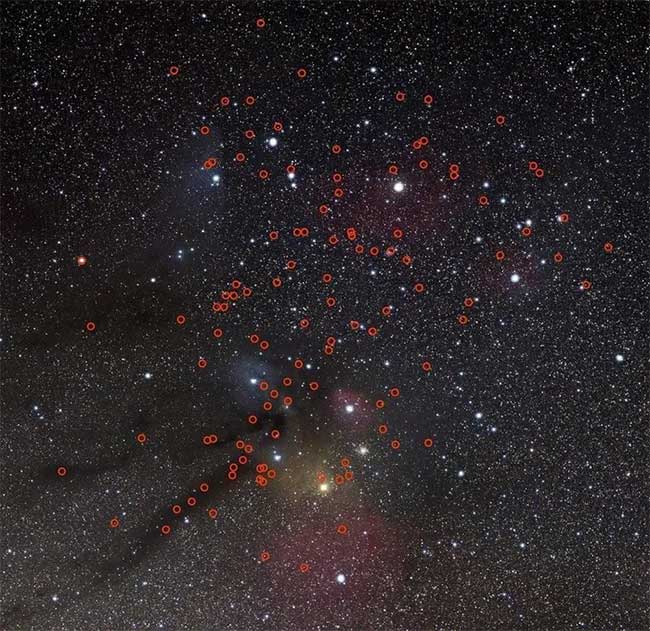
More than 100 places are believed by scientists to have rogue planets (red rings). Astronomers estimate that billions of rogue planets exist in the Milky Way. (Photo: Universal Science).
The Earth could enter the next ice age. Instead of global warming, humanity will worry about 'global cooling'.
However, besides hypothetical scenarios, scientists also mention the fact that there are many objects in space, and the chance of a rogue planet threatening Earth is not high.
"I estimate that in the next 1,000 years, the chance that a rogue planet could approach Earth, instead of Mars or Venus, is one in 2,000 billion times," said Garrett Brown, an astronomer at the University of Toronto (Canada).
Michael Zemcov, associate professor of physics at the Rochester Institute of Technology, said it was surprising that the Solar System had been able to remain stable for more than 4.5 billion years, when the gravity and magnetic fields of planets like Jupiter could have pushed others out of orbit, turning them into rogue planets.