The saber-toothed tiger is one of the most well-known Ice Age animals, yet modern science still doesn't really understand this massive predator.
The giant animals that lived during the Ice Age have always attracted the attention of many people. Among the most famous large animals of this time period, Smilodon , also known as the saber-toothed tiger or saber-toothed cat , is the animal that has received the most attention.
About 12,000 years ago, the saber-toothed tiger went extinct, although the exact cause of this event is still unknown. Those saber-toothed tigers likely went extinct due to climate change, but the mysteries surrounding this animal are still very much alive, according to Live Science.
Measuring more than 2 meters long and more than 1 meter tall, some subspecies of saber-toothed tigers could weigh up to 250 kg. From scientists' studies, we know that all Smilodon species were different from modern cats.
Today, saber-toothed tiger fossils are commonly found in North, Central, and South America. At the same time, the habitats of the big cats that still exist on the North American continent have been pushed into urban areas like Los Angeles. So we can't know for sure what exactly would have happened if saber-toothed tigers had survived until today. But based on what we do know, here's what humans could have faced.
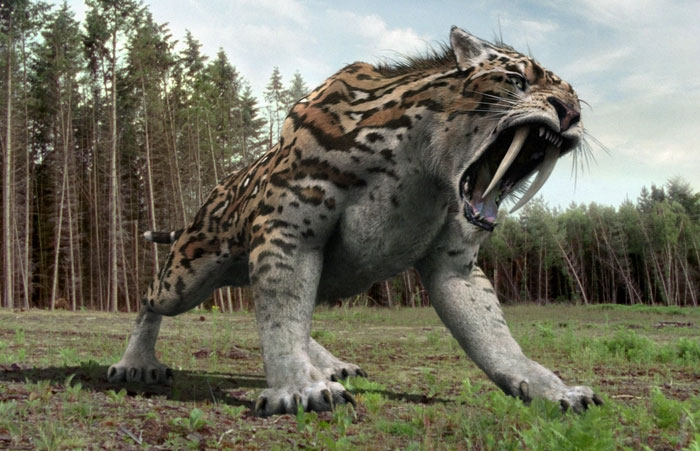
Smilodon is a genus of extinct Machairodonts in the Felidae family. They are among the most famous prehistoric mammals and the most widely known saber-toothed cats. Although often referred to as saber-toothed tigers, the genus is not closely related to modern tigers or cats.
The most prominent and recognizable feature of the saber-toothed tiger is its two serrated fangs, which are up to 15cm long . Meanwhile, the fangs of modern big cats are only about 5 to 7cm long.
From this it can be seen that the saber-toothed tiger was a formidable predator . According to fossil data, it is possible that they would have been ambush predators similar to modern tigers, but they also possessed enough speed and strength to attack other predators such as the North American gray wolf.
Similar in size to modern African lions, saber-toothed tigers may have also eaten bison, giant ground sloths, baby mammoths, horses and camels during their time, according to the San Diego Zoo Wildlife Alliance Library.
It's not known for sure how social saber-toothed tigers were - whether they were solitary like modern tigers or lived in packs like lions - but it's clear that these creatures were ambush predators and faced little competition for territory . They were therefore adapted to a wide range of habitats - more than a thousand saber-toothed tiger fossils have been found at the La Brea Tar Pits in Los Angeles.
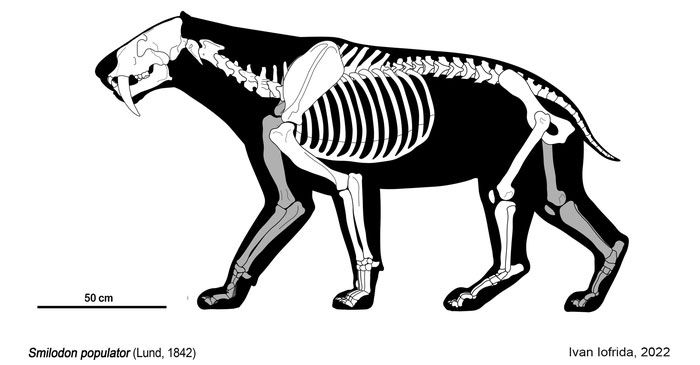
Smilodon had a more robust body than any other feline predator, with particularly well-developed forelimbs and exceptionally long upper canines. Its jaws had a larger opening angle than those of modern cats, and its upper canines were quite slender, adapted for delivering a precise bite.
The big cat found in Los Angeles today is a mountain lion, according to The Guardian. Despite its large size, modern mountain lions are still much smaller than saber-toothed tigers.
Mountain lions are also known to be ambush predators, often killing deer as well as other smaller prey, according to the National Wildlife Federation.
However, with the rapid urbanization and human development, the territorial boundaries between mountain lions and humans have gradually become blurred. Many mountain lions are forced to live in wildlife reserves and national parks adjacent to human urban areas.
To keep animals and humans safe, cities like Los Angeles (USA) and Mumbai (India) have taken steps to make life easier for them. However, the urban environment itself poses dangers, as shown by the recent death of mountain lion P-22, who died after being hit by a car.
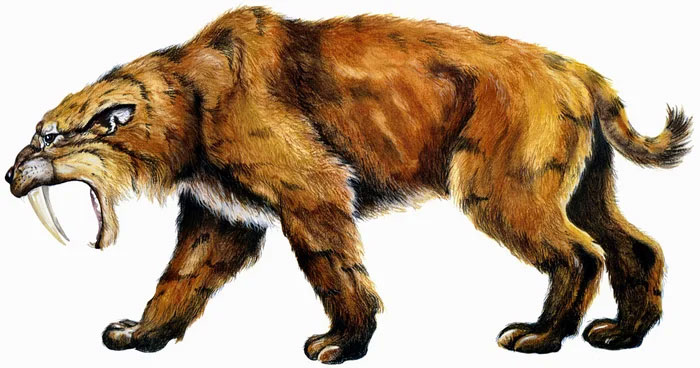
The saber-toothed tiger was a formidable predator.
But what if the saber-toothed tiger still lived? Most of the saber-toothed tiger's large prey, such as the giant ground sloth, have gone extinct. So it's unlikely that the animal could have survived on prey similar in size to that of the mountain lion .
However, there is a possible hypothesis: Small populations of the species may have thrived in places like Yellowstone National Park in Wyoming, where bison herds have recovered. For these reasons, if saber-toothed tigers survived, they would likely have been few in number, confined to a limited range of habitats , and likely avoided human habitation.