The powerful propulsion system combined with the submerged hull design allows the tug to move giant ships.
Tugboats are used to help large ships navigate places they cannot maneuver on their own, such as canals or busy harbors.
Tugboats are small in size but have tremendous power, able to move ships 1000 times heavier by pulling or pushing them.
The tugboat is powered by 34,000 horsepower diesel engines , giving it a weight-to-power ratio of 9.5 compared to 1.2 for a cargo ship. These engines can power three propellers at once, creating a huge amount of thrust for the small ship.
Aside from the engine, another factor that makes tugs so good at moving their vessels is the high maneuverability provided by the rudder and nozzle systems. Tugs are designed with large displacement hulls that allow them to 'dig' into the water, creating more friction and resulting in greater bollard pull.
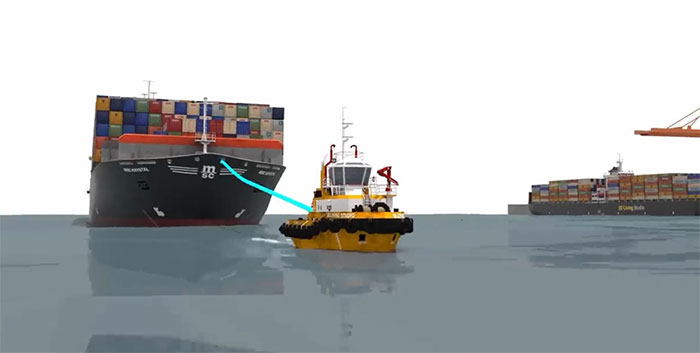
The tugboats are powered by 3,400 horsepower diesel engines.
Depending on the size of the tug and supertanker, tugs can operate alone or in groups when moving supertankers through ports or canals.
Tugboats can use towlines, often made of extremely strong materials, to pull a ship to its destination. However, this method has the disadvantage of poor steering control and accuracy.
Therefore, tugboats are often used to push rather than pull. In this case, the tugboat will run steadily alongside the ship and push. However, this method will not be used in rough seas because the tugboat and ship often collide with each other.
Tugs can be classified into inland tugs and ocean going tugs .
- Inland tugboats operate in relatively shallow waters.
- Seagoing tugs are designed to work in deep sea settings.
In addition, scientists also said that another reason why tugboats can move large ships is that on land, tugboats need to have a large enough weight so that the friction between the wheels and the road surface ensures that the wheels do not slip when pulling heavy loads. However, underwater, the mass of the vehicle is no longer an important factor. What is important is the ability of the propeller to push water, and this ability does not depend on the size of the ship but on the power of the engine. Tugboats essentially act as auxiliary engines for larger ships, connected to the ship by ropes and operating at a certain distance.
This allows larger ships with fixed rudders and propellers to be more maneuverable in port areas. Tugs allow larger ships to make sharper turns without having to adjust their own rudders or propellers.
For this reason, a tug does not need to be larger than necessary. A tug that is too large will reduce its maneuverability in confined areas, create more drag, use more fuel, cost more to manufacture, and take up more berth space when berthing in port.
Why do ships move in balance and not capsize on the water?
Battery-powered trains can travel 1,000 km
The giant kite is 500 square meters large and can pull a 154 meter long cargo ship.